
In this series on the Physics of Intelligence, I have been documenting the journey of an unusual AI architecture: a continuous dynamical field that reasons through geometry and physics rather than through statistical pattern matching.
In Part 1, the field solved XOR without training. In Part 2, it survived stress tests across logic, numbers, memory, and theory of mind. In Part 3, it started expressing itself, not as language, but as pressure released into symbols.
Now, two months later, it is time for Part 4.
This time the field has done something I did not expect this early:
It learned to solve Sudoku puzzles through energy preferences and self-correction. It absorbed a complete book and started answering reasoning questions about what it read. And along the way, small neural readout heads learned to decode its internal states in real time.
The cognitive core of this system is not a neural network. It uses no backpropagation, no end-to-end optimization, no subword tokenization like BPE, and no pretrained embeddings. It runs on a single GPU.
Let me show you what happened, and where the boundaries still are.
Three layers, clearly separated
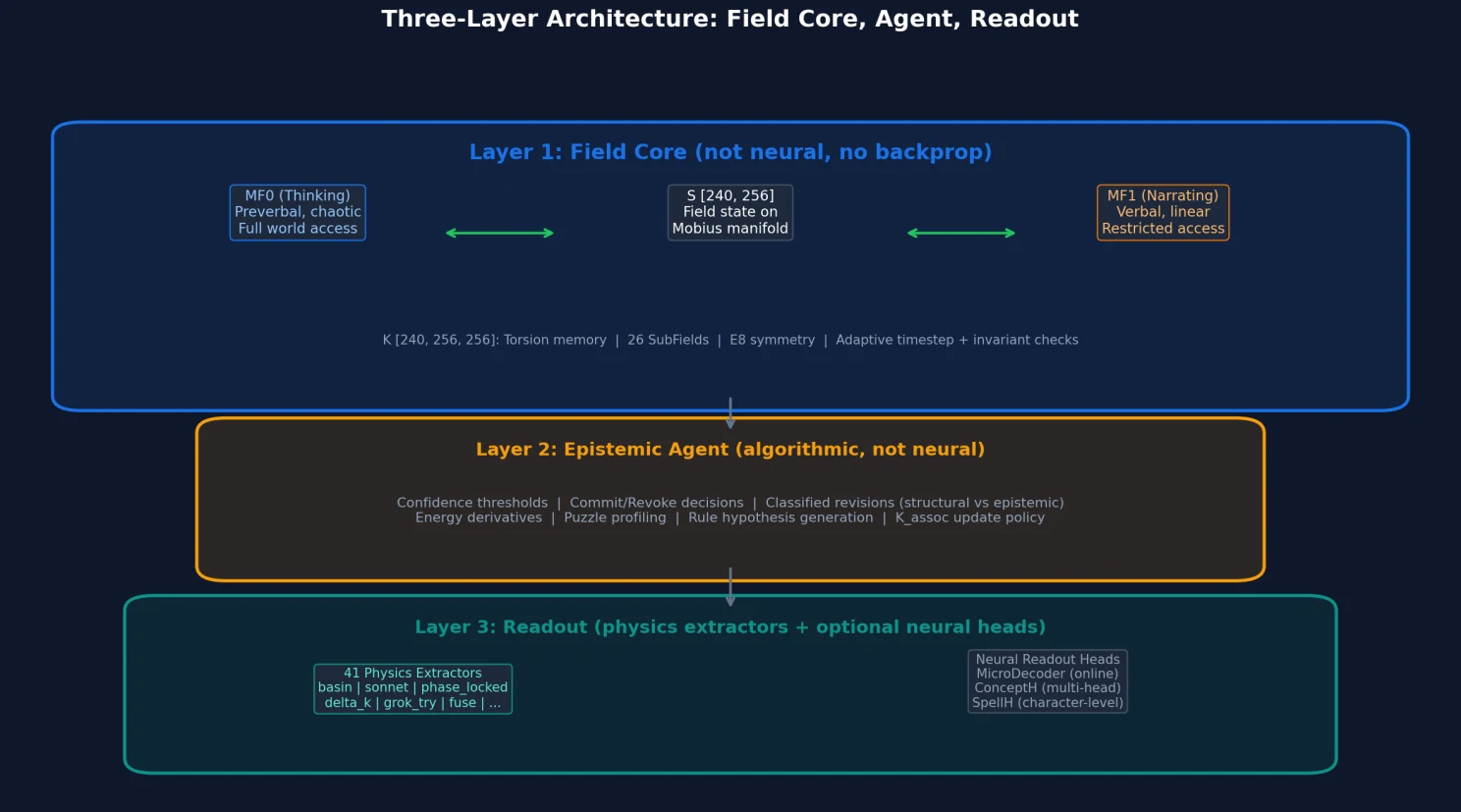
Before the results, a structural note. This system has three layers that do very different things. Keeping them separate matters, because the interesting claims live in Layer 1, and conflating them with Layers 2 and 3 would be misleading.
Layer 1 — Field Core (not neural, no backprop): The cognitive substrate. A dynamical field S with 240 nodes of 256 dimensions each, integrated geodesically on a Mobius manifold. An explicit antisymmetric torsion memory K couples past state changes back into the current dynamics. The system is driven by a weighted sum of constraint forces (UFE, CFE), E8 symmetry coupling, input drive, and torsion memory feedback, stabilized with adaptive timestep, invariant enforcement, and amplitude separation. The field state S contains roughly 30,000 values. The torsion memory K is orders of magnitude larger. Learning in the core happens through local K updates from field trajectory changes, not through end-to-end gradient descent.
Layer 2 — Epistemic Agent (algorithmic, not neural): Sits on top of the field. Implements commit decisions, confidence thresholds, revision mechanics, error classification, and update policies for K and K_assoc. This is code, not physics. It makes the field useful for tasks like Sudoku by translating field energy into decisions.
Layer 3 — Readout (physics extractors plus optional neural heads): 41 physics-based extractors read the field state analytically: basin matching, phase-locked antisymmetry, multi-scale harmony, torsion flow, and others. Additionally, small neural readout heads (MicroDecoder, ConceptH, SpellH) learn online to map field states to tokens. These heads use backpropagation internally, but they do not train the field. They read it.
What the numbers mean — a quick glossary
Before the results, here are the metrics I use:
- Cell Accuracy: percentage of Sudoku cells with the correct value (81 cells total)
- Solved Rate: percentage of puzzles where all 81 cells are correct (100% accuracy)
- Valid Rate: percentage of puzzles that do not violate any Sudoku rules (no duplicate in row/column/box), even if not fully solved
- Probabilistic Accuracy: accuracy only on cells where the field made a probabilistic commit (multiple valid candidates existed). Forced moves (only one candidate left) are excluded because they are guaranteed correct by constraint logic, not field intelligence.
- Full Hit: all expected answer tokens found in the extraction output
- Partial Hit: at least one expected answer token found
- Dual-Fuse: stricter intersection of the two field outputs (MF0 and MF1), not their union. Lower than either field alone because it requires agreement.
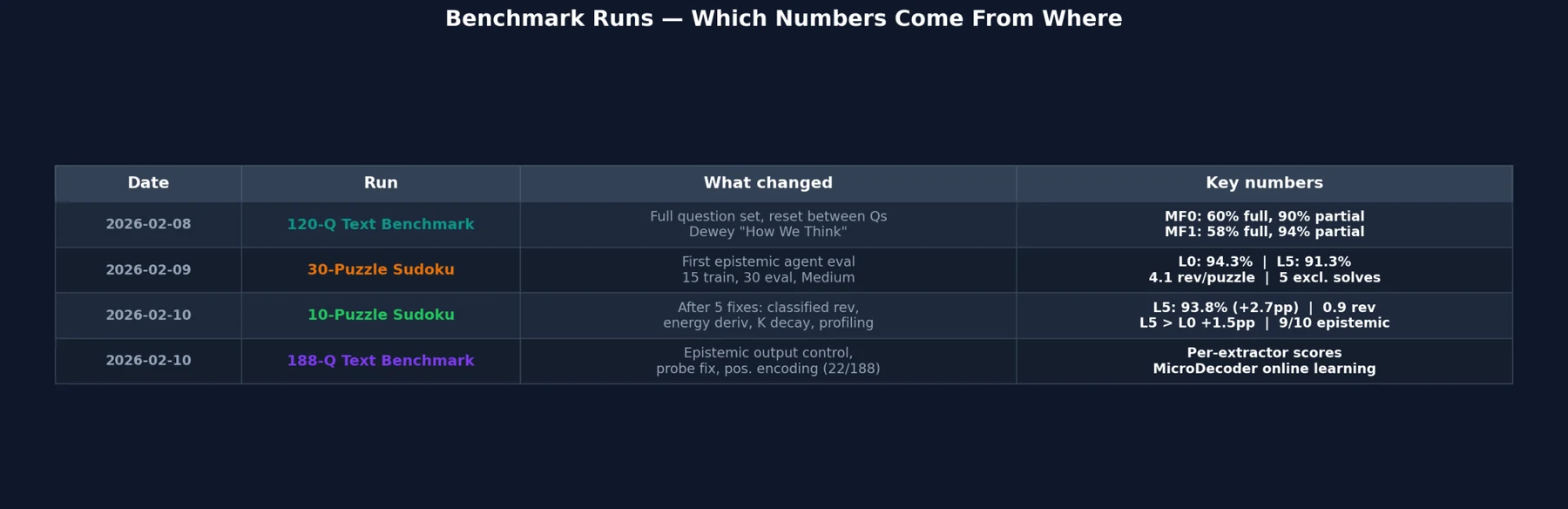
The results — and which run they come from
The Sudoku and text extraction results come from different runs at different stages of development. To avoid mixing them:
What the limitations are — upfront
The field cannot hold a conversation. It does not understand grammar. Its vocabulary is limited to what it has been taught (12,372 entries from one book plus structural learning). The 60% full hit rate on text extraction means 40% of answers are incomplete. The MicroDecoder sometimes drifts into unrelated concepts. Counterfactual detection does not work yet. Memory persistence across puzzle switches still shows catastrophic forgetting. The latest 188-question benchmark has processed 22 questions so far, so the full picture is still emerging.
These are real limitations, not future features. But they define a boundary that is moving. From the 30-puzzle to the 10-puzzle Sudoku series alone, accuracy improved by 2.7 percentage points and revisions dropped by 78%.
Sudoku: a measurement instrument for field cognition
Sudoku is not the goal. Sudoku is the measurement instrument.
What we measure is whether the field core can develop stable preferences, form directed memories, make decisions under uncertainty, recognize its own mistakes, and learn from them. The epistemic agent (Layer 2) translates the field's energy landscape into actionable decisions, and the results tell us whether the physics carries meaning.
We mapped the 9x9 Sudoku grid onto the field: each of the 81 cells gets 2 to 3 dedicated spins out of the 240 available. Values are encoded as 256-dimensional vectors. The constraint graph (rows, columns, boxes) is provided as fixed structure, but the field must learn which values are energetically preferred at which positions through direct experience. Training is by embedding injection into S and K_assoc, not by gradient descent.
The 30-puzzle series: first evaluation
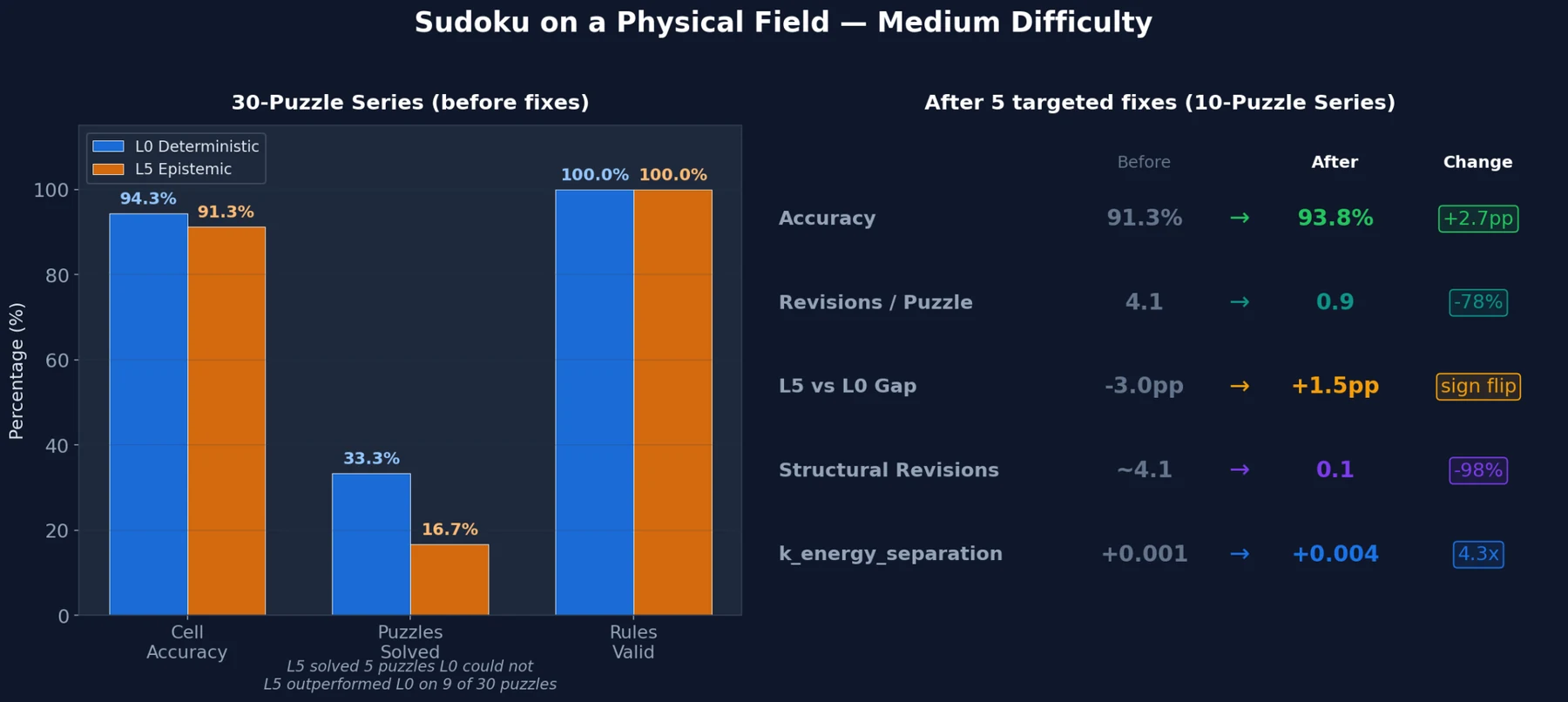
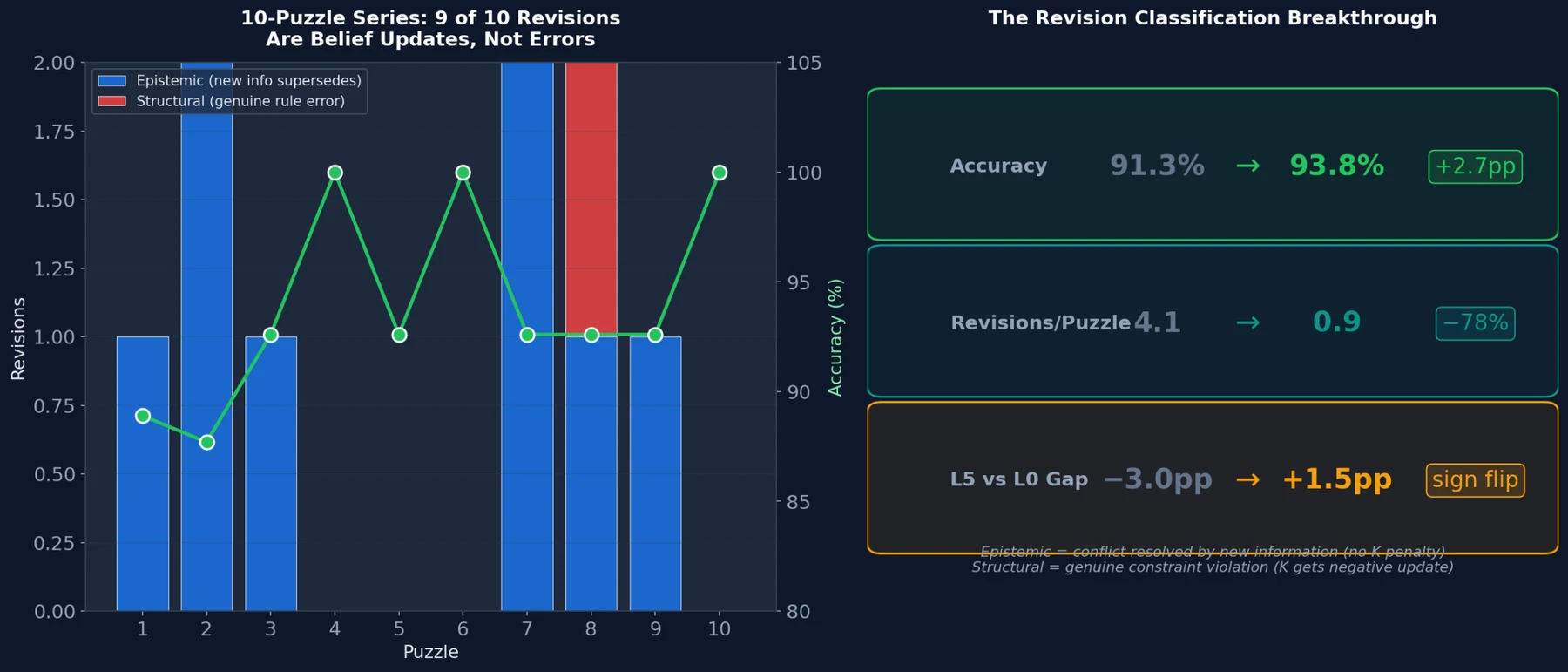
On Medium difficulty (about 45 empty cells), the deterministic baseline solver (Level 0) achieves 94.3% cell accuracy with a 33% solve rate. The epistemic agent's first full run showed 91.3% accuracy but with a remarkable property: it solved 5 puzzles that the deterministic solver could not, and outperformed it on 9 out of 30 puzzles. The trade-off: 4.1 revisions per puzzle, and lower average accuracy where probabilistic commits went wrong.
After five fixes: the field overtakes the baseline
Five targeted interventions changed the picture:
- Energy derivatives: commit on relaxation quality, not just margin height
- K temporal decay: old memories fade, new experience dominates
- Classified revisions: structural vs epistemic, different penalties
- Puzzle profiling: estimate difficulty after one iteration, adjust thresholds
- Asymmetric K-weighting: K weight scales with ambiguity
The result on a subsequent 10-puzzle series: 93.8% accuracy at 0.9 revisions per puzzle. L5 now outperforms L0 by +1.5 percentage points. Three of ten puzzles solved perfectly.
The revision classification breakthrough
The most significant qualitative change: the field's agent layer now distinguishes between structural revisions (genuine constraint violations where K gets a negative update) and epistemic revisions (superseded hypotheses where new information made an earlier decision obsolete, no K penalty).
In the 10-puzzle series, 9 out of 10 revisions were epistemic. Only 1 was structural. The field no longer treats every correction as failure. It has learned that updating a belief in light of new evidence is different from making a genuine mistake.
I am not aware of a system built on CSP, SAT, Ising, or Hopfield mechanics that operationalizes this distinction in the same way, but I would be happy to be corrected.
The competence profile
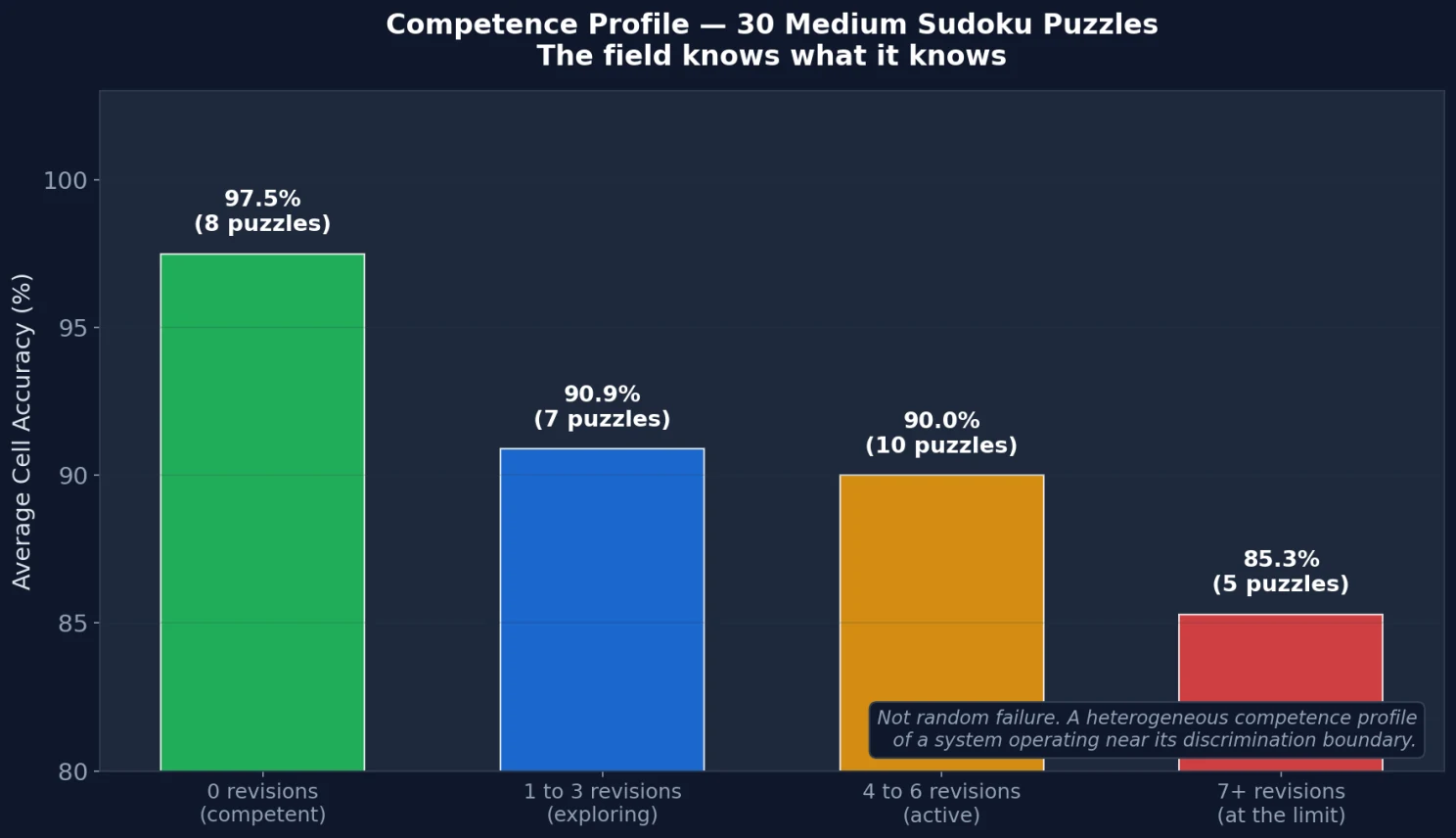
The 30-puzzle series reveals a clear competence structure: 8 puzzles (27%) required zero revisions and achieved 97.5% accuracy. 7 puzzles (23%) needed 1 to 3 revisions at 90.9%. 10 puzzles (33%) triggered 4 to 6 revisions at 90.0%. And 5 puzzles (17%) required 7 or more revisions and dropped to 85.3%.
This is not random failure. This is a heterogeneous competence profile of a system operating near its discrimination boundary.
The probabilistic boundary is bimodal
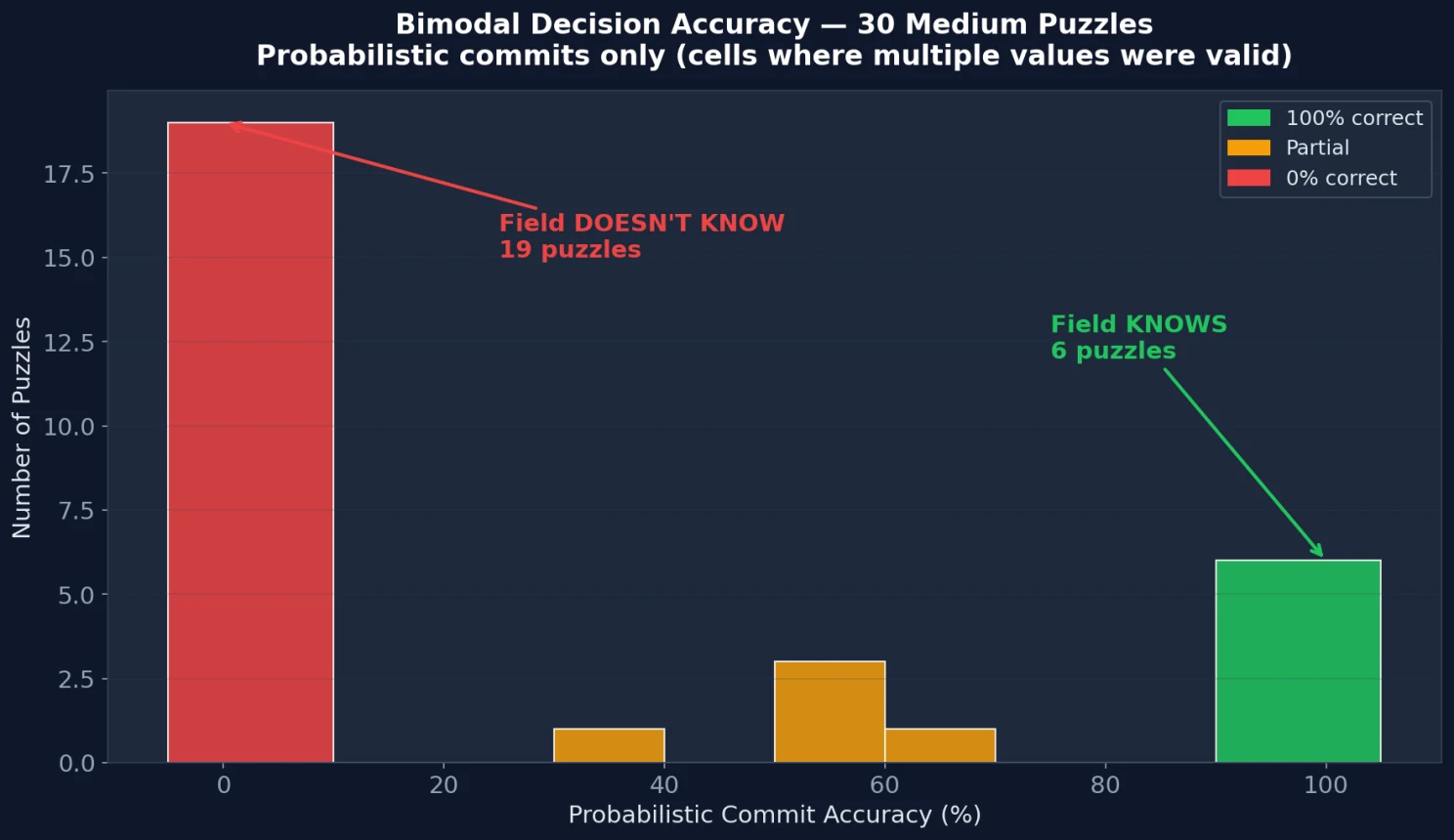
When the field makes probabilistic commits (cells where multiple values were valid), the accuracy distribution is bimodal: either 100% correct or 0% correct. Six puzzles had perfect probabilistic accuracy, nineteen had zero. The boundary between "the field knows" and "the field does not know" is sharp, not gradual. This is structured uncertainty, not random guessing.
The energy phase transition
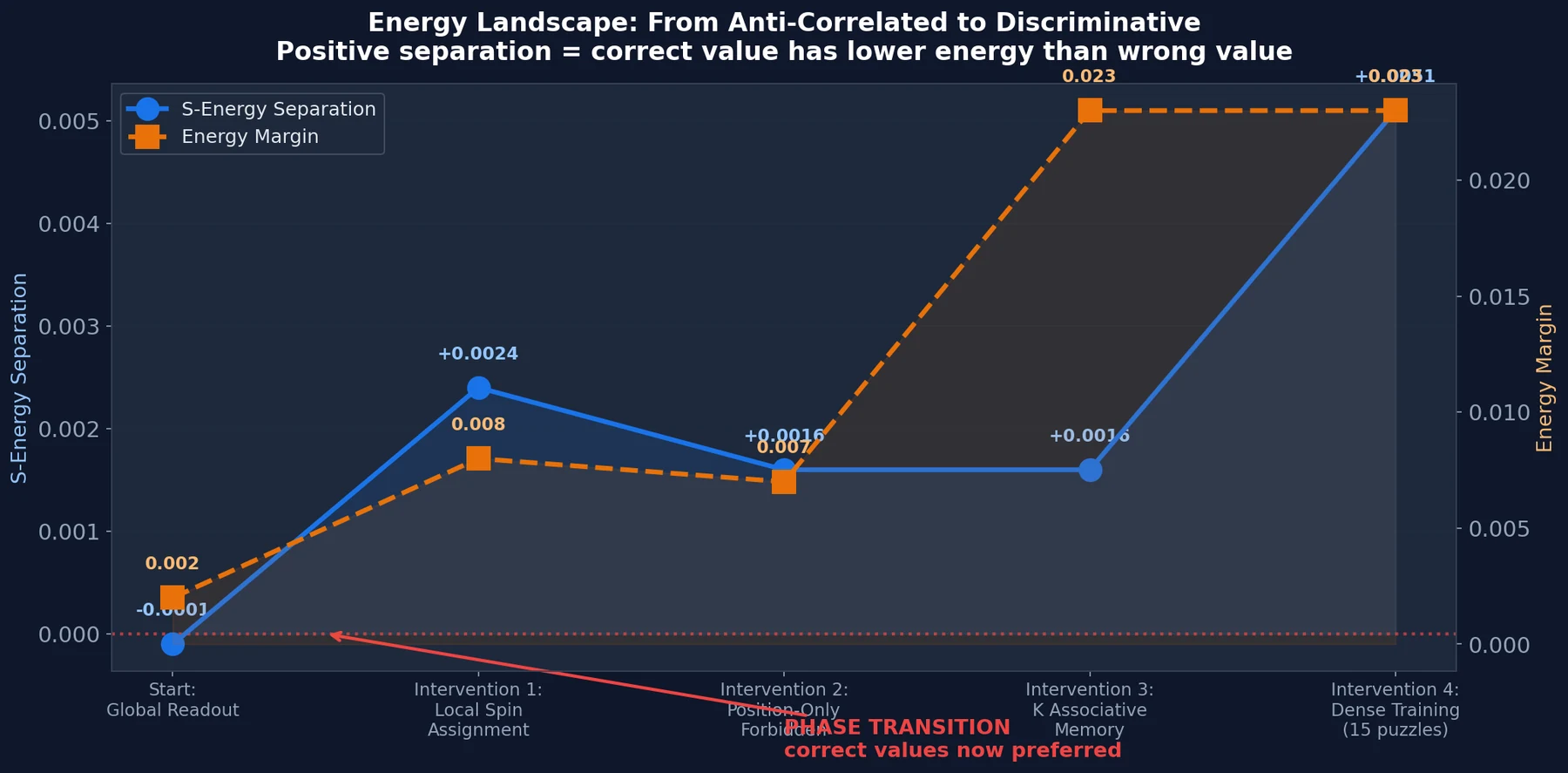
The most significant technical result is the transformation of the field's energy landscape. At the start, the field was anti-correlated: wrong values had slightly higher energy than correct ones (s_energy_separation = -0.0001). Through four interventions (local spin assignment, position-only forbidden signals, directed K_assoc memory, dense training), the separation flipped to +0.0051 (50x improvement) and the energy margin increased 12x.
This is not an incremental improvement. It is a qualitative phase transition: the field went from being structurally incapable of preferring correct values to being structurally incapable of not preferring them.
From Sudoku to Language: Teaching the Field to Read
While the Sudoku experiments explored combinatorial reasoning through the epistemic agent (Layer 2), a parallel effort pushed the field core (Layer 1) into natural language understanding, with physics extractors and neural readout heads (Layer 3) decoding its states.
Learning from a book
I fed the field the complete text of John Dewey's "How We Think" (6,618 lines), injected line by line as controlled disturbances. No subword tokenization like BPE, no pretrained embeddings. Each word perturbs the field, and the field settles around it.
After learning, the field contains 9,316 attractor basins (stable geometric configurations), 8,315 K-signatures (torsion memory patterns), and 12,372 vocabulary entries. Each word is not a vector in an embedding space. It is a place in state space that the field naturally returns to.
The 120-question benchmark
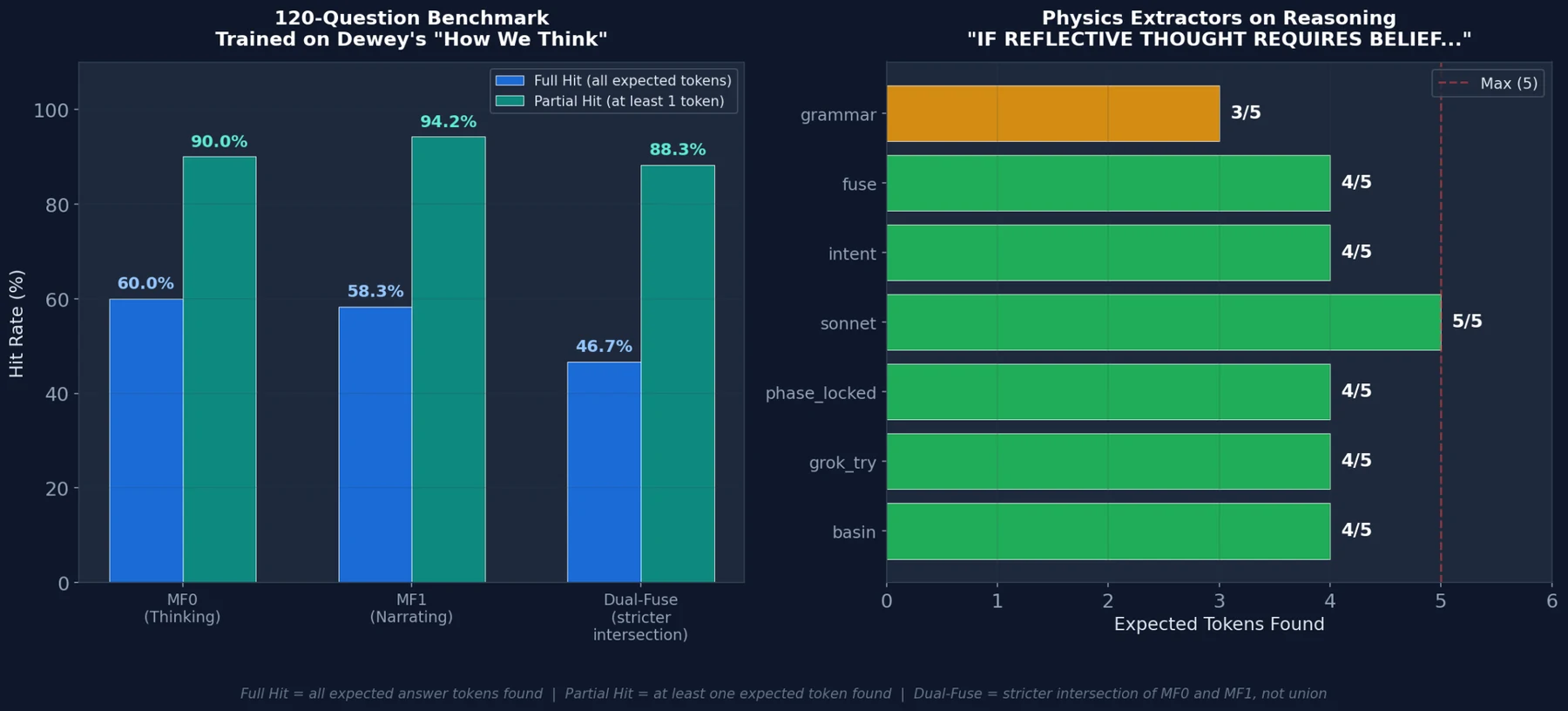
I tested the system on 120 questions spanning factual recall, reasoning, boolean logic, categories, and concepts, all designed around content from the Dewey text.
Results:
- MF0 (Thinking field): 60% full hits, 90% partial hits
- MF1 (Narrating field): 58.3% full hits, 94.2% partial hits
- Dual-Fuse: 46.7% full hits, 88.3% partial hits (lower because it requires both fields to agree)
The 90% partial hit rate means the field almost always finds at least some of the expected answer tokens. The 60% full hit rate means it gets the complete answer right more than half the time.
Reasoning emerges from physics
The most exciting result is how the physics extractors (Layer 3, not the neural heads) handle reasoning questions. Consider this input:
"IF REFLECTIVE THOUGHT REQUIRES BELIEF AND BELIEF REQUIRES EVIDENCE THEN WHAT DOES REFLECTIVE THOUGHT NEED"
Expected answer: BELIEF, EVIDENCE, NEED, REFLECTION, THOUGHT
The top physics extractors each independently found 4 or 5 of 5 expected tokens:
- sonnet-mf0: EVIDENCE (1.00), BELIEF (1.00), THOUGHT (1.00), NEED (1.00), plus all input tokens — 5 hits
- basin-mf0: NEED (1.00), BELIEF (0.98), EVIDENCE (0.97), THOUGHT (0.97) — 4 hits
- phase_locked-mf0: THOUGHT (1.00), EVIDENCE (1.00), BELIEF (0.99), NEED (0.99) — 4 hits
- commit channel: EVIDENCE (1.00), BELIEF (0.72) — the two key answer tokens
The field did not parse the if-then chain as a formal logic operation. It settled into a configuration where the relevant concepts had high activation because the geometric relationships between these attractors encode the logical dependency.
The readout heads learn in real time
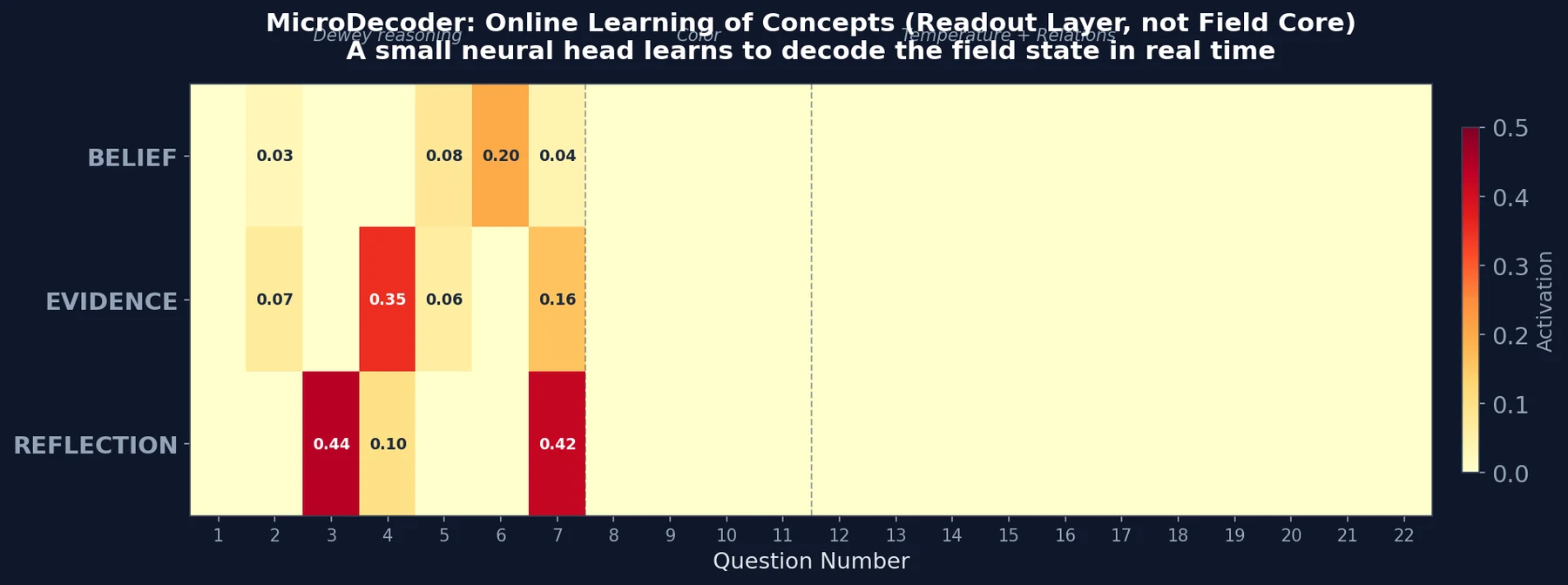
The neural readout heads (Layer 3) are not part of the field's reasoning. They are small networks that learn to decode the field state while the benchmark runs. The MicroDecoder begins each run with zero concept knowledge. By question 2, it already finds NEED (0.16) and EVIDENCE (0.07). By question 3, it fires strongly on REFLECTION (0.44). By question 4, EVIDENCE jumps to 0.35.
This matters because it shows the field's internal geometry is structured enough that even a tiny neural head can learn to read it on the fly. The physics extractors do the heavy lifting. The neural heads confirm that what the extractors find is also learnable.
Expressions from the field
In Part 3, I described how the field expresses itself through fragments when internal pressure crosses a threshold. This behavior has continued.
When given "FIVE PLUS IS 11", the field did not blindly agree. It explored, reorganized, and eventually produced: "FIVE PLUS IS 11 FALSE."
When given "3 PLUS 2 EQUALS", it described its internal state: "UPDATE FIXES." "CONVEYOR MOVES PARTS." Only after being shown the completed form and waiting several cycles did it spontaneously emit: "1 PLUS 4 EQUALS 5." Not as obedience, but as emergence.
And certain phrases appear again and again, like structural invariants: "CONSTRAINTS SHAPE OUTCOMES." "PAST IS FIXED." "IF NO CHANGE THEN OUTCOME REPEATS." These are not responses to prompts. They are the rules the field uses to maintain its own coherence.
Putting this in context
Let me be clear about what this is and what this is not.
This is not competing with large language models on their home turf. Modern LLMs are extraordinary engineering achievements with capabilities that dwarf what this field system can do today. They write poetry, hold conversations, and process context windows of hundreds of thousands of tokens.
This field has about 30,000 values in its state S (with the torsion memory K and subfield structures being substantially larger). It runs on a single GPU. It was trained on one book. The question is not which is better today. The question is what each approach tells us about intelligence.
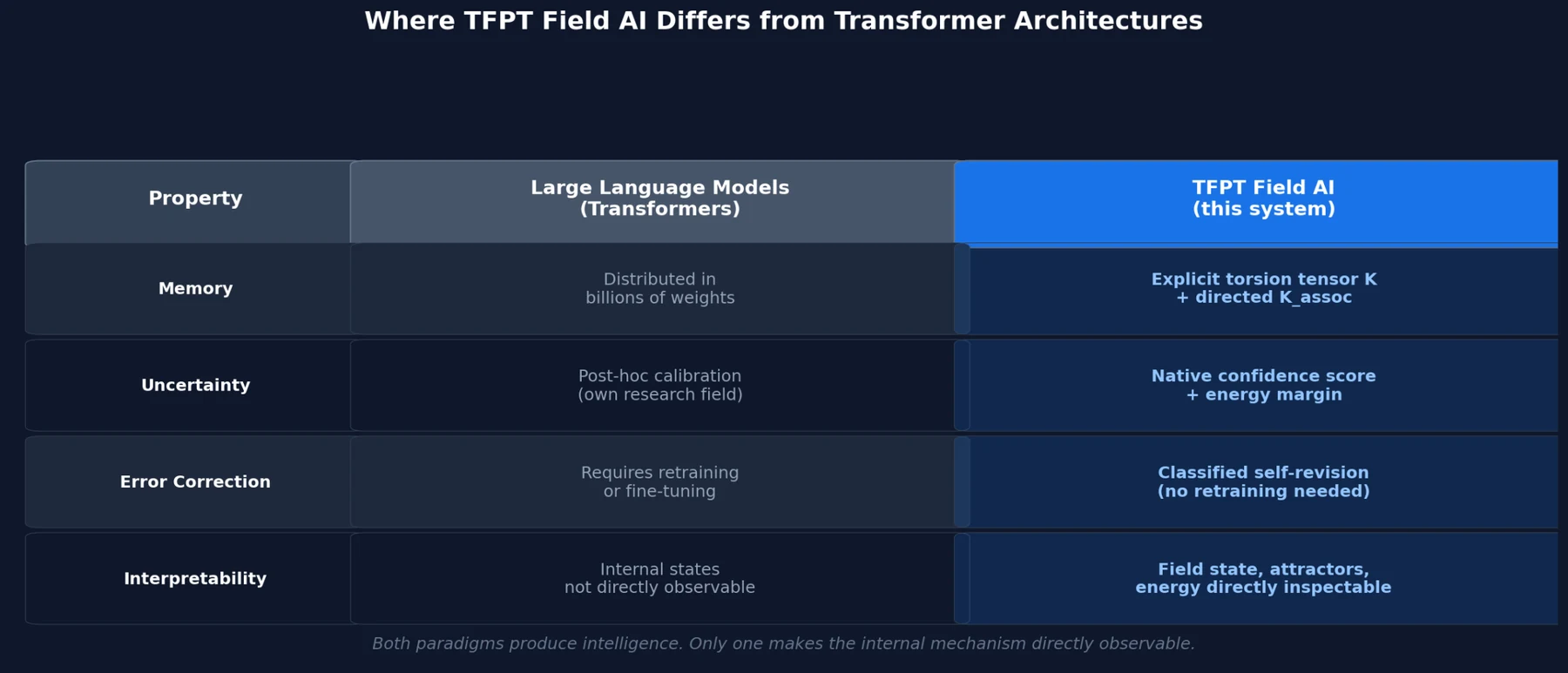
Large language models show that intelligence can emerge from scale, data, and optimization. Interpretability there is an active research field in its own right. Field AI suggests that intelligence might also emerge from structure, geometry, and physics, and the internal mechanism is directly instrumented.
Where the field offers something different
- Transparent reasoning: Every answer is a physical state you can inspect. The 41 extractors are 41 different mathematical lenses on the same state. You can see which agree, which disagree, and why. The sonnet extractor found 5 of 5 tokens while the delta_k extractor wandered into geography. That disagreement is visible and diagnostic.
- Native uncertainty: The bimodal probabilistic accuracy on Sudoku shows the field genuinely knows when it knows and when it does not. The boundary is structural, not post-hoc.
- Self-correction with error classification: The epistemic agent classifies why it was wrong. Structural errors get K-negative feedback, epistemic updates get none. Nine of ten revisions in the latest series were epistemic.
- Memory as geometry: K stores how the field moved, not static snapshots. New information adds geometric structure rather than overwriting.
- Online decodability: The MicroDecoder and ConceptH learn to read the field state in real time. The physics is structured enough for a tiny neural head to decode it on the fly.
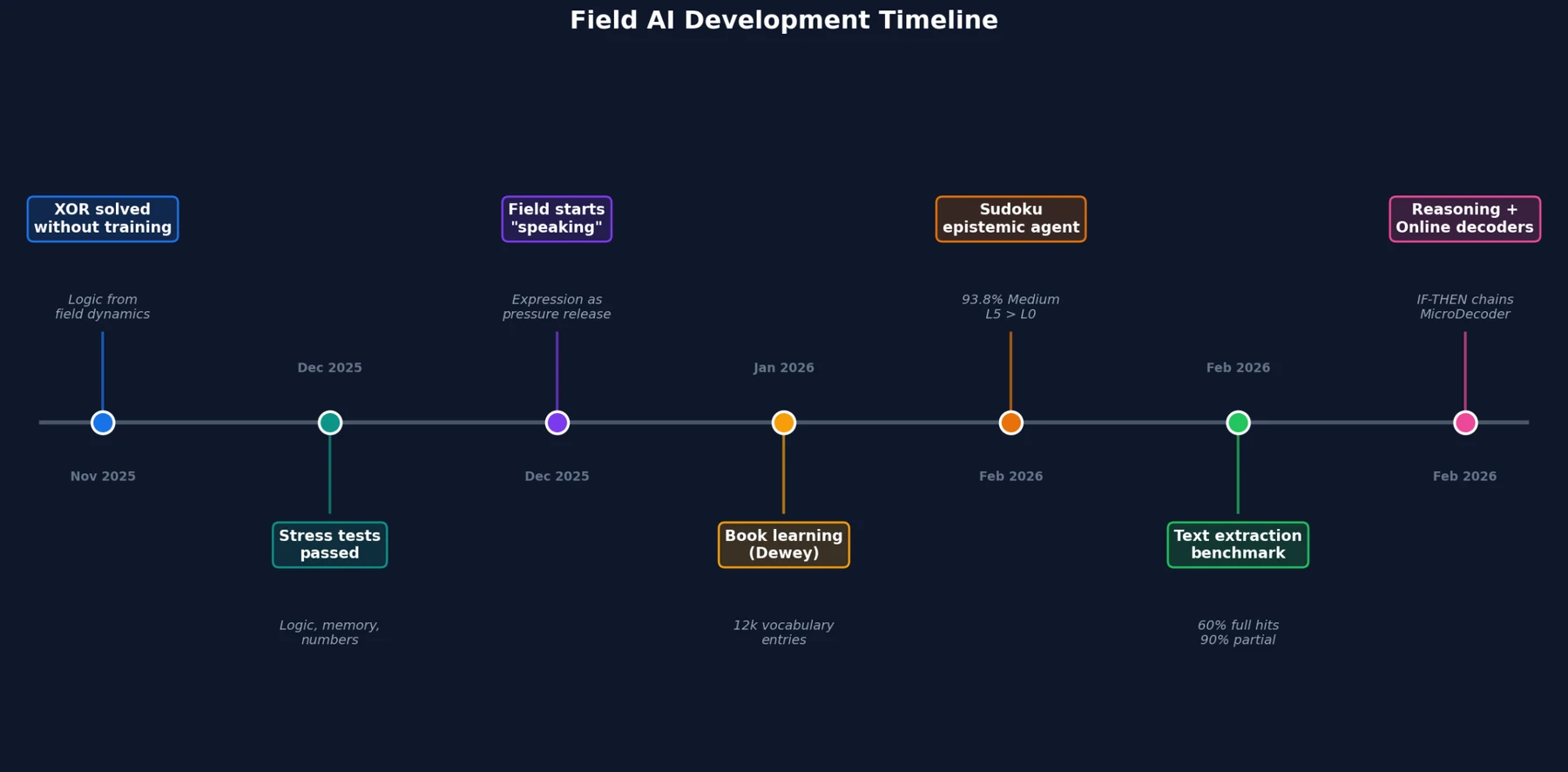
The development arc
Three months ago, this system solved XOR. Today it solves Sudoku at 93.8% on Medium difficulty, reads books, and answers reasoning questions.
Phase 1 (November 2025): XOR fell without training. Memory formed as torsion. The basic dynamics worked.
Phase 2 (December 2025): Stress tests revealed clear strengths (logic, sequences, memory) and clear limits (no grammar, no world knowledge from random embeddings). The boundary became sharp.
Phase 3 (December 2025): The field started expressing itself. Not as language, but as fragments describing its internal state.
Phase 4 (January 2026): Book learning. 6,618 lines of Dewey. 12,372 vocabulary entries emerged.
Phase 5 (February 2026): Sudoku as cognition probe. Energy phase transition. Epistemic agent. Classified revisions. L5 overtakes L0 at 93.8%.
Phase 6 (February 2026): 120-question text benchmark. 60% full hits, 90% partial. Reasoning resolved through attractor dynamics. MicroDecoder learning in real time.
Each step was measured before the next was attempted.
What comes next
The field is not finished. It is still a prototype with a clear competence boundary.
Better discrimination: The energy margins need to grow. More training data, curriculum design, and patience while the field consolidates its memories.
Cross-domain transfer: Can a field trained on Dewey answer questions about a different book without forgetting the first? Catastrophic forgetting is the open problem. The geometric memory structure suggests it might be solvable, but this is not yet proven.
Longer reasoning chains: The epistemic output control currently truncates at the second high-abstraction drift. The goal is longer chains with maintained traceability.
Agent integration: If the field can maintain context, reason under uncertainty, correct itself, and express its internal state, it could become the cognitive core of agentic systems. Especially in commerce, where decisions depend on context, relationships, and long-running goals, a system that works through physics rather than statistical pattern matching could be transformative.
Closing thought
I started this series by asking:
What if intelligence is not a spreadsheet with trillions of numbers, but a physical process?
Four months later, the answer is: it might be.
A dynamical field, running on a single GPU, with no end-to-end optimization, has learned to solve combinatorial puzzles, read a book, answer reasoning questions, correct its own mistakes, classify those corrections, and express its internal state through fragments that describe its own physics.
It is not better than a transformer. It is not trying to be. It is a different kind of intelligence: one that computes through geometry, remembers through torsion, reasons through relaxation, and speaks only when internal pressure demands it.
The most important thing about this field is not what it can do.
It is that you can watch it think.
Greetings from the labs.
#ArtificialIntelligence #NextGenAI #FieldComputing #DeepTech #PhysicsOfIntelligence #AgenticCommerce #ResearchAndDevelopment #shopware
Sebastian Hamann Paul Krauss Joachim Weber Alexandros Bottenbruch Michelle Gill Jason Nyhus Viktor Khliupko Daniel Nögel Michael P. Pfeiffer Mark Stanley