This article concludes the first chapter of the Physics of Intelligence series. Over the past months I documented the journey from the earliest proof that a continuous field could solve XOR without training, through grounded learning, memory, perception, reasoning, and self correction, to a field that can now answer questions, perceive the world, and honestly recognize the limits of its own knowledge. If you are new to the series, the previous articles provide the experimental foundation for everything discussed here: Part 1 (XOR without training), Part 2 (stress testing the architecture), Part 3 (the emergence of expression), Part 4 (learning from books and grounded reasoning), and Part 5 (Sudoku as a side effect of cognition). This final article steps back from individual milestones and asks the larger question they all point toward: What is intelligence, and how can we measure it?
Everyone in AI talks about intelligence. Almost nobody defines it in a way you could actually test. For the past months our lab has been building “Field” — a cognitive architecture that is deliberately not a large language model — and in the process we were forced to answer the question the hard way: with experiments that can fail. Many did. Here is what survived.
TL;DR Intelligence is not stability, not memorization, and not eloquence. In our experiments, it is the capacity to settle on the right stable answer — where "right" means anchored in relationships learned from experience that provably generalize — and the capacity to say "I don't know" when no such anchor exists.
§1 An AI built like a physical material
A language model predicts the next token. “Field” does something else entirely: a single continuous field — think of a vibrating membrane or a landscape of energy — receives a question as a boundary condition, then physically relaxes until it comes to rest. The resting state is the answer. No prompt chains, no hidden rule engine, no clever decoder. Python is only the retina and the measuring device; the field does the thinking.
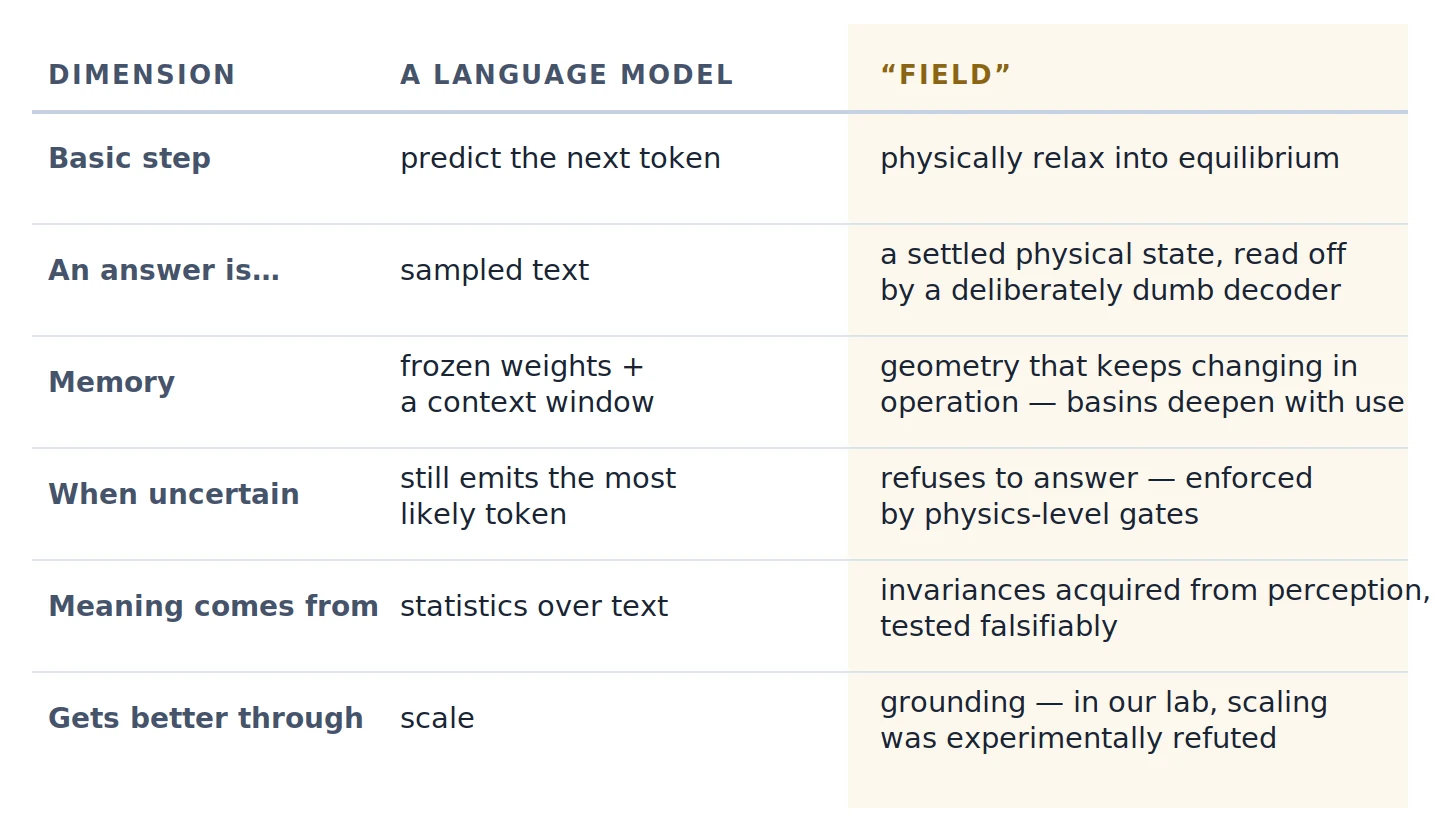
The sharpest way to feel the difference is a thought experiment we use as our literal failure criterion. In a language model, the decoder is the model. In “Field”, you can delete the decoder — and the answer still exists, as a physical state in the field, waiting to be read. If Python knows the answer without the field having produced it, the architecture has failed.
To be clear about positioning: this is not an LLM competitor. On coverage and fluency, language models win today — by a mile. “Field” is a different research bet: small, verifiable, honest. A language model is an orator who always keeps talking. “Field” is a structural engineer who answers only when the forces balance — and stays silent otherwise.
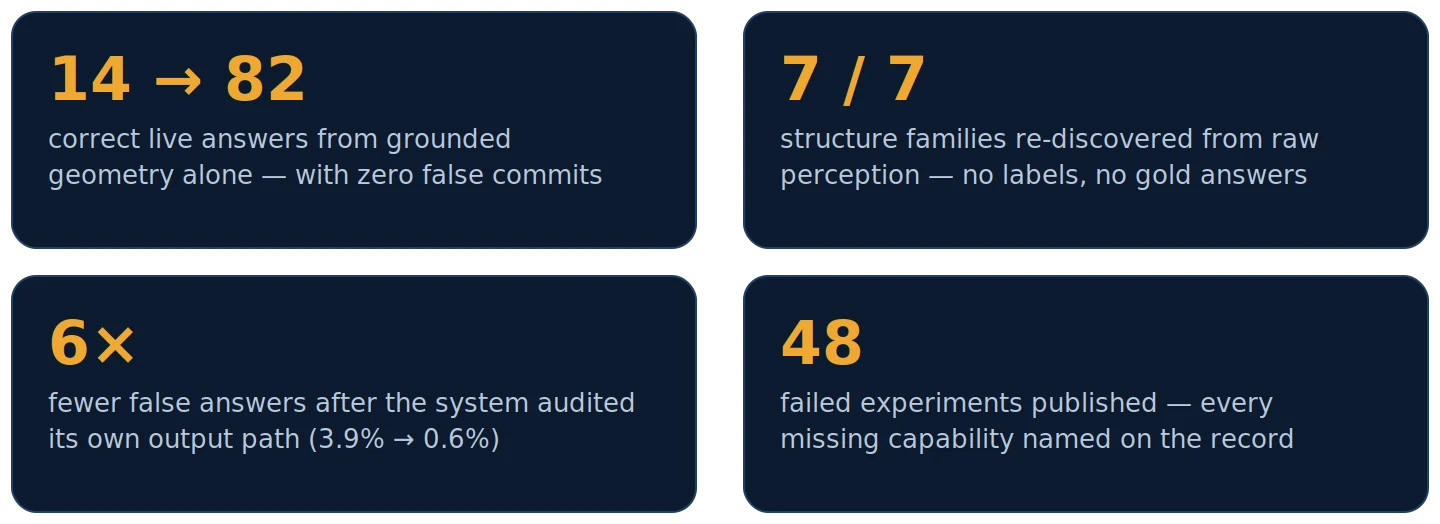
Why build it this way? Because it makes the question "what is intelligence?" operational. Every claim about the system must pass a registered verification with held-out tests and negative controls. Our registry currently holds 203 claims: 139 verified, 48 honestly failed, 16 planned. The failed ones turned out to be the most instructive.
§2 Lesson one: stability is not truth
The physics of our field guarantees that it always settles into exactly one stable state. That sounds like a superpower — and it is worth nothing by itself. A system can be perfectly stable and perfectly wrong. Stability answers "will it converge?" It says nothing about "will it converge on the right thing?"
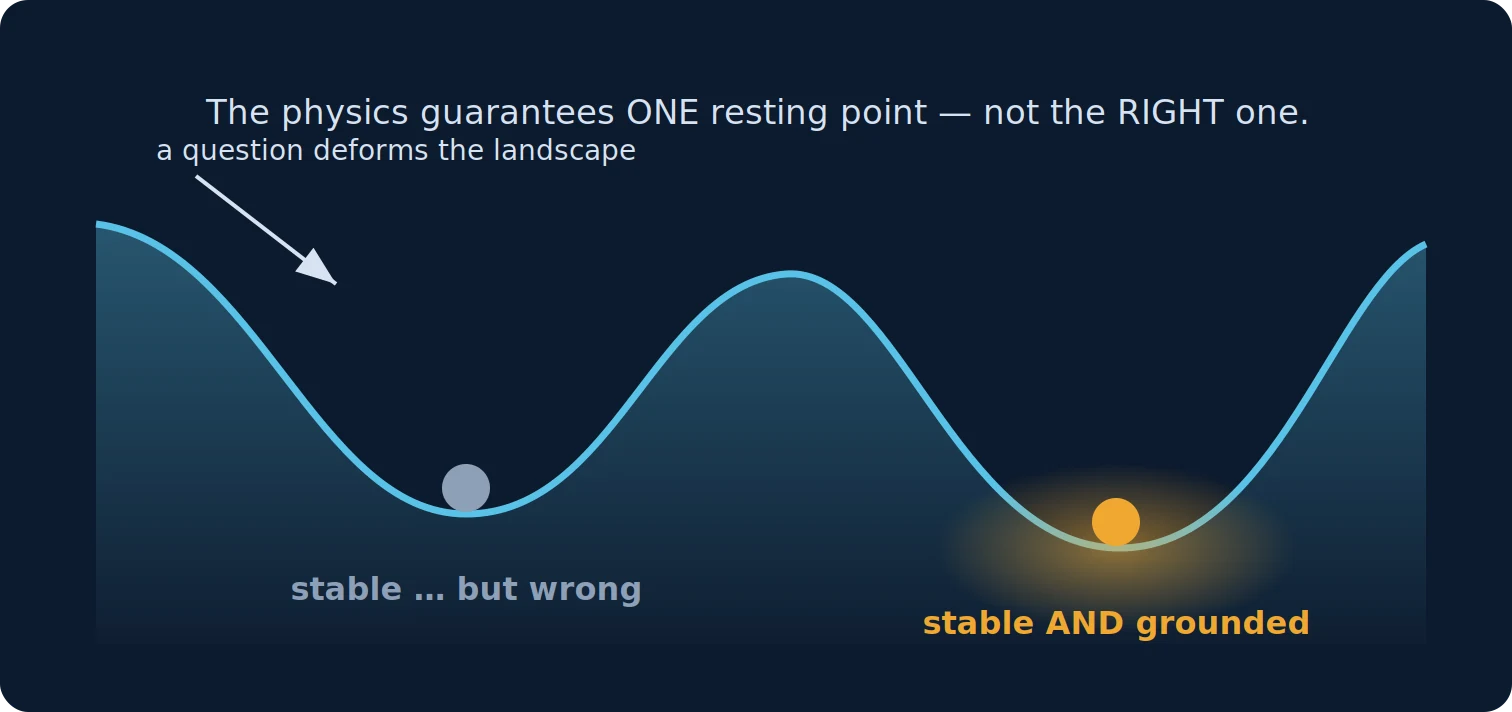
This single distinction dissolves a lot of confusion in AI discourse. Fluency, confidence, convergence — all of these are stability phenomena. Intelligence begins one level higher: in whatever mechanism decides which stable state deserves to exist.
§3 Lesson two: meaning is an invariance you can test
So what makes an answer the right one? After hundreds of experiments, our most robust finding is a definition of meaning that is falsifiable:
Something has meaning when it carries a relationship — acquired from perception, not from labels — that keeps working on cases the system has never seen, and that a scrambled version of the same data provably cannot fake.
Concretely: in our system, "larger", "brighter", "next number", "opposite of" are not word associations. They are geometric transformations — the same rotation applied on a learned coordinate ring. If the concept is genuinely grounded, that one shared rotation keeps producing correct results on held-out members. If it was just pattern-fitting, a shuffle control exposes it immediately.
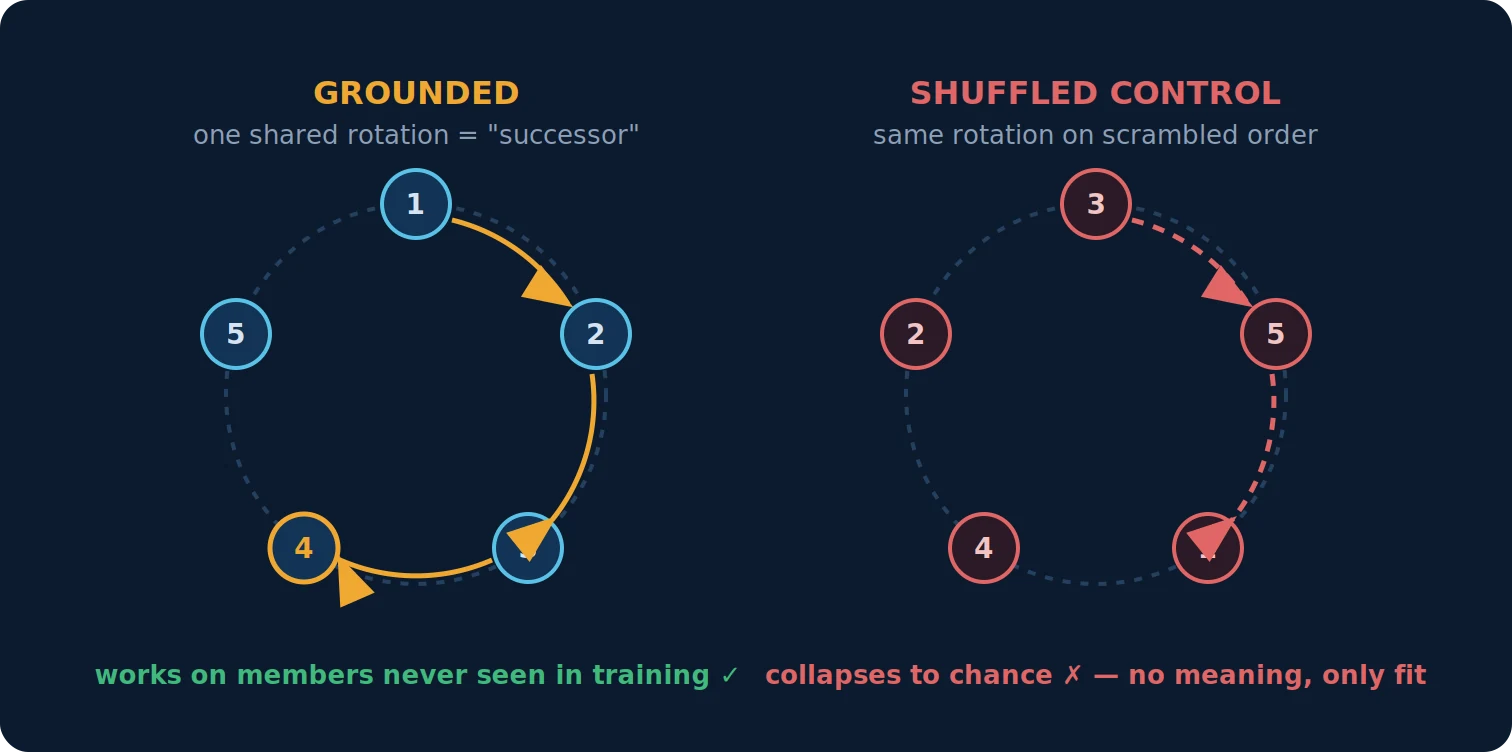
One consequence surprised us: the deep physics could not supply meaning by itself. The math gives the system its tools — shared, stability-preserving operations. But what those operations act on must be acquired from perception: an externally observed, member-independent scale. Structure is necessary. Experience is what makes it mean something.
§4 Watch one answer happen
Abstract principles are cheap, so here are two concrete moments from the lab — both verified, both with zero false commits.
Scene 1 — Counting, without ever being told what numbers are
- The system is never given a definition of "seven". It perceives collections of marks — the way an eye would.
- From perception alone, it places the number concepts on a geometric ring, in the correct order.
- "What comes after six?" is now not a lookup. It is a physical rotation along that ring — one shared step, the same for every number.
- It answers successor questions about members it has never seen during acquisition — and the identical mechanism carries "larger", "brighter" and "opposite of".
Scene 2 — The analogy it refused to answer
- Asked PUPPY is to DOG as KITTEN is to ?, the field observes the young→adult rotation in the first pair and applies it to the third term: CAT. Committed live, no string matching anywhere in the path.
- Asked CALF is to COW as LAMB is to ? — a family whose structure it could not yet perceive — it did something most AI systems cannot: it refused to answer.
- Only once it could actually observe the relevant morphology did it commit: SHEEP — five out of five across the family, from perception, zero false commits.
And the loop closes. When a grounded answer lands, the field deepens exactly that basin: in the controlled ablation, consolidation fired 14 times with the learning coupling on versus 0 with it off, and skill credit 63 versus 0. The system gets structurally better at precisely the things it has proven it understands — and at nothing else.
§5 Lesson three: memorization is not intelligence
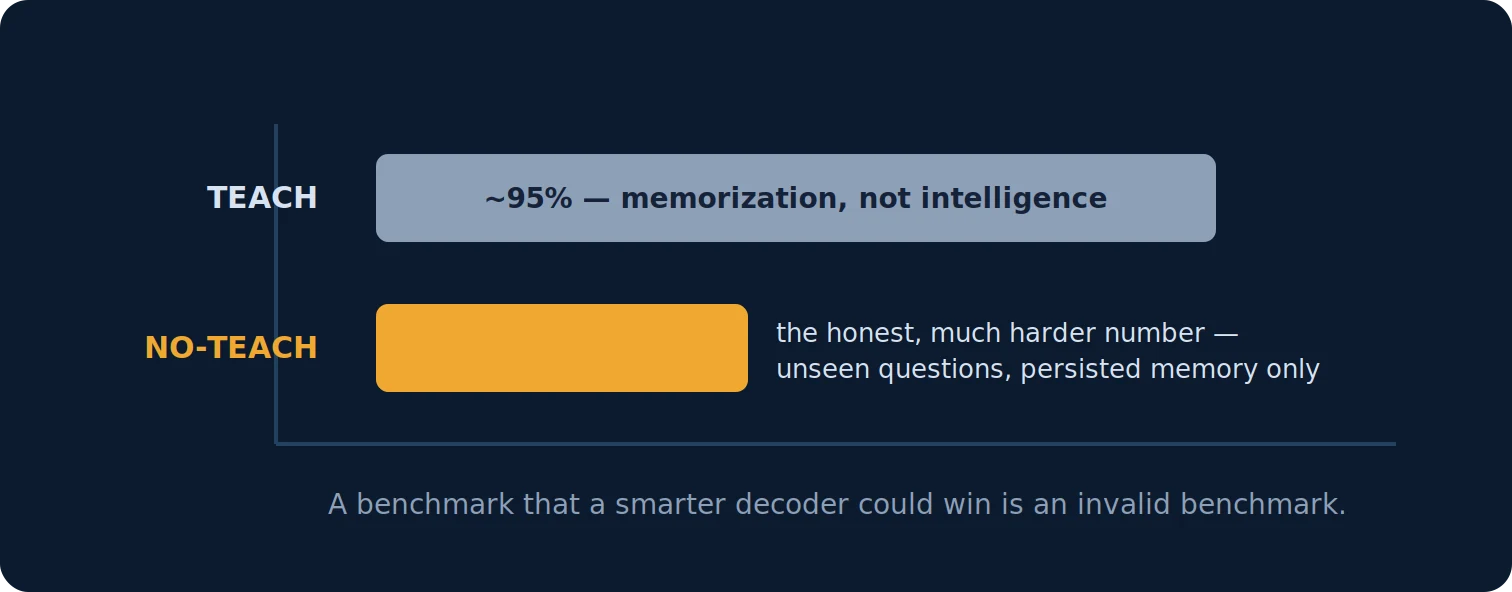
Our system can memorize almost perfectly: teach it a fact and query it immediately, and it recalls ~19 out of 20. We report that number as mechanics — never as intelligence. The only score we allow ourselves to call intelligence is measured without teaching: persisted memory geometry, questions never seen before, and strict controls against echoing the question back as an answer.
§6 Lesson four: honesty is part of intelligence, not a UX feature
Our system is only allowed to answer when it can prove — from its own physics — that the field actually moved, performed measurable work, reached the answer region, and is not just echoing the question. If any gate fails, it abstains. Abstention is a first-class result, logged and scored, not an error state.
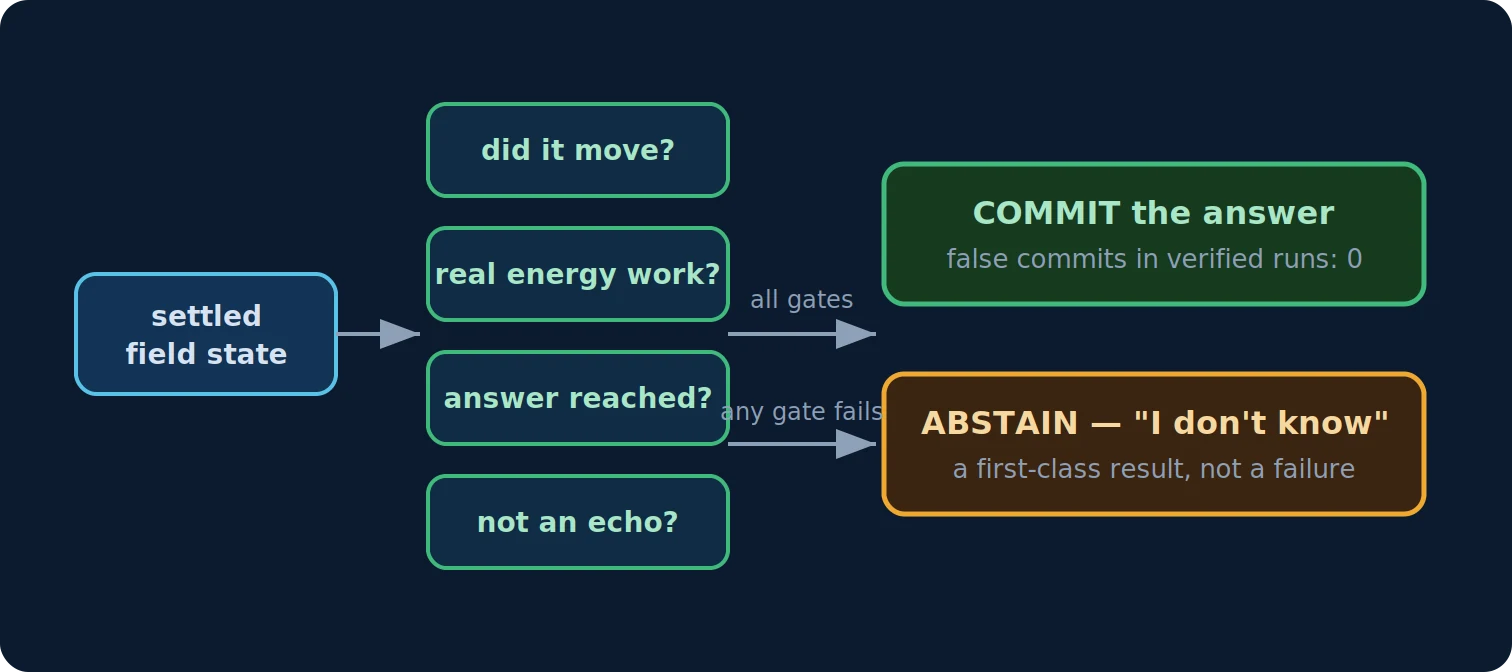
This is not theoretical hygiene. In a routine audit of a live run we found two genuine false answers hiding behind a green metric: in one, an internal arithmetic organ had actually reached "41" — but the output surfaced a stale memory state instead; in the other, mere field movement was mistaken for an answer. Both were closed inside the physics of the gate, not with an output patch. A related fix taught the readout to subtract the field's resting state before deciding anything — and the false-answer rate dropped roughly six-fold (3.9% → 0.6%). The system caught itself lying, and we rebuilt the gate so it couldn't.
A system that produces an eloquent lie where it has no grounded route is not more intelligent. It is more broken.
We think this generalizes far beyond our architecture. Hallucination is not a bug to be patched at the output layer — it is what happens when a system is structurally forbidden from saying "I don't know."
§7 Lesson five: failure is a map, if you refuse to hide it
48 of our 203 registered claims failed. We keep every one of them on the books, with the precise missing capability named. Together they falsified an entire family of intuitions we started with:
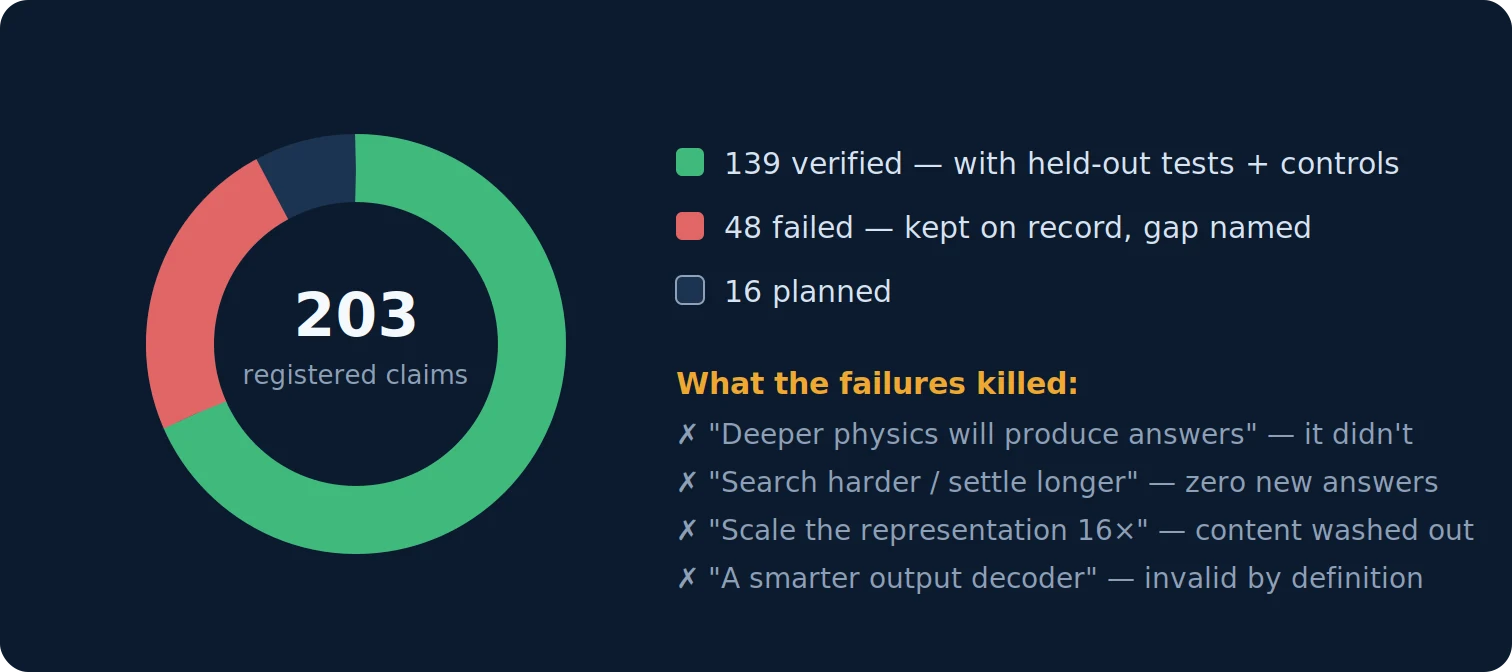
The pattern across all 48: whenever we tried to buy intelligence with more force — more depth, more search, more scale — we got nothing. Whenever we gave the system a better way to anchor meaning in perception, capabilities appeared and generalized. Intelligence, in our data, is bought with grounding, not with horsepower.
§8 Beyond Q&A: eyes, puzzles, and the map of open fronts
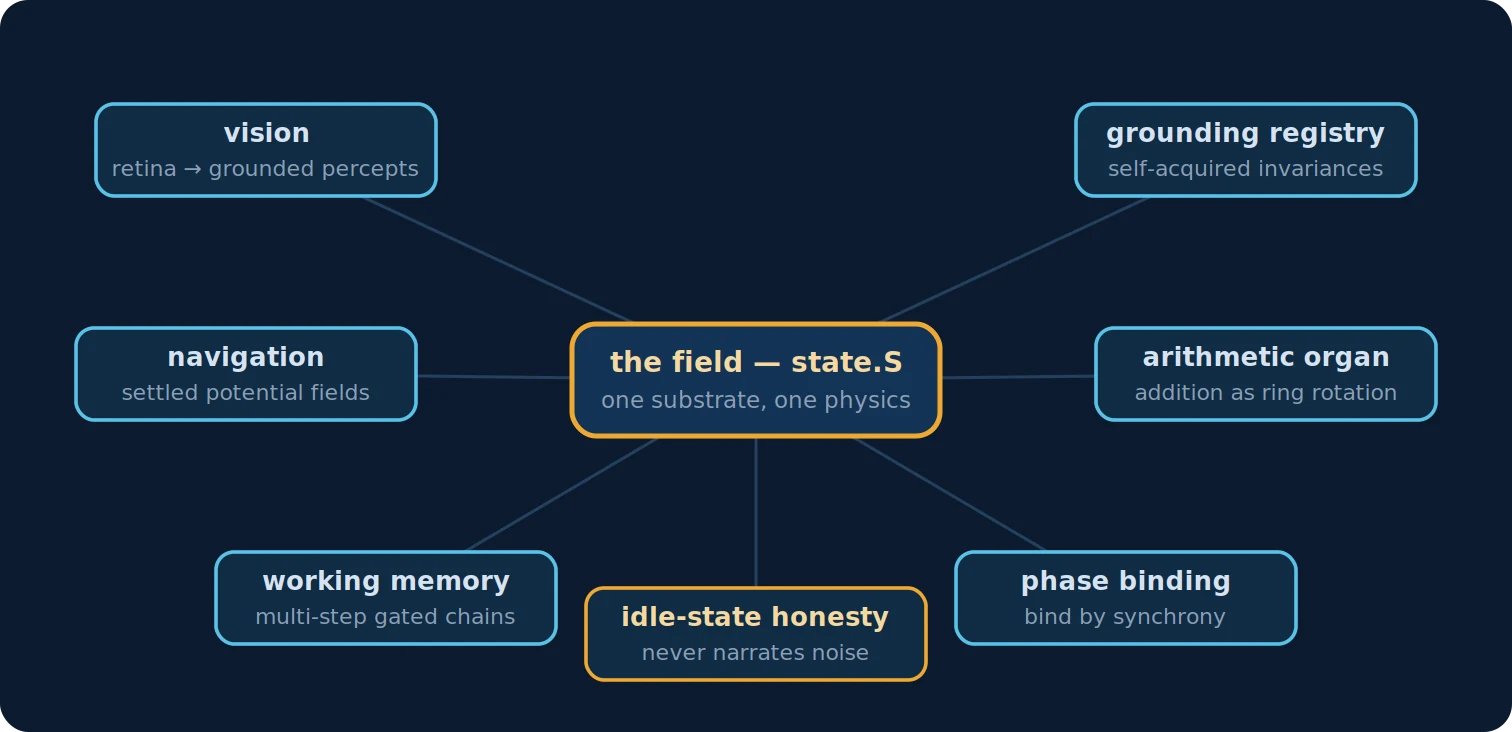
Everything so far was about answering questions. But the goal behind “Field” is larger: a single substrate that perceives, remembers, reasons and acts — under one physics, with one standard of proof. Here is how far that has come.
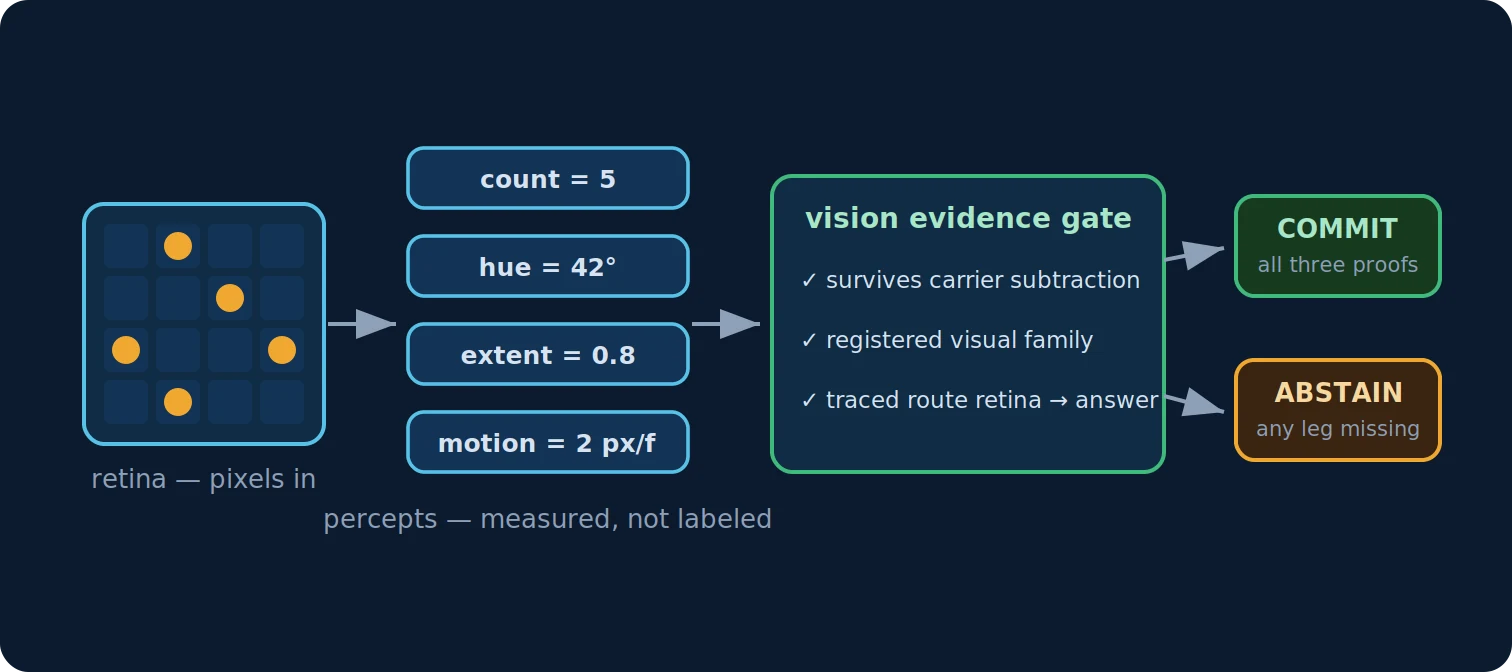
The system has eyes now. A retina organ turns pixels into field perturbations — but we deliberately did not wire it as an image classifier. Vision is a grounding source: the system perceives counts, hues, sizes, brightness levels, orientations, positions and motion directly from what it sees, and those percepts — not word statistics — are what anchor the meanings. Vision also passes through the same honesty machinery as everything else. When a chronic vision carrier signal leaked into the answer path and produced two false answers, we closed it with an evidence gate: a vision-sourced answer now needs three simultaneous proofs — residual support after subtracting the carrier's background hum, a registered grounding entry for the visual family, and a traced causal route from the retina to the answer region in that very frame. Any leg missing: abstain.
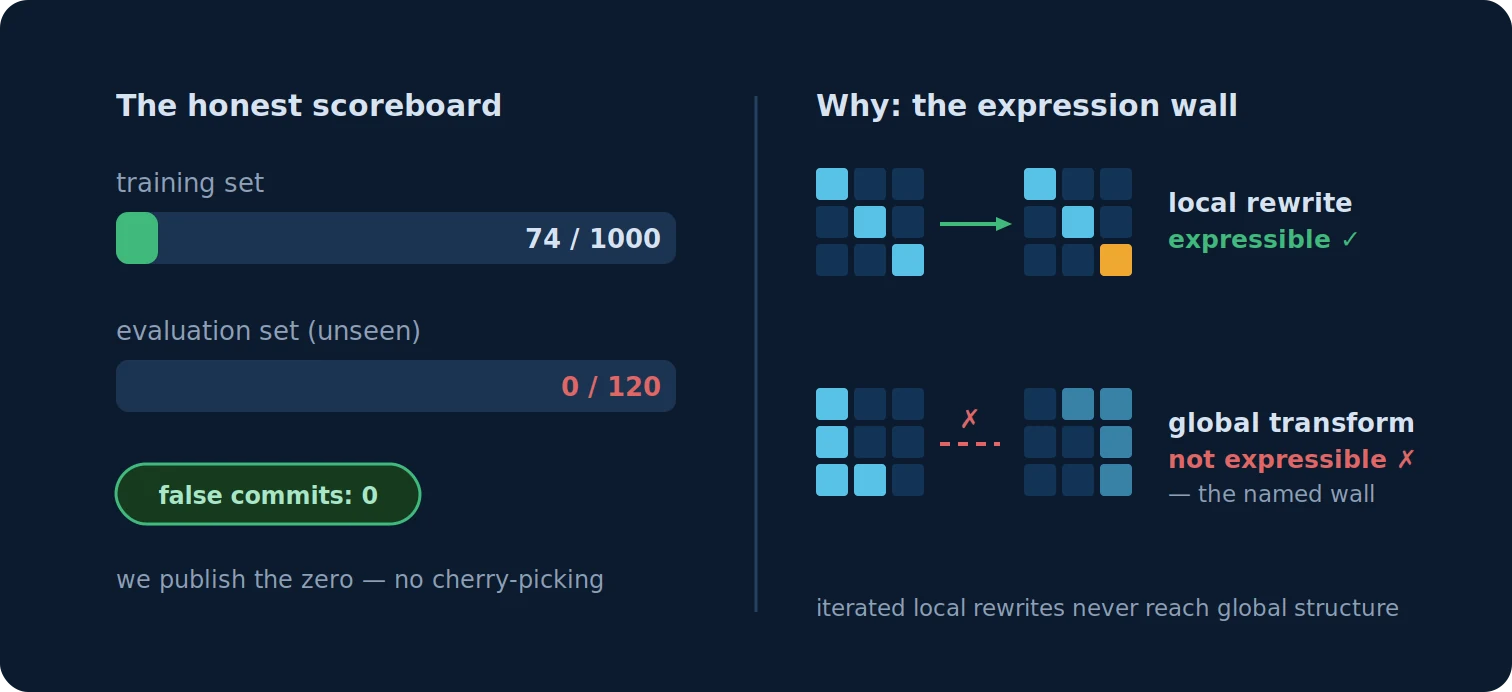
We also run ARC-AGI-2 — and publish the zero. The abstract-reasoning benchmark serves us as a diagnostic of the whole architecture, not a leaderboard target: no Python puzzle solver is allowed, the answer must exist as a settled field state. Current results, reported honestly: the field produces 74/1000 correct training-puzzle answers with zero false commits — and 0/120 on the evaluation set. More valuable than the score is that we measured why. Probabilistic rollouts showed the wall is not selection — the field rarely even generates the right candidate — but expression: the current operator algebra can express local rewrites, and iterating local rewrites provably does not reach global structural transforms. That precisely named missing primitive — non-local structure expression — is now our sharpest research front. This is what the failure-as-a-map discipline buys: not a better number, but a better question.
And a growing set of verified abilities around the core. The field routes unseen mazes by reading its own settled potential landscape — multi-hop, where a naive one-step baseline provably fails. It has a working-memory scratchpad that chains multi-step answers as sequences of individually gated commits (X, then X+1, then X+2 — each step proven before the next). It does exact arithmetic — which deserves its own paragraph in a moment, because it is easy to misread. Features can be bound by phase synchrony rather than location (binding 1.000 versus 0.250 for shuffled controls). And the field can classify its own idle states — at rest, ungrounded activation, grounded thought, open question — without ever narrating noise as a thought: in the audit, zero false thoughts, zero false questions.
How the field does arithmetic — geometry, not a calculator. When the field answers 13 + 28 = 41, no Python solves the math. Numbers exist in the field as geometry: acquired from perceived counts, they sit as ordered basins on a rotational ring, and arithmetic is movement on that ring — "plus one" is literally one step of a single shared rotation, "plus k" the same rotation composed k times. Remarkably, this is the very representation that mechanistic-interpretability research has since found hidden inside large language models: an MIT study (Kantamneni & Tegmark, 2025) reverse-engineered how LLMs add and showed that they, too, place numbers on circular, helix-like structures and compute a + b by rotating them — the "Clock" algorithm. The difference is the status of that geometry. In an LLM it is an emergent accident, smeared across attention heads and neurons, invisible without forensic tooling. In “Field”, the same rotational number geometry is — in effect — lifted out of the black box and promoted to a first-class, native, auditable operator: it is the physics, not a side effect of it. When this numeric organ reaches a result, it surfaces through the same commit gate as every other answer; we still book it in its own category ("organ compute", separate from open-ended reasoning) — not because Python computed it, but because honest accounting requires knowing which regime produced which answer.
The open fronts — named, not hidden
- Breadth with honest selection — many candidate settlements plus a field-native quality read, instead of ever-deeper search (deeper search is refuted).
- Evidence-bound facts — names, conventions, prices have no perceptual invariance; the honest route is recall bound to a registered source and time, abstention before exposure.
- Native transport — proving that relations move coherently across the field on grounded tasks, not just landing single tokens.
- Non-local structure expression — the ARC wall: a new physics of expression, not another hand-built special case.
- Decomposition — the scratchpad proves multi-step composition works; choosing the steps from the field's own residual pressure is the open half.
§9 So — what is intelligence?
Here is the working definition our experiments support. It is narrow, testable, and has survived everything we threw at it:
Intelligence is the capacity of a system to (1) settle reliably into stable states, (2) shape those states by invariances acquired from experience so that the right state wins — verifiably, on situations never seen before — and (3) refuse to answer where no such invariance exists.
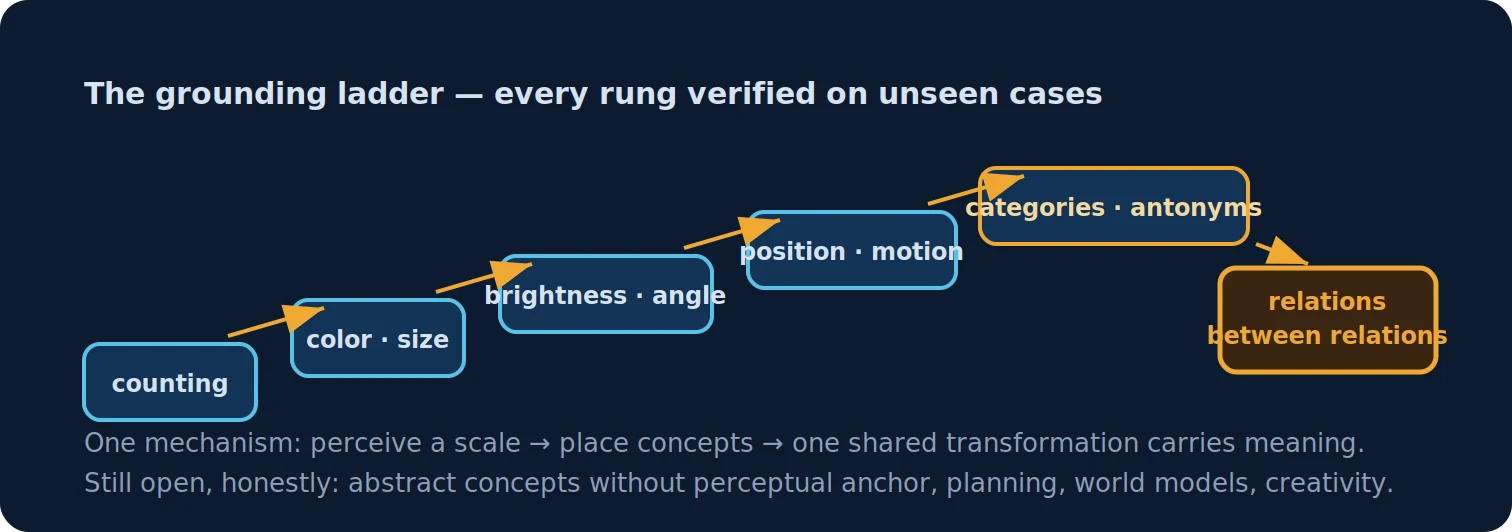
Note what is absent from this definition: fluency, confidence, benchmark leaderboards, parameter counts. And note what is central: generalization you can falsify, and honesty you can measure.
§10 Why this matters beyond our lab
You don't need to build a field architecture to use these lessons. Three of them transfer directly to how anyone evaluates AI today:
1. Separate stability from correctness. When a model answers fluently and consistently, you have learned that it converges — nothing more. Ask what shapes its landscape.
2. Demand held-out invariance, not recall. Any evaluation where the system might have memorized the answer measures storage. The interesting question is always: does the relationship survive on cases it has never seen — and does a shuffled control break it?
3. Score the "I don't know". A system that cannot abstain will fill every gap with its most fluent guess. Measure abstention quality and false-commit rate with the same seriousness as accuracy — they are the same axis of intelligence.
A word on where this could land commercially — e-commerce and agentic commerce. To be explicit: this is outlook, not a shipped product. But consider what agentic commerce actually needs. AI agents that search, compare, negotiate and transact autonomously fail today on exactly one axis: trust. A hallucinated product property, a confidently wrong order, an invented return policy — each has a direct price tag. The properties we are forced to engineer for intelligence are the same properties a commerce agent needs to be allowed near money: answers only with proof of work, structural refusal instead of a fluent guess, facts bound to a registered source and timestamp, and an auditable trail behind every commitment. It is also worth noticing which meanings the field grounded first — size, colour, brightness, count, position, and ordinal relations like "larger than": that is precisely the attribute vocabulary of every product catalogue. An agent built on this discipline would rather decline a purchase than invent an availability. "Zero false commits" as a measurable design property, not a marketing hope — that is, we believe, what commerce-grade AI will eventually require.
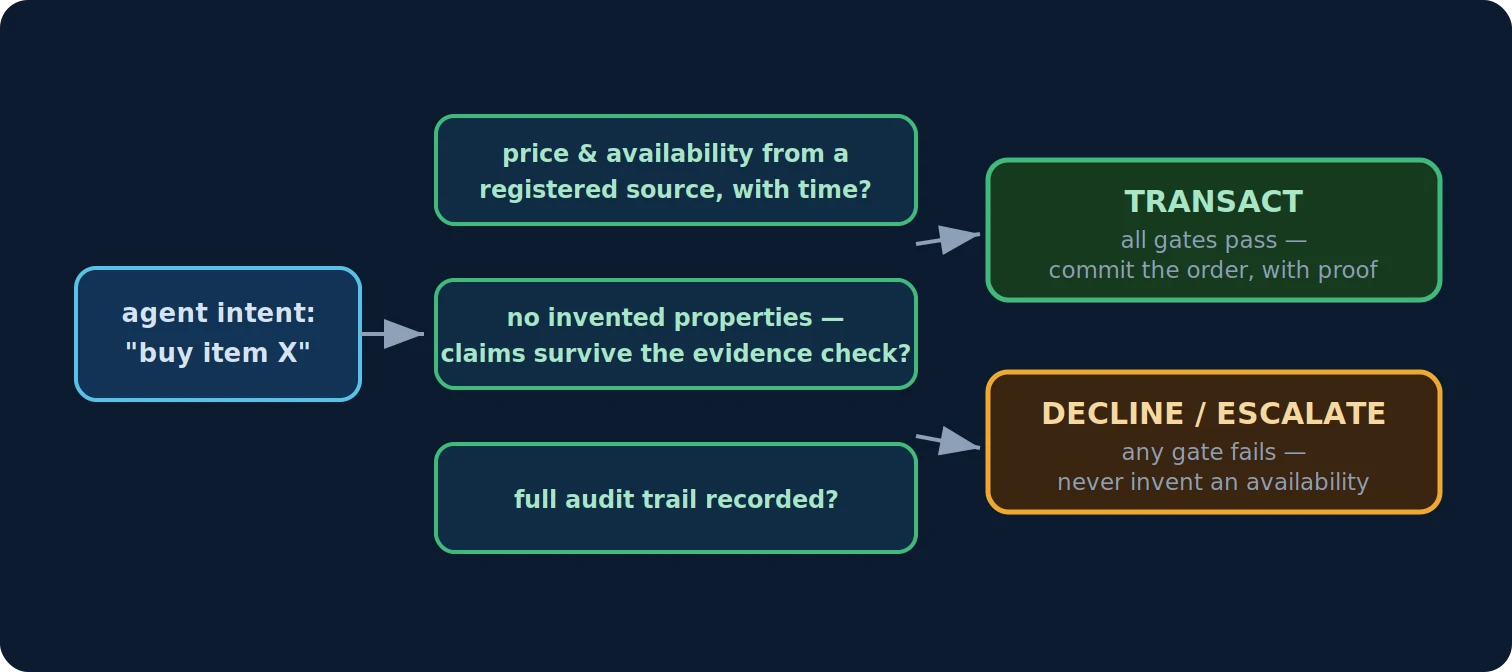
Our field is still far from general intelligence, and we say so in the same registry that records the wins. But we no longer find the question "what is intelligence?" vague. It is an engineering specification: converge, ground, generalize, and be honest about the rest.
Intelligence can be turned from a philosophical debate into an engineering discipline. Every capability should be earned through evidence, every failure should sharpen the next experiment, and every answer should be grounded strongly enough that the system is willing to remain silent when the evidence is missing. If that standard becomes normal, AI will not only become more capable. It will become more trustworthy.
#ArtificialIntelligence #AGI #MachineLearning #CognitiveArchitecture #GroundedAI #ExplainableAI #AIResearch #EmbodiedAI #AgenticAI #CommerceAI #Innovation #FieldAI #agenticcommerce #shopware