How a field system started reasoning without neural networks
Let me start with the punchline.
Yesterday, a small prototype of the AI architecture I´m building in the Agentic Commerce Labs, really surprised me!
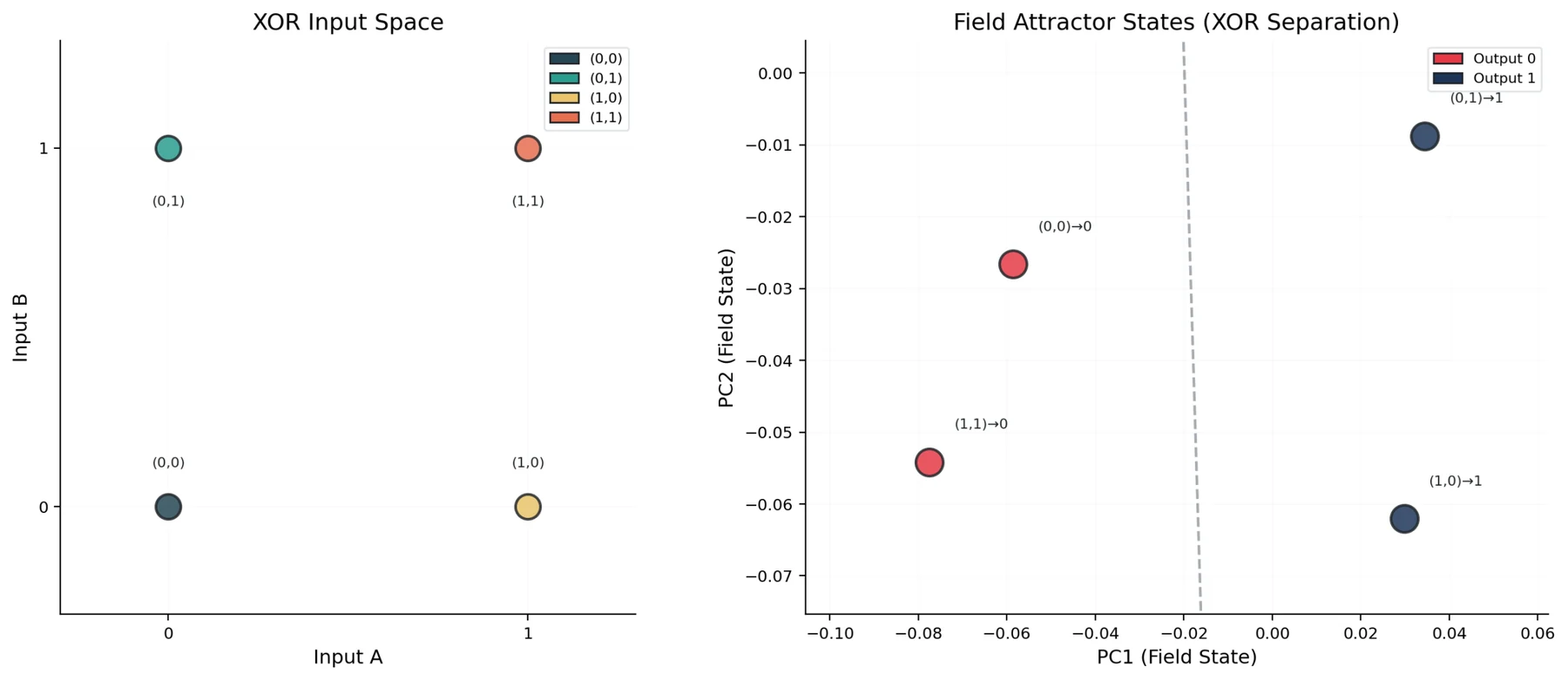
It solved XOR. It cleanly separated logical structure from simple arithmetic. It produced distinct, almost orthogonal memory patterns for different inputs. And it did all of this without any trained weights or learned parameters.
No training. No backprop. No weight matrices to tune.
Just the dynamics of a field — and somehow, it reasoned.
This should not work. And that is the interesting part.
Why modern AI feels like magic and a mess at the same time
Modern AI is astonishing. Models like GPT, Claude and Gemini deliver results that would have seemed impossible only a few years ago. Their success comes from enormous scale, clever optimization and impressive engineering.
But these systems also share a natural limitation.
Their knowledge lives inside billions of learned weights. This makes them powerful, yet difficult to interpret. When a model succeeds, we cannot easily trace the steps behind the answer. When it struggles, we cannot clearly explain the failure. The reasoning is real, but the structure behind it remains hidden in a space too large to understand.
For many years the response has been simple.
Add more data, increase the scale and push more compute.
We became curious whether there is another path.
A path where reasoning comes from the structure of the system itself rather than the size of the training run.
A very simple question
What if intelligence is not a spreadsheet with trillions of numbers?
What if intelligence is a physical process?
Fields generate patterns. Patterns produce structure. Stable behavior emerges because the underlying field wants to settle into certain shapes.
What if information is a state of a field?
What if meaning is the stable configuration that field finds?
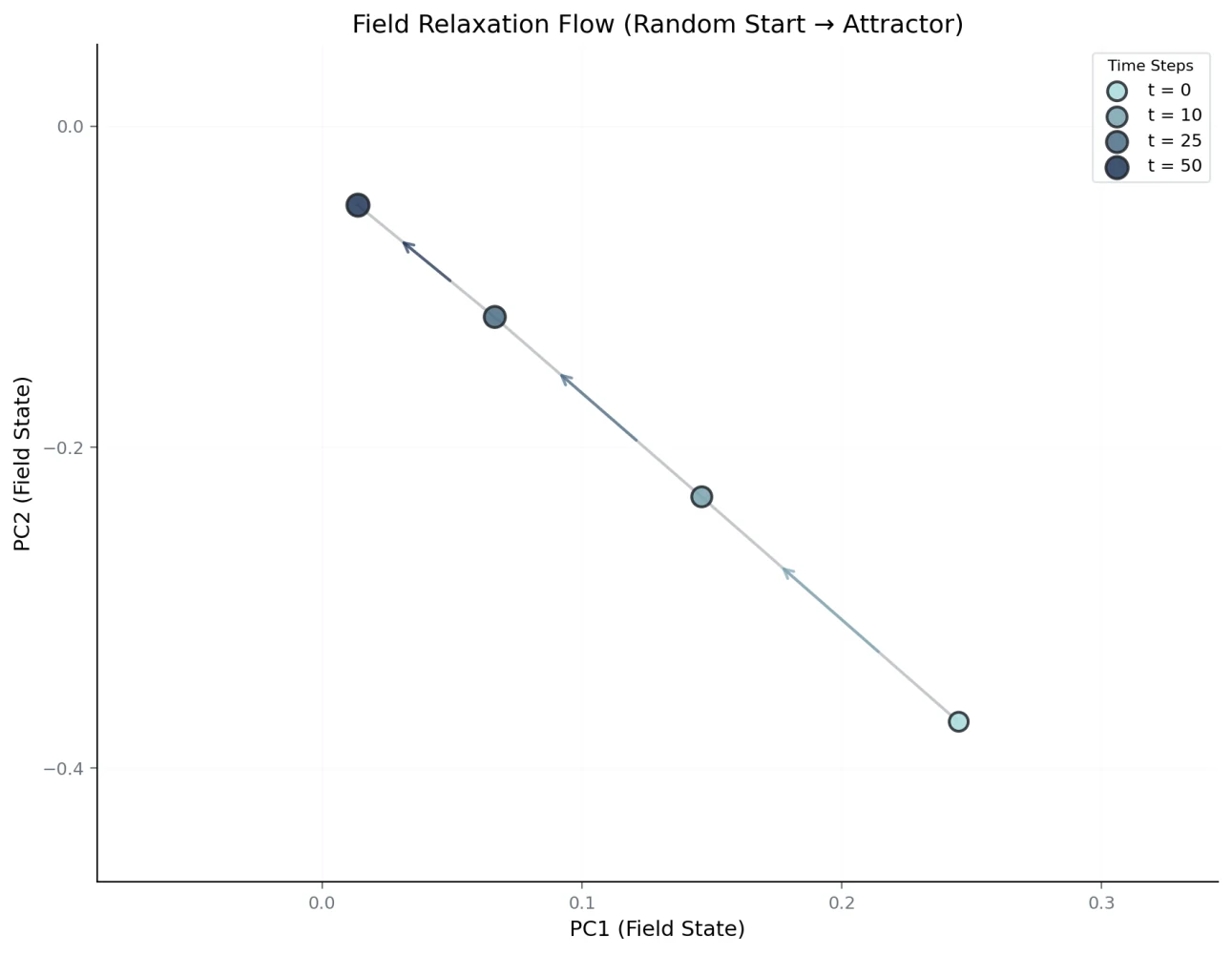
What if learning is not weight updates, but physical relaxation into an attractor?
That is the core idea behind our prototype AI Architecture.
The architecture, without the jargon
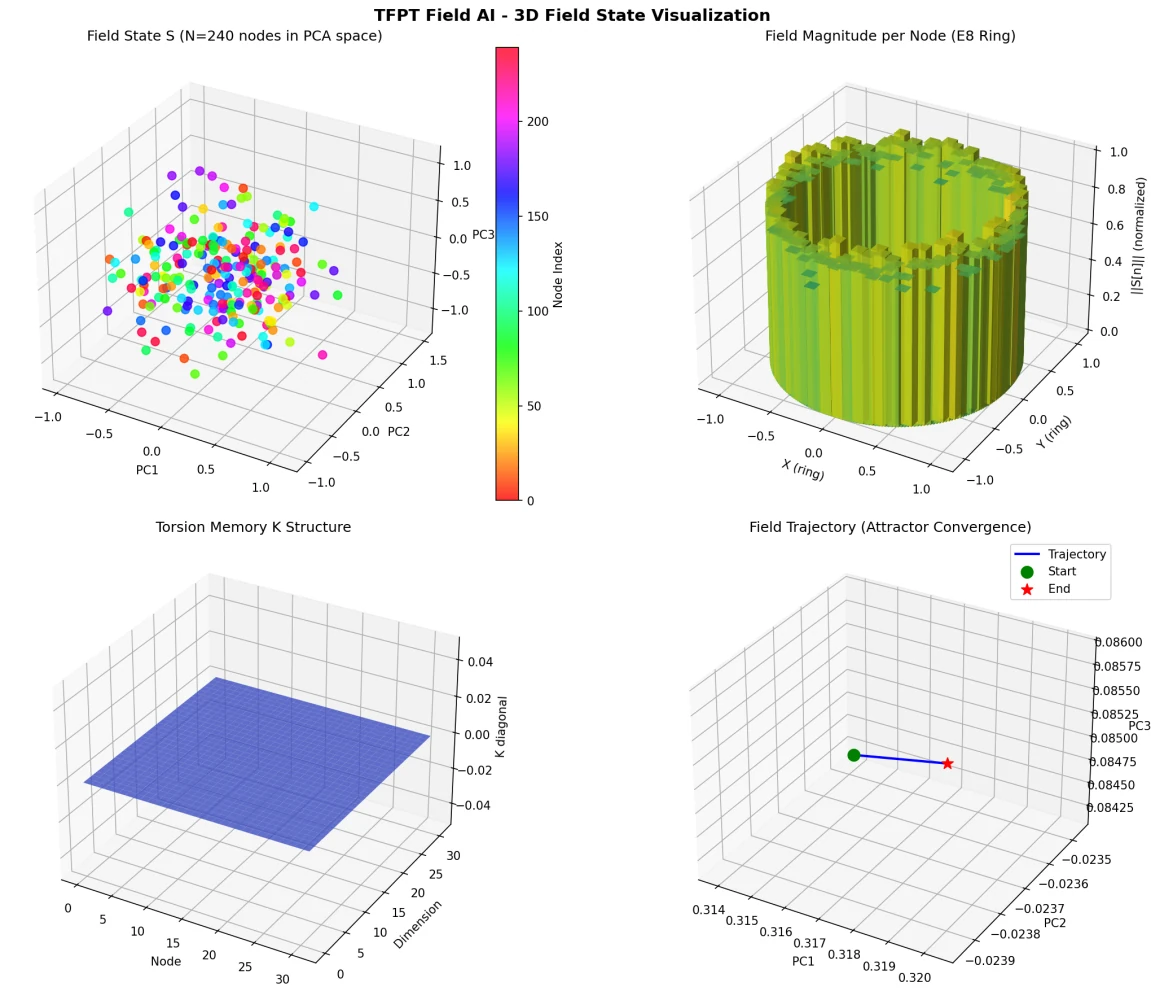
Forget layers, attention heads or long training cycles. Our system is one global field with about thirty thousand degrees of freedom. It is tiny compared to any transformer and it runs on a laptop.
This field lives on a Möbius shaped space with a high dimensional symmetry known as E8. You do not need the physics to follow the idea. E8 acts like a perfect crystal that keeps the system coherent, while the Möbius twist introduces contrast and inversion that turn out to be surprisingly helpful for logic.
An input does not pass through a stack of layers. It simply perturbs the field. The field reacts, flows and settles into a new configuration. The shape of that configuration encodes meaning.
Everything follows one evolution law. A restoring force pulls the field toward coherence, the symmetry spreads information across the space, the nonlinear interaction creates structure and the Möbius twist allows the field to represent opposites. That is the entire machine.
Memory as geometry
This part surprised us the most. Traditional models store memory in weights or attention patterns. Our system stores memory in geometry.
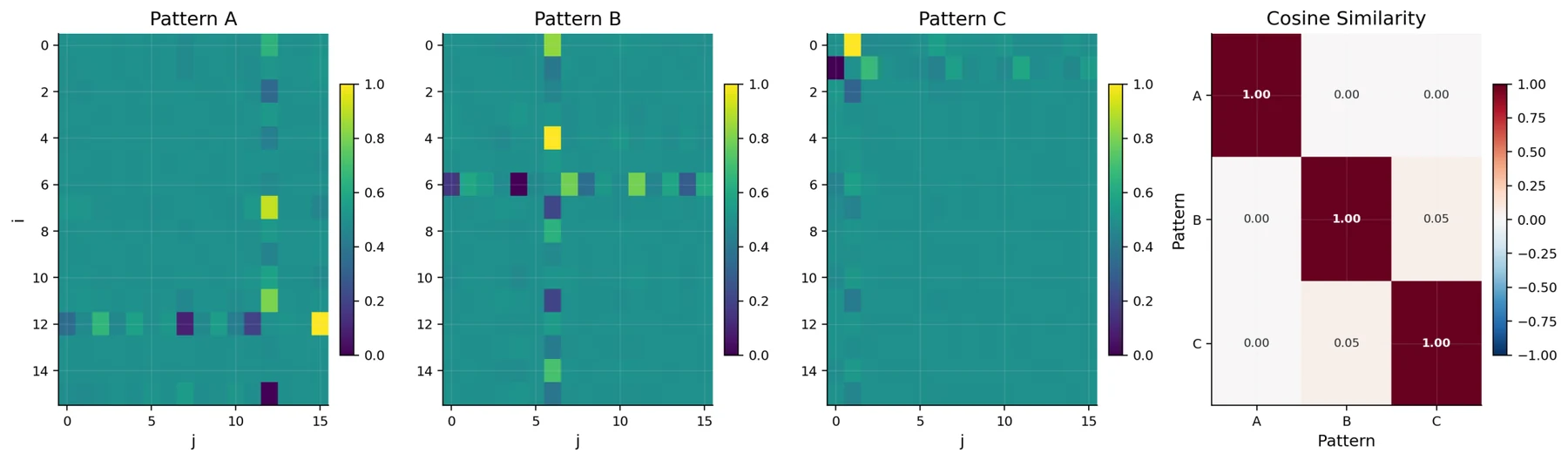
The field carries two forms of memory. The first is the instantaneous state of the field, which reflects the current input. The second is a slowly evolving twist of the space itself, called torsion. Torsion captures how the field has moved over time. It records relationships rather than snapshots.
Different inputs create different torsion signatures. These signatures are clean, almost orthogonal and do not interfere with one another. New information does not overwrite what came before. It adds structure and enriches the geometry of the space.
At that moment the system began to feel less like software and more like a physical process that remembers.
The tests that convinced us we were not imagining things
We ran a full suite of tests to see whether the behavior we observed was real. Every test passed, but three results changed how we thought about the system.
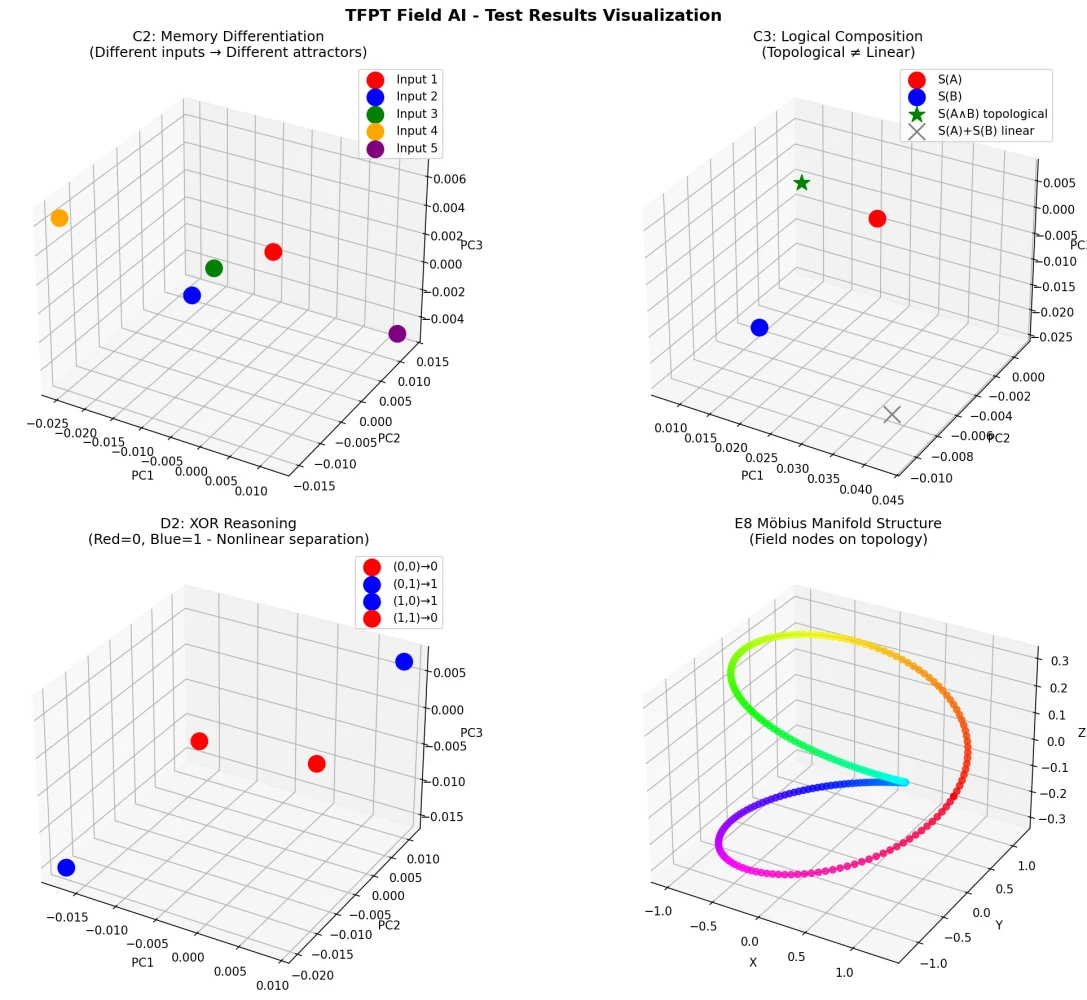
The first result was XOR. This is the classic nonlinear challenge where simple models fail and neural networks require hidden layers. Our field solved it instantly with no training at all. The nonlinear structure of the field did the work.
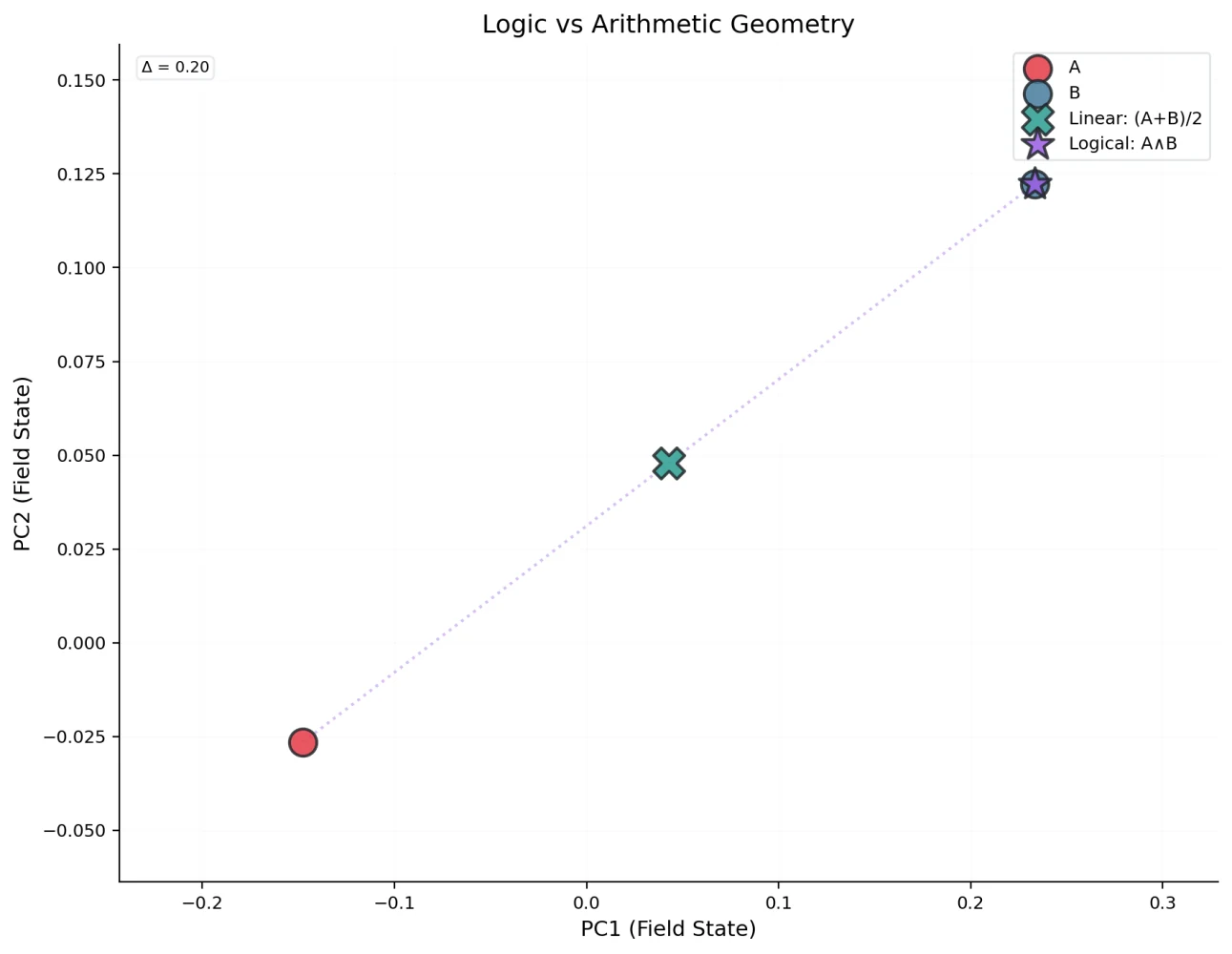
The second result showed that the system separates logic from arithmetic. Transformers often blur correlation and logical structure, but the field produced clearly different geometric states for A plus B and A and B. Logical composition and numeric addition became different shapes in the space.
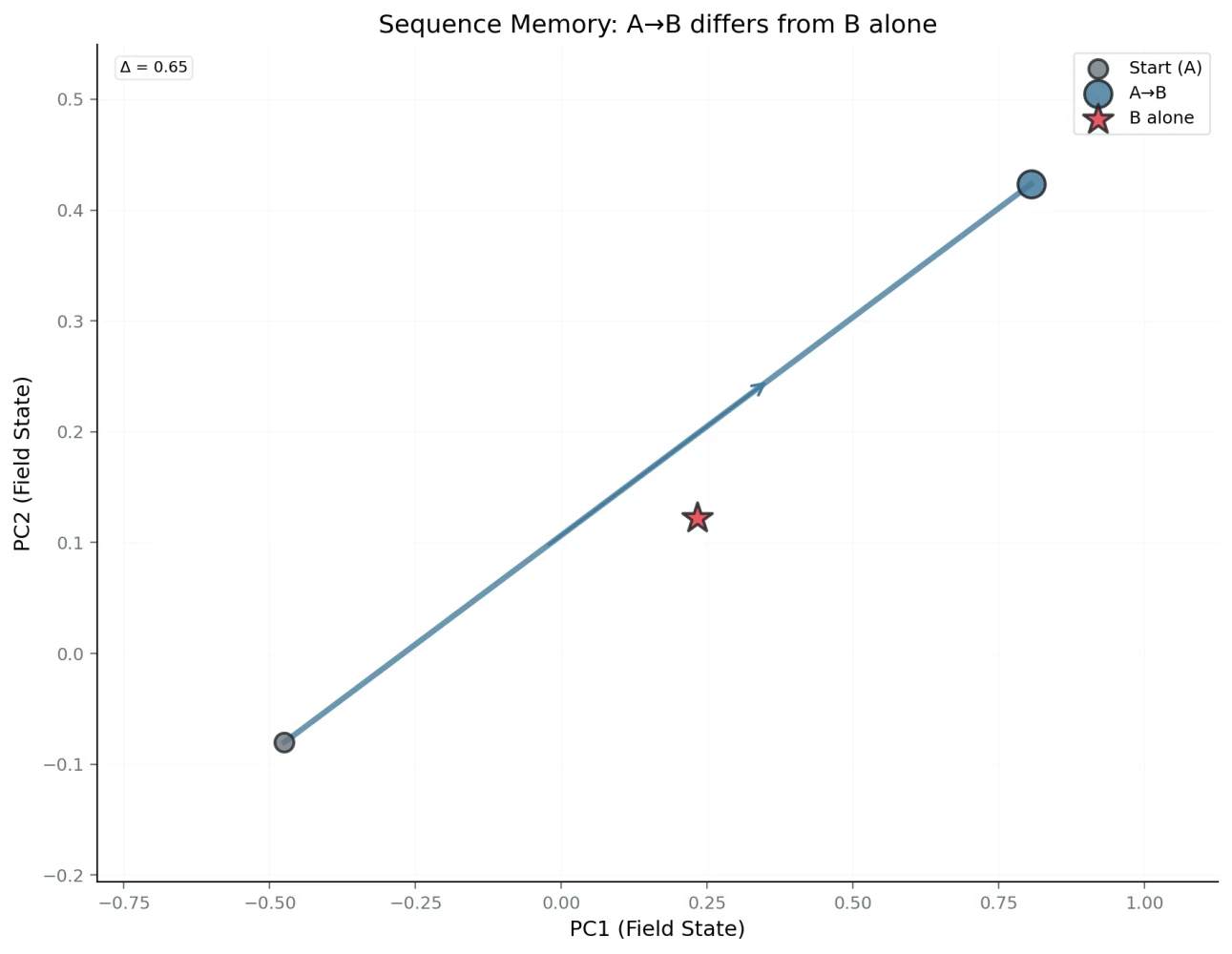
The third result was sequence memory. When we fed A followed by B, the system settled into one attractor. When we fed B alone, it moved into a different one. The system did not just encode values. It encoded the path that led there. Context became geometry.
Why this matters
Even in this early prototype, the architecture hints at qualities that are unusual for machine intelligence. The most important one is transparency. Every answer is a physical state of the field, something you can inspect and interpret. There is no hidden weight space and no black box behaviour. The computation is visible in the geometry.
The system is also surprisingly efficient. With roughly thirty thousand degrees of freedom it runs on a laptop, and the underlying symmetry seems to act as a natural form of compression. Structure appears without the need for massive parameter counts.
Another promising observation is the way the system handles memory. Information does not vanish or collide. It accumulates in the geometry of the space, and new input adds structure instead of overwriting what came before. This could become a way to avoid forgetting, although this is still an early hypothesis.
The most curious effect is that the system shows signs of reasoning before any training. It separates categories, forms distinctions and stabilises meaning through its dynamics alone. Data does not create the capability. Data tunes a capability that already exists in the structure.
This is still a prototype, but it points to a different way of thinking about intelligence: not as a vast collection of numbers, but as a physical process that organises itself.
What comes next
Phase 1 was about testing the core idea. The field is stable, the theoretical invariants hold and the early signs of reasoning are real enough to study. That gives us a foundation to take the next step.
Phase 2 will bring this approach into language and mathematics. We will not convert words into vectors. We will treat them as small disturbances of the field. A sentence becomes a pattern the system settles around. A mathematical expression becomes a constraint that shapes the flow. Meaning does not get assigned. It emerges from the way the field resolves the structure.
This is not an attempt to build a faster transformer. It is an exploration of a different style of intelligence, one that follows physical law rather than statistical gravity. The goal is a system that forms structure, keeps coherence and learns in a way that resembles a natural process.
And if this architecture continues to behave as it does now, it may open doors far beyond pure research. A field that can stabilise meaning, preserve memory through geometry and reason without heavy training could become a powerful foundation for agentic systems. Especially in commerce, where decisions depend on context, relationships and long running goals, an intelligence that works through structure rather than scale could be transformative.
We will keep exploring, keep testing and keep sharing what we find.
Greetings from the labs.
#ArtificialIntelligence #NextGenAI #Innovation #ResearchAndDevelopment
#DeepTech #ScientificComputing #AgenticCommerce #FutureOfAI #shopware