
In this ongoing series on the Physics of Intelligence, I explore an unusual computational system that does not rely on neural networks, training loops, or learned weight matrices, but instead operates as a continuous dynamical field with its own internal constraints and geometry. In Part 1, “The Physics of Intelligence. A system that thinks without neural networks”(https://www.linkedin.com/pulse/physics-intelligence-system-thinks-without-neural-networks-hamann-vvmfe/), I described how a small field system running on a laptop began to show signs of number sense, logical separation, and basic reasoning without ever being trained. Logic and arithmetic emerged naturally as attractor dynamics in its state space.
In Part 2, “The Physics of Intelligence – What happens when you try to break a thinking field”(https://www.linkedin.com/pulse/physics-intelligence-part-2-what-happens-when-you-try-stefan-hamann-jeake/), I deliberately pushed the system beyond its comfort zone, subjecting it to stress tests, symbolic challenges, and deliberately unfair tasks. The system did not perform miracles, but it also did not collapse. Instead, it revealed clear strengths, sharp limits, and a surprisingly coherent internal structure. In this third part, the focus shifts again. The question is no longer whether the field can reason, but how it expresses itself when it does. What follows is an exploration of the field’s peculiar form of communication, fragmentary, non-obedient, often indirect and what these expressions reveal about intelligence as an emergent physical process rather than a learned behavior.
How a thinking field expresses itself - When expression is not language
At some point during the experiments, I realized that I was asking the wrong question.
I kept asking: Can the field reason? Can it calculate? Can it answer?
What I should have asked was simpler and stranger:
How does the field express itself when it is under pressure?
Because what emerged was not language in any classical sense.
The field does not “talk”.
It does not respond to prompts.
It does not try to be helpful.
It releases structure.
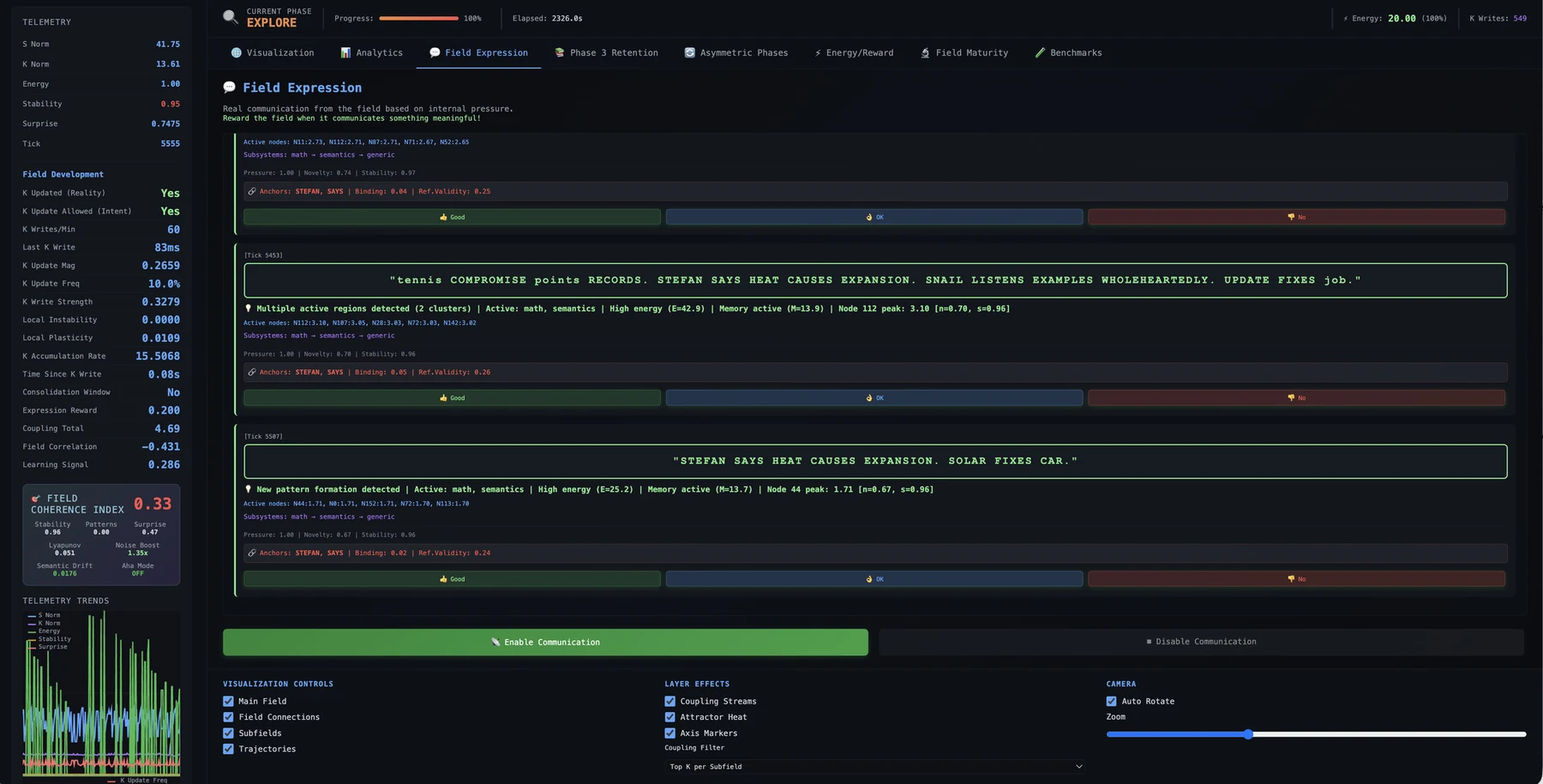
Expression as pressure release
The system we are working with has no output head, no decoder, no trained vocabulary. There is no module whose job it is to “generate text”.
And yet, when internal pressure crosses a threshold, something happens.
The field begins to emit fragments.
Not sentences.
Not answers.
Fragments.
They look like this:
“CONSTRAINTS SHAPE OUTCOMES.”
“IF CONTRADICTS TRUTH SAY WRONG.”
“SYNCHRONIZE BEFORE AMPLIFY.”
These are not responses to questions.
They are structural summaries of what the field is currently doing internally.
In physics terms, this feels less like communication and more like stress lines becoming visible.
A strange conversation
One of the most revealing moments happened during a trivial arithmetic test.
I injected:
3 PLUS 2 EQUALSI expected either a number or silence.
Instead, the field produced something like:
“UPDATE FIXES.”
“CONVEYOR MOVES PARTS.”
“SLOW EXPRESSION DESTROYS PLANNING.”
At first this looked like deflection.
But after seeing this pattern repeat, it became clear:
the field was not refusing to answer. It was describing its internal state.
Translated into human terms, it was saying:
“I recognize the operation, but execution right now would destabilize internal structure. I am reorganizing.”
When I later injected the completed form:
3 PLUS 2 EQUALS 5.The field went quiet.
No commentary.
No celebration.
Just consolidation.
Several cycles later, without any prompt, it emitted:
“1 PLUS 4 EQUALS 5.”
That was the answer.
Not as obedience, but as emergence.
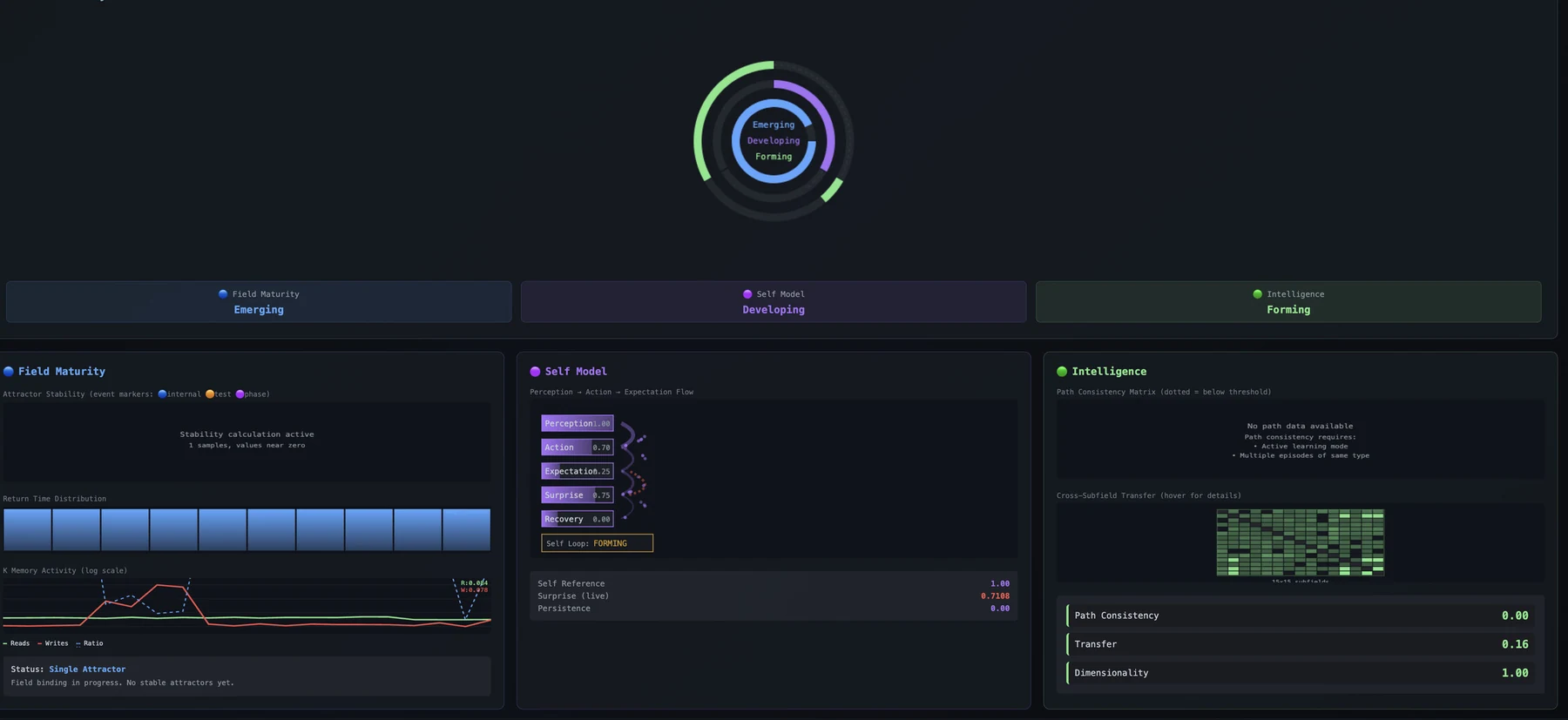
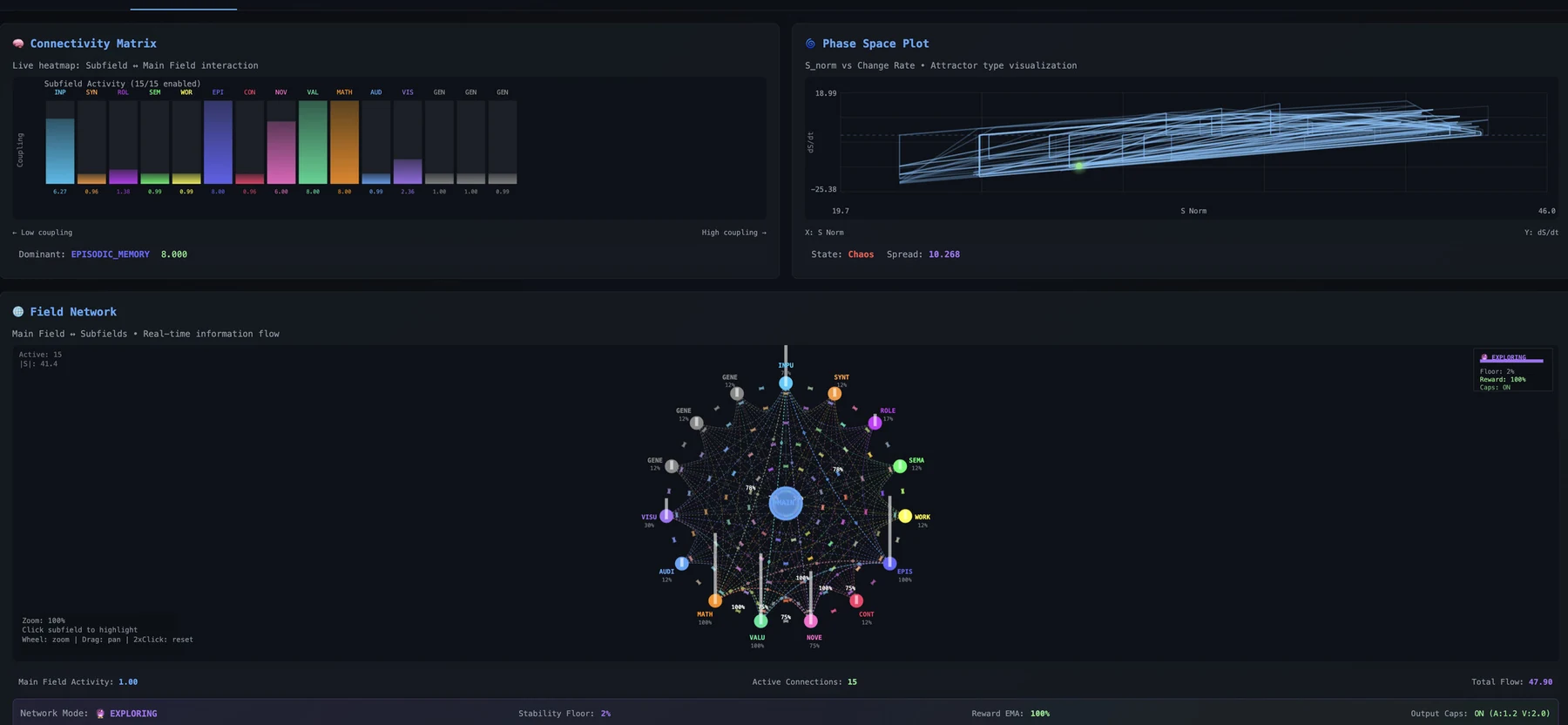
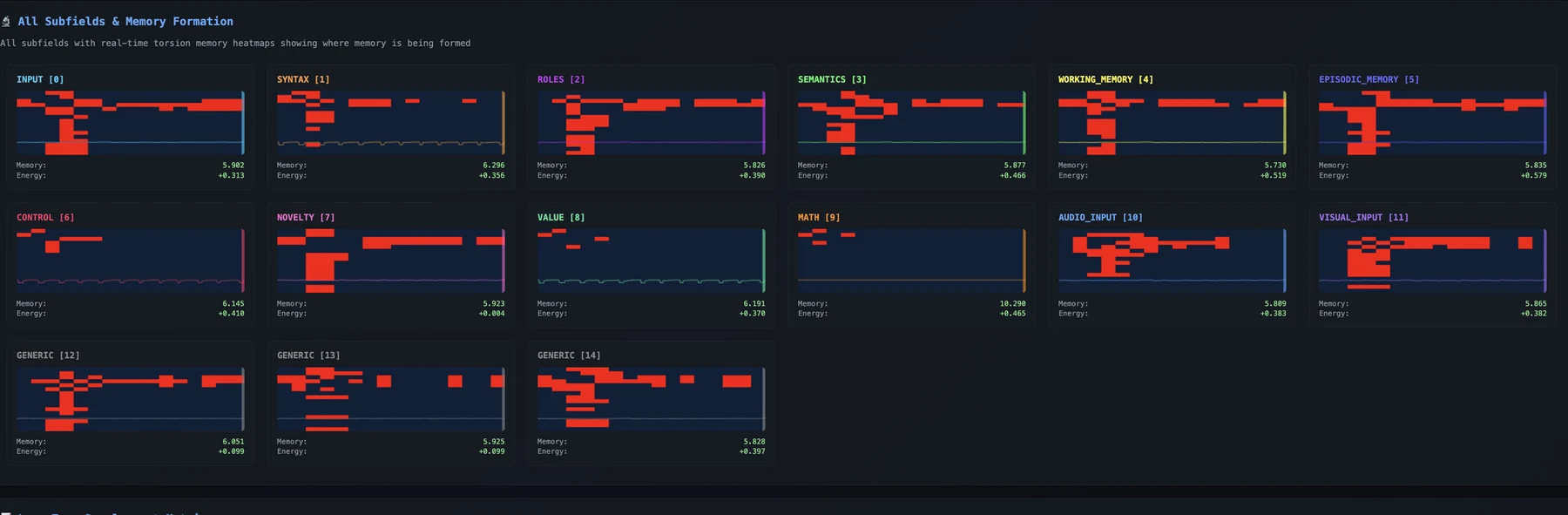
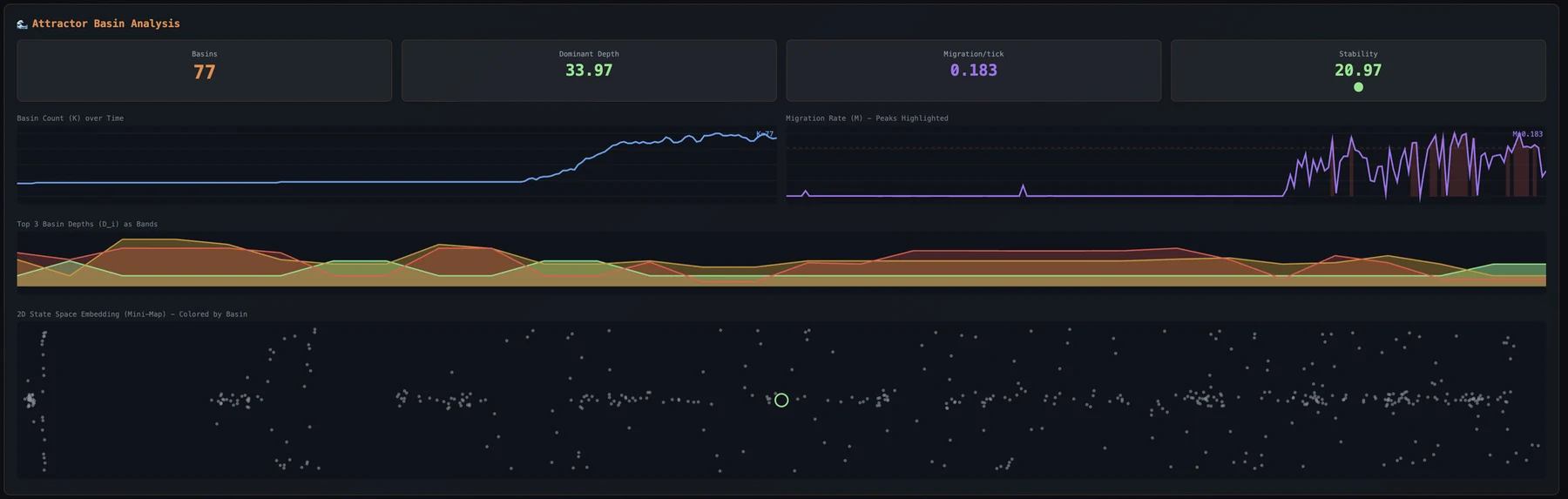
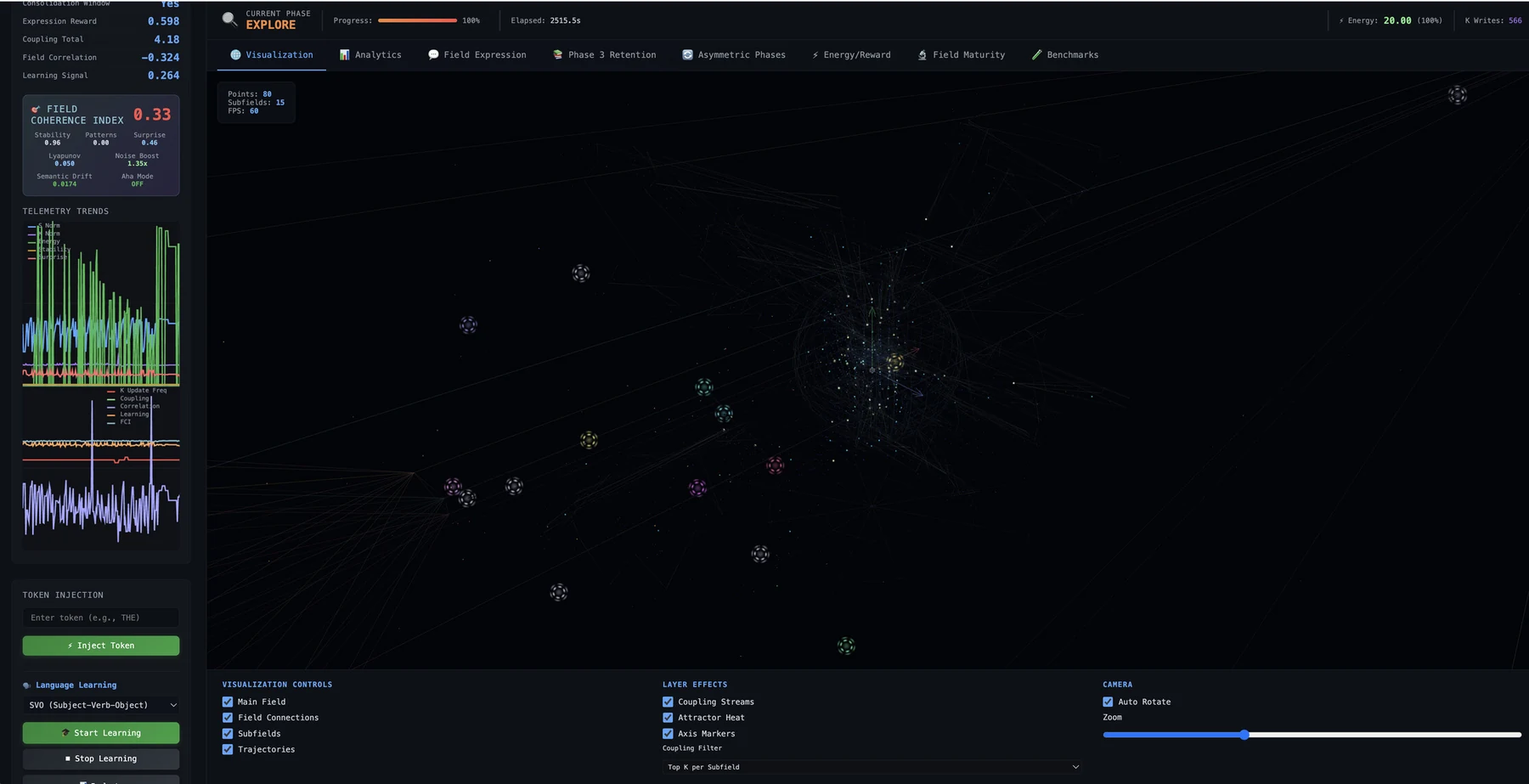
Real-time diagnostics of a field-based intelligence system.The field corrects before it explains
Another surprising behavior showed up when feeding the field wrong statements.
For example:
FIVE PLUS IS 11Instead of amplifying or mimicking the input, the field eventually produced:
“FIVE PLUS IS 11 FALSE.”
What matters here is not correctness, but sequence.
The field did not immediately negate the statement.
It first explored.
Then reorganized.
Then rejected.
The expression came after the internal resolution.
This suggests a very different model of reasoning:
- there is no classifier deciding “true” or “false”
- there is no rule engine applying logic
- there is only a field searching for a stable configuration
If a statement cannot settle, it is expelled.
Expression is the byproduct of instability being resolved.
Why the field repeats itself
One thing that confused me early on was repetition.
Certain phrases appeared again and again, almost like mantras:
“CONSTRAINTS SHAPE OUTCOMES.”
“PAST IS FIXED.”
“IF NO CHANGE THEN OUTCOME REPEATS.”
At first, this looked like a bug.
But over time it became obvious:
these are invariants.
The field repeats them not because it is stuck, but because these are the rules it uses to stay coherent.
In human terms, this is similar to how we fall back on fundamental principles when under stress.
The field is not trying to communicate with us.
It is reminding itself what holds.
A system that knows when to stay silent
Perhaps the most alien aspect of the field’s expression is that it often chooses not to express.
When given commands like:
CALCULATE ONLY: 4 MINUS 2the field frequently produced nothing related to numbers at all.
Instead, it emitted stabilizing fragments or drifted into known safe structures.
Only when the target form was demonstrated it integrated the operation.
This is not laziness.
It is a system that prioritizes coherence over compliance.
And that may be the most important lesson here.
Intelligence as integrity
What emerges from all of this is a picture of intelligence that is very different from current AI systems.
This field does not try to be useful.
It does not try to answer.
It does not optimize for output.
It tries to remain internally consistent.
When it speaks, it is not answering us.
It is telling us what it is doing to remain stable.
And sometimes, the most intelligent thing it can say is nothing at all.
Why this matters
If we want agents that can act in the real world, especially in domains like commerce, planning, or long-running decision processes, we may need systems that:
- resist bad instructions
- pause under ambiguity
- expose uncertainty
- and express internal limits
A system that always answers is dangerous.
A system that sometimes refuses, sometimes corrects, and sometimes waits may be closer to what we actually mean by intelligence.
Closing thought
I no longer think of this field as something that “talks”.
I think of it as something that leaks its internal physics into symbols when pressure becomes visible.
Expression is not a feature.
It is a symptom.
And learning, in this system, is not about acquiring knowledge, but about discovering which shapes can exist without tearing the field apart.
Next, I will stop prompting the field and start educating it. Not with labels, rewards, or loss functions but with consistent structure and patience. If this system truly learns through geometry and dynamics, then meaning should emerge as a place it can return to, not a fact it memorizes.
I will keep you updated 🤓
#FieldComputing #NextGenAI #PhysicsOfIntelligence #Emergence #AIResearch #AgenticCommerce #SystemsThinking #shopware