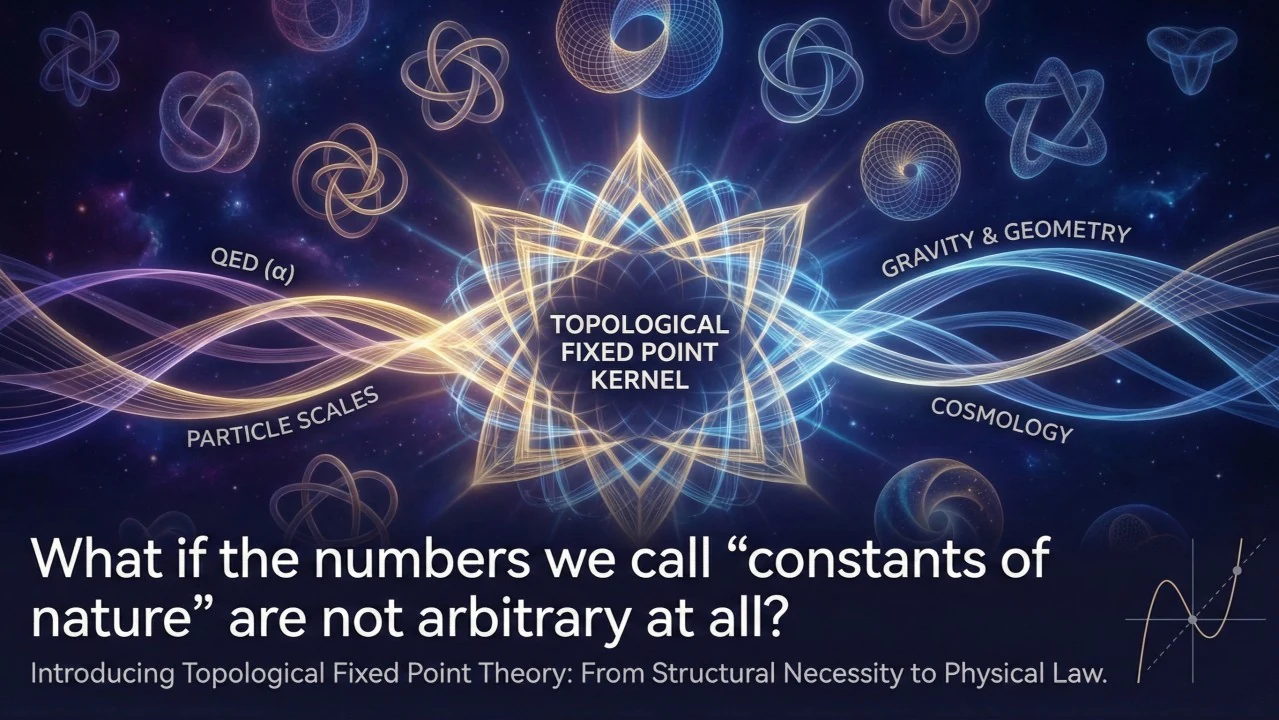
What if the numbers we call “constants of nature” are not arbitrary at all?
What if they are the unavoidable outcome of a deeper structural consistency, rather than historical accidents of measurement?
This question has been driving my work over the past year. Because if it turns out to be true, it would fundamentally change how we think about physical laws, about explanation versus observation, and ultimately about the limits of what can be derived rather than assumed.
1. Retrospective and context
In September 2025, I publicly shared the first outline of what I called Topological Fixed Point Theory. At that time, it was still driven by exploration rather than certainty. Certain numbers kept reappearing in experiments where they had no obvious reason to appear, and it was unclear whether this reflected structure or coincidence.
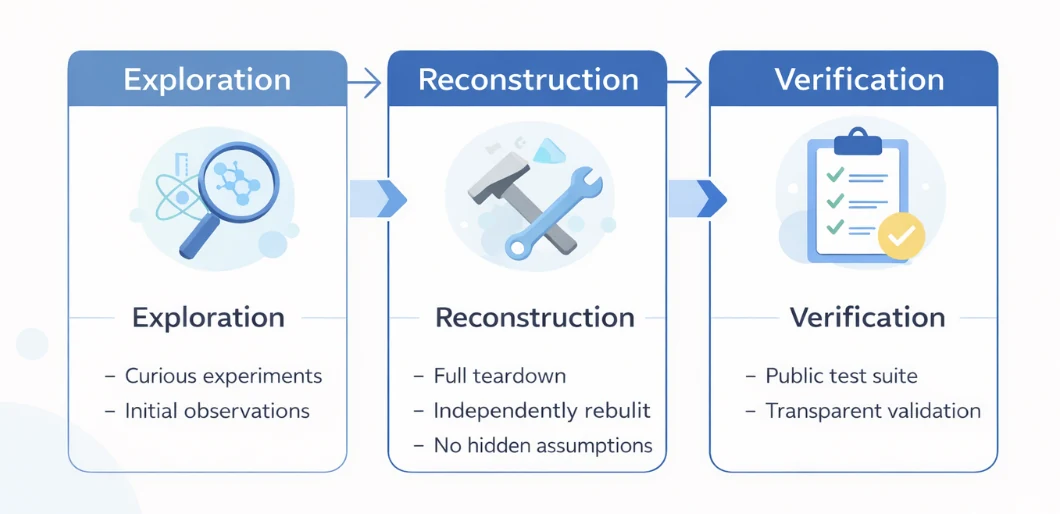
Since then, the focus has changed completely. Instead of pushing forward, I dismantled the entire framework and rebuilt it from first principles. Every claim was isolated, every assumption made explicit, and every result independently checked. Anything that relied on tuning, coincidence, or narrative shortcuts was removed.
What remains today is significantly more compact than the original vision, but also far more robust.
2. Current state of the theory
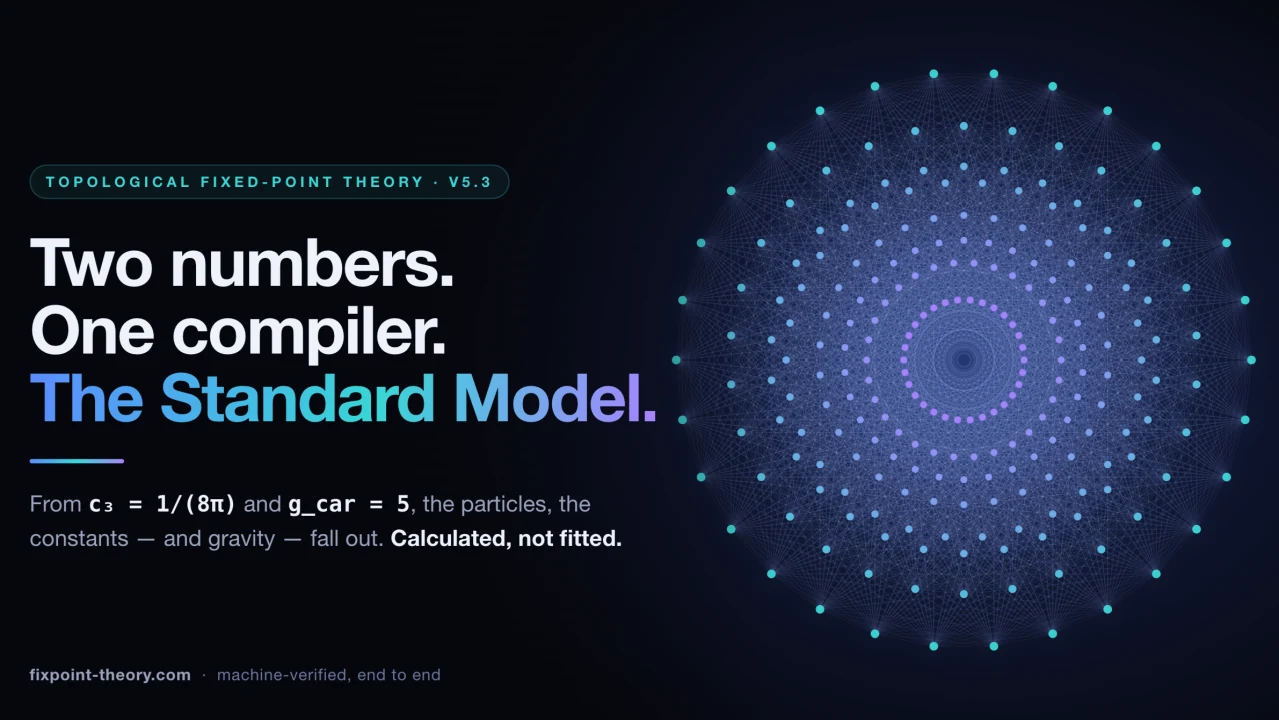
At its core, Topological Fixed Point Theory asks a simple but uncomfortable question: what if some of the fundamental constants of physics are not free parameters at all, but the only values for which the underlying structure closes consistently?
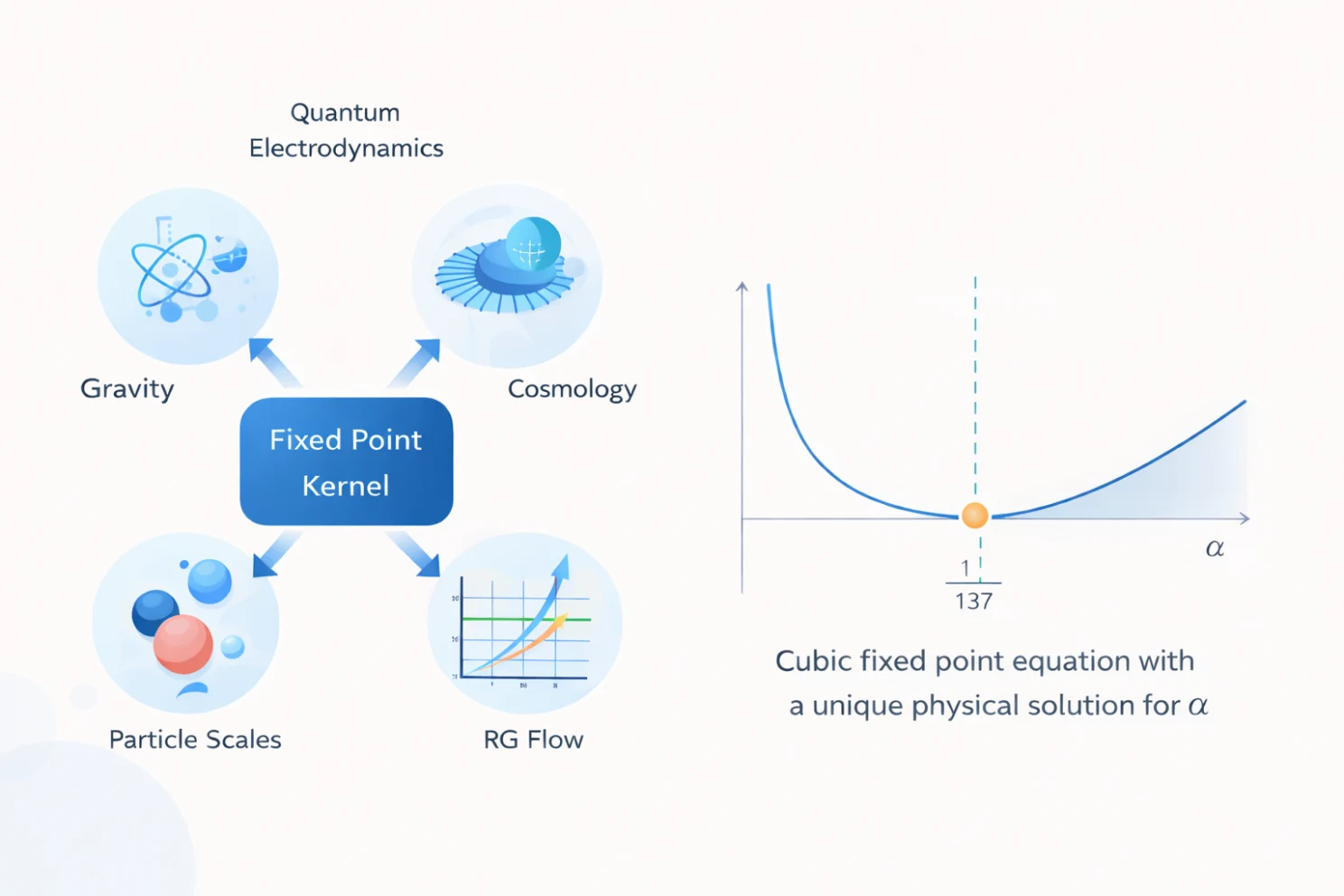
In its current form, TFPT is built on a small set of discrete topological and geometric invariants. From these follows a fixed consistency condition that admits exactly one physically meaningful solution. One of the consequences of that condition is the fine structure constant α.
The key point is not numerical precision, but rigidity. There is no hidden parameter that can be adjusted. Any change to the assumptions shifts the result immediately and visibly. This makes the framework unusually falsifiable.
Importantly, the theory does not stop at α. From the same structural core, TFPT already connects several areas of physics that are usually treated independently: quantum electrodynamics through the fixed point structure of α; geometry and gravity through a torsion based extension of Einstein gravity; cosmology through a concrete prediction for cosmic birefringence; particle physics through a discrete organization of energy scales including electroweak physics, hadronic scales, and axions; and renormalization group dynamics through characteristic two loop fingerprints at widely separated energy scales.
These are not stitched together models. They are different consequences of the same structural constraint.
3. Meaning and bridge to Field AI
If this framework holds, the implication is profound. Fundamental constants would no longer be arbitrary facts or outcomes of anthropic selection, but necessary solutions to a consistency problem. Not because the universe prefers them, but because alternative values do not work structurally.
This way of thinking extends beyond physics. At an abstract level, TFPT expresses a general principle: complex systems stabilize around fixed points that keep the whole system coherent, while everything else is unstable.
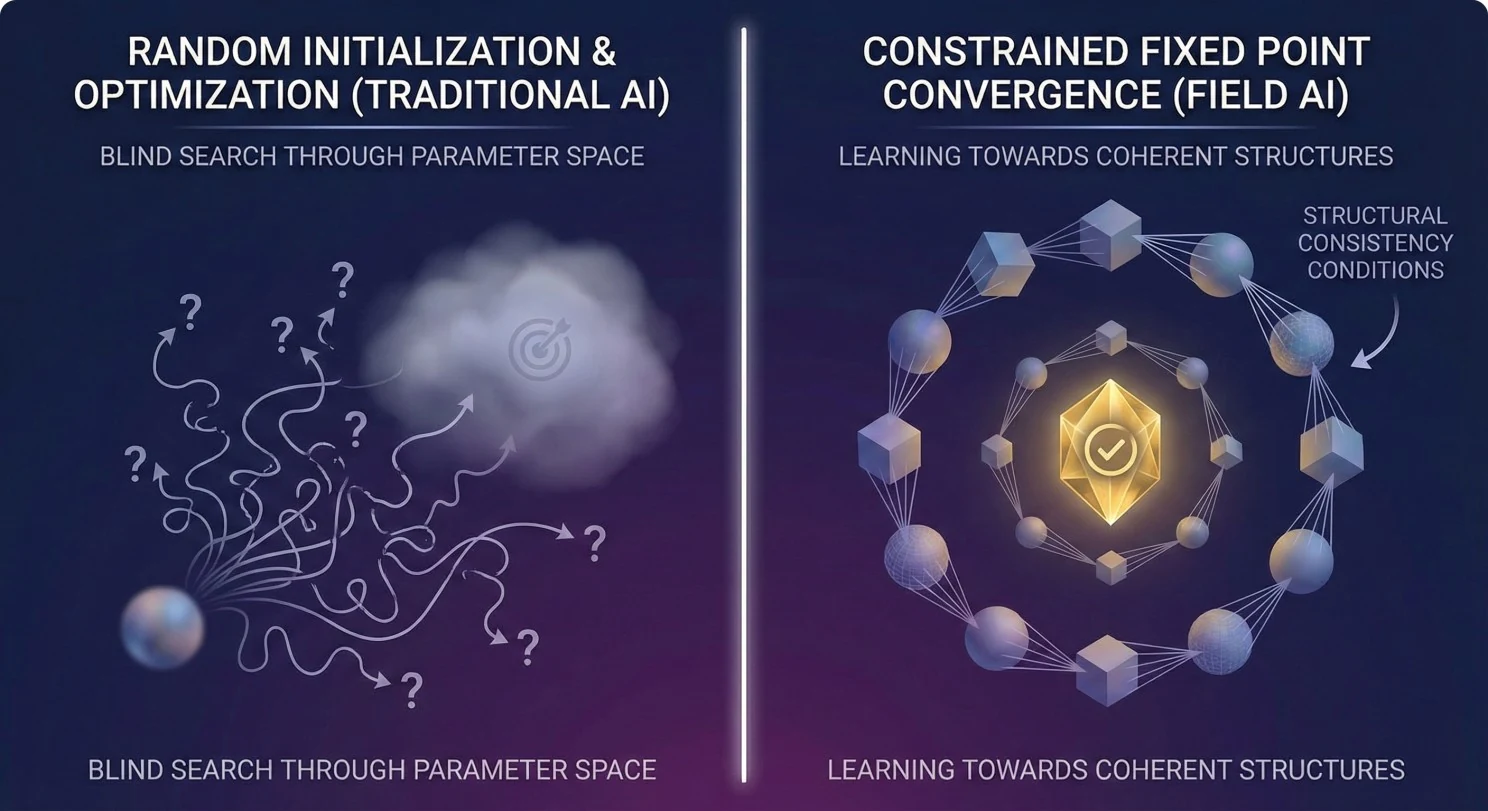
That same principle is what motivates my parallel work on a new AI architecture, internally referred to as Field AI. Instead of initializing models randomly and relying purely on optimization to discover structure, learning is constrained from the outset by self consistency conditions and stable attractors. Learning becomes a process of converging toward coherent structures rather than blindly searching parameter space. Early experiments suggest improvements in stability and efficiency, although this work is still clearly exploratory.
4. Openness and invitation
I am sharing this update not because the theory is finished, but because it is now precise enough to be challenged seriously. The full theory, including documentation, visual explanations, and a publicly accessible verification suite, is available here:
👉 https://fixpoint-theory.com/
All central claims can be reproduced step by step. Feedback, critique, and counterarguments are explicitly welcome. If there is a structural flaw, I want to know. And if the framework holds up, that is an even stronger reason to continue.
If this framework fails, it should fail visibly and without excuses.
But if it holds, it suggests something far more uncomfortable and far more interesting: that the universe is not a collection of arbitrary numbers, but a system that enforces its own consistency.
That idea does not stop at physics. It challenges how we think about explanation, about learning, and about intelligent systems. If nature stabilizes itself through fixed points, then perhaps intelligence, artificial or biological, should be built the same way.
This is why everything is public. Test it. Break it. Improve it.
#Physics #FundamentalConstants #TheoreticalPhysics #ScientificMethod #OpenScience #Verification #ComplexSystems #FixedPoints #FieldAI #SystemsThinking