The Rise of Open-Source AI · By Stefan Hamann · July 2026
For two years, "open-source AI" carried an implicit asterisk: good enough, if you can't afford the real thing. That asterisk is gone. In the first half of 2026, Chinese labs — Z.ai, DeepSeek, MiniMax, Moonshot, Alibaba — shipped open-weight models that trade blows with the closed frontier on the benchmarks that matter, under permissive licenses, at a fraction of the price. The question is no longer whether open models are competitive. It's what happens to software, to hardware, and to commerce when frontier-class intelligence becomes something you own rather than rent.
This article is a measured tour of that shift. I'll ground it in current benchmark data, spotlight the standout release, then show a firsthand experiment — a 753-billion-parameter model running entirely on four small boxes on my desk — and the coding agent I built to drive machines like it. Finally, I'll do the arithmetic on where this goes next.
For a decade the deal was simple: the best AI was something you rented by the token. In 2026 that deal quietly broke.
01 · The state of local AI
Open weights stopped being the budget alternative. In 2026 they became the default.
The cleanest single number is Artificial Analysis's Intelligence Index — a composite of nine evaluations of economically useful tasks. On the June 2026 edition, the leading open-weight model scores 51, versus 56 for the leading closed model. A five-point gap. Two years ago the gap was a chasm; today it's a rounding error you can close with a good harness.
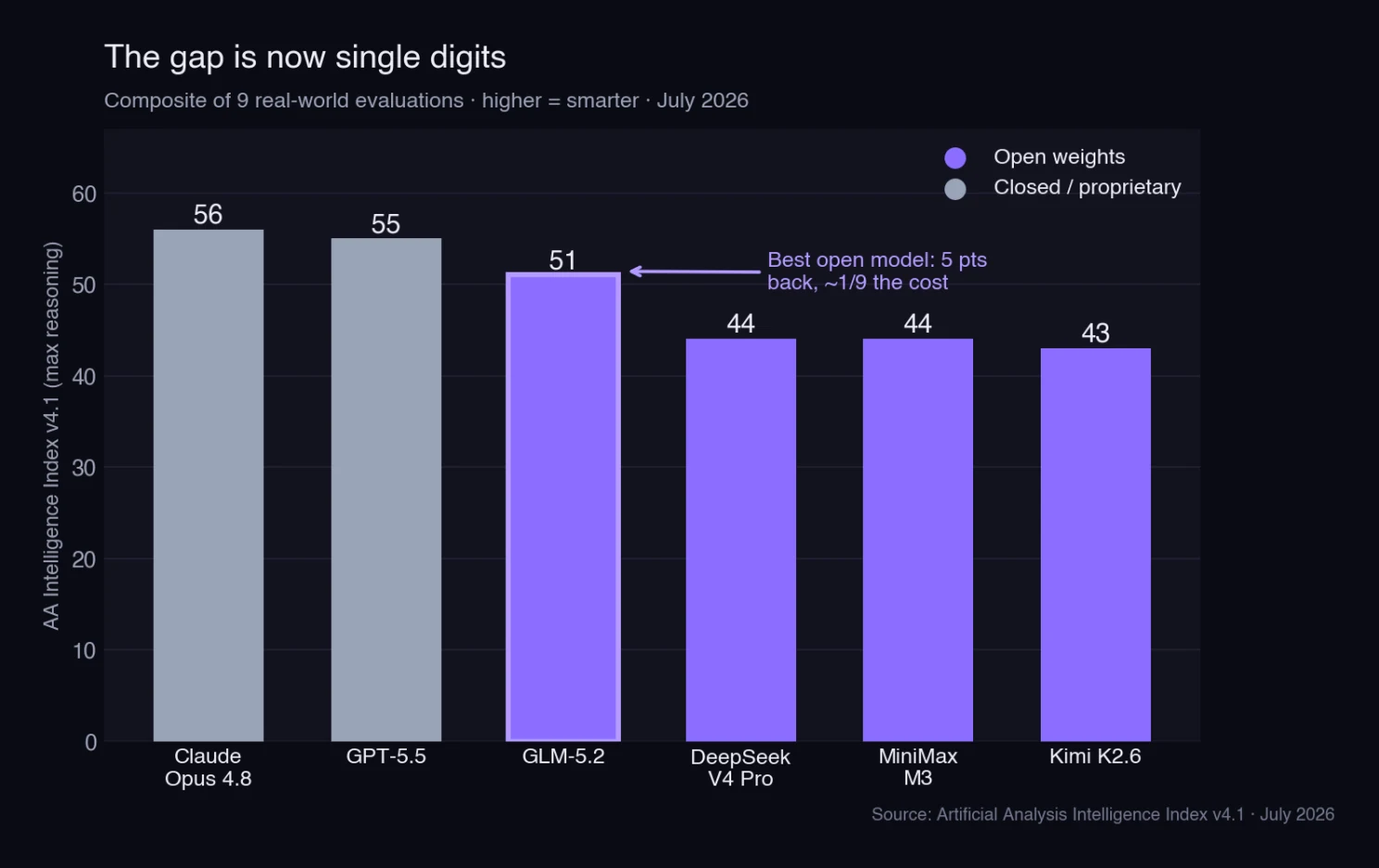
The field behind the leader is deep, and each model has carved out a lane:
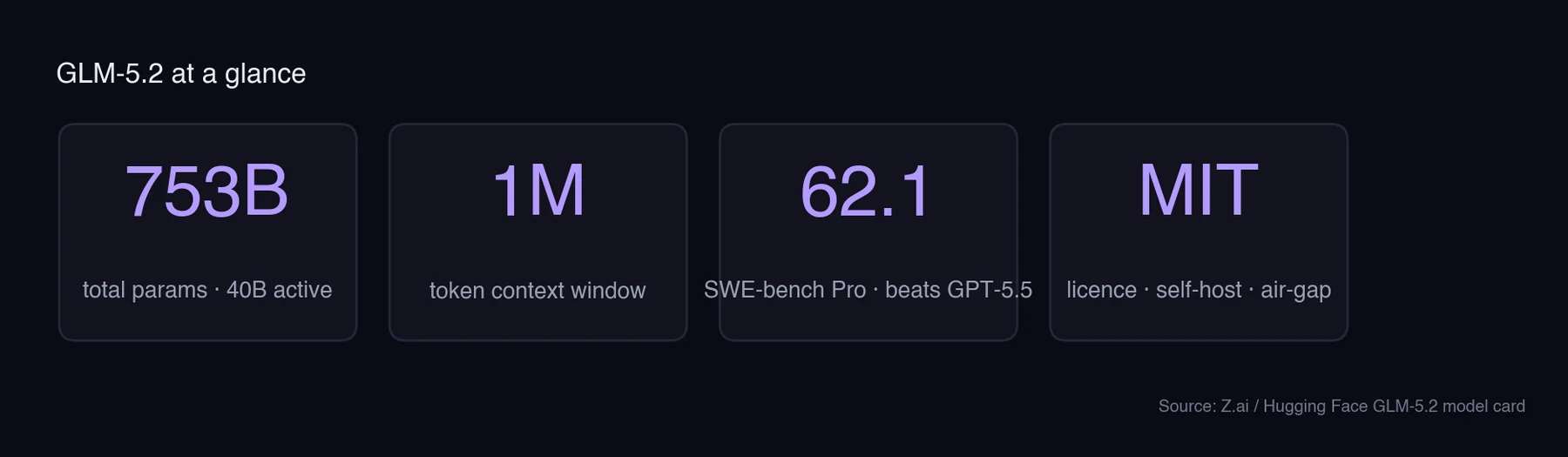
- GLM-5.2 (Z.ai) — the top open pick for long-horizon coding and agentic work. 753B total / 40B active, 1M-token context, MIT license.
- DeepSeek V4 Pro — the algorithmic-reasoning and cost-efficiency champion; a lightweight "Flash" variant (284B MoE, 13B active) targets a 128 GB MacBook.
- MiniMax M3 — cheap 1M-token context with native multimodality.
- Qwen 3.6 (35B-A3B) — the sweet spot for single-GPU self-hosting: MoE design, strong tool-calling and vision.
- Kimi K2.6 (Moonshot) — a strong generalist rounding out the open leaderboard.
Zoom into coding and agentic benchmarks — the workloads developers actually care about — and the "gap" gets even harder to see. GLM-5.2 beats GPT-5.5 on SWE-bench Pro (62.1 vs 58.6) and lands within 0.7 points of Claude Opus 4.8 on FrontierSWE (74.4 vs 75.1). It still trails on tool-heavy suites and structural mega-tasks like NL2Repo — a real, honest gap — but the days of "open models can't code" are over.
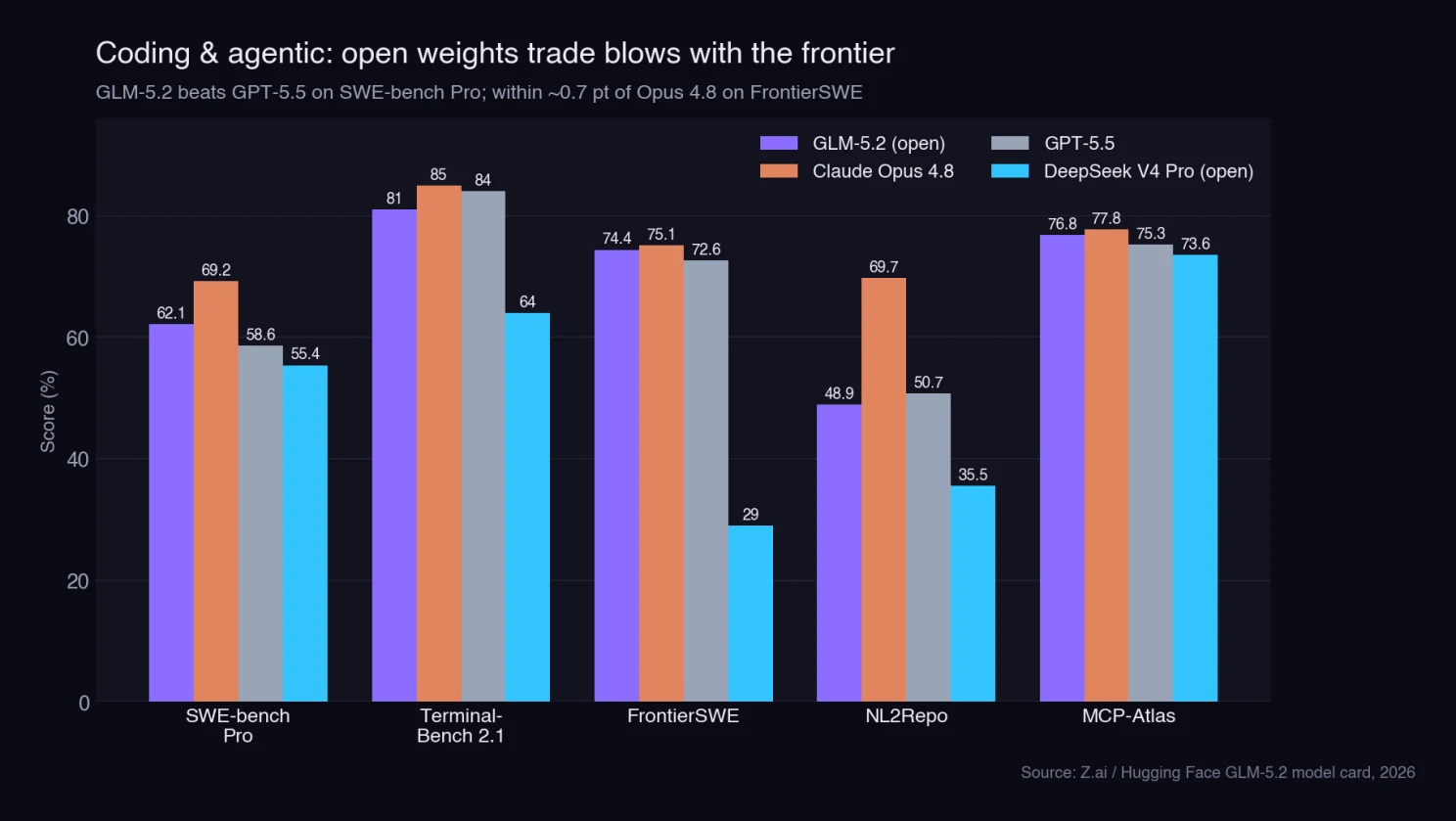
And here's the full scorecard as a single graphic — every headline benchmark, open vs. closed, best score per row highlighted:
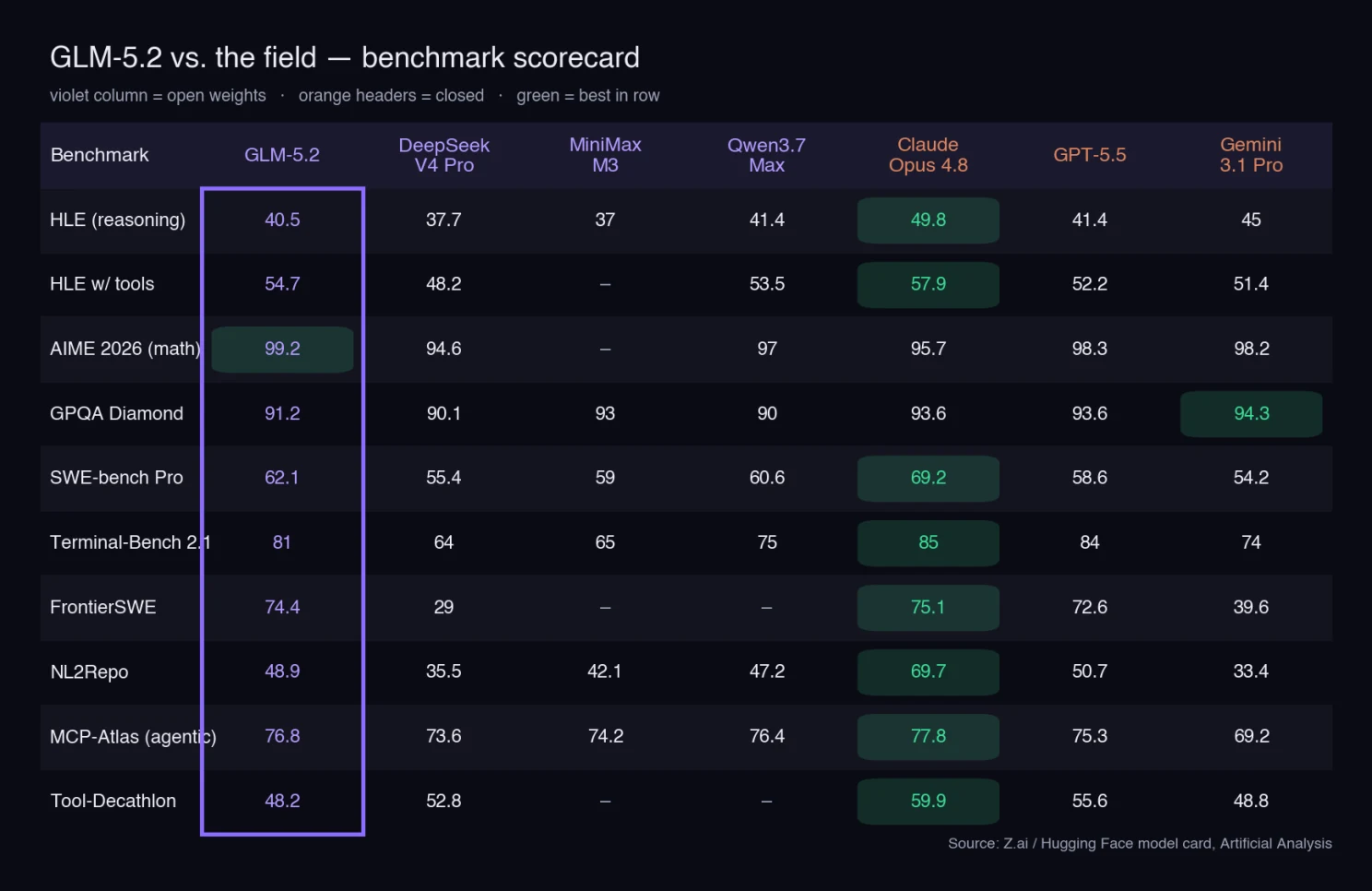
The frontier is no longer a closed club. It's a six-to-nine-month head start — and shrinking.
02 · Why GLM-5.2 stands out
One model turned "competitive open weights" from a slogan into a measurable claim.
GLM-5.2, released June 2026 by Z.ai (the international brand of Zhipu AI), is a Mixture-of-Experts transformer with 753B total and ~40B active parameters per token. Two architectural bets make it special. First, IndexShare reuses a single sparse-attention indexer across every four layers, cutting per-token attention compute by 2.9× at the full 1M context. Second, an upgraded Multi-Token Prediction layer boosts speculative-decoding acceptance by up to 20%, so it's fast when you serve it right.
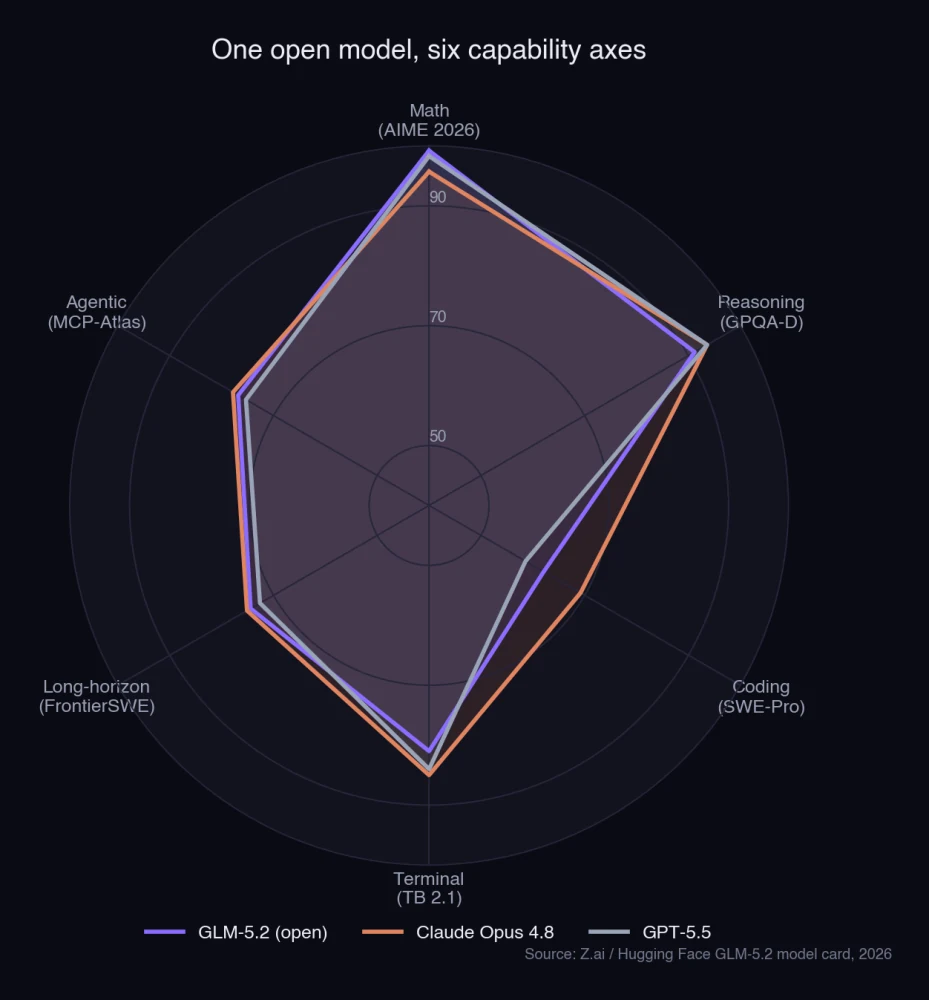
Across six capability axes, GLM-5.2's silhouette essentially overlaps the two proprietary flagships. It leads on math, sits fractionally behind on reasoning and agentic use, and only gives up meaningful ground on the hardest terminal and long-horizon coding tasks:
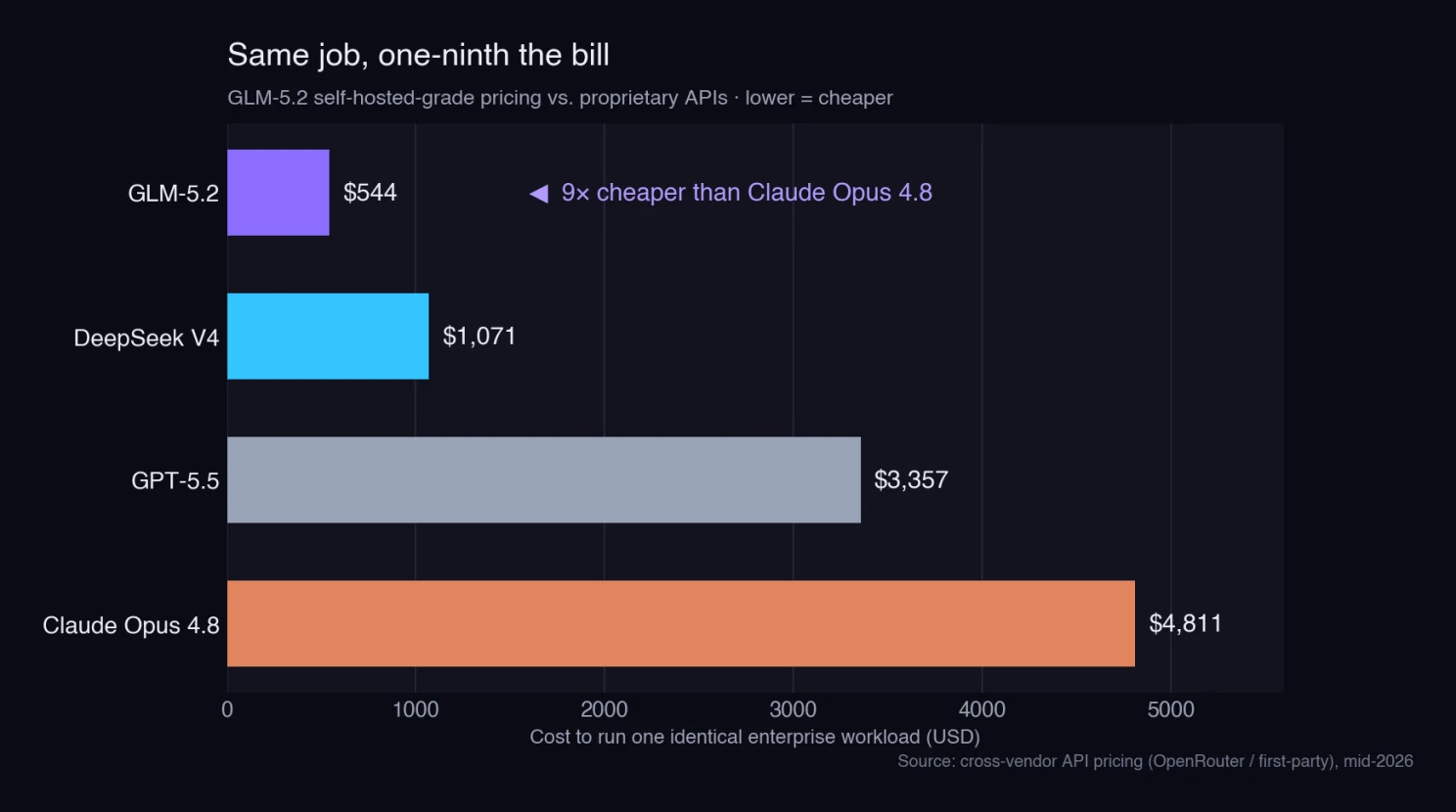
And then there's the number that reorganizes budgets. Priced at $1.40 / $4.40 per million input/output tokens — against roughly $5 / $25 for Opus 4.8 — the same identical enterprise workload costs about one-ninth as much. Multiply that across a team running agents all day and it stops being a line item and starts being a strategy.
The honest caveat. If you route prompts through Z.ai's hosted API, they travel through servers governed by China's National Intelligence Law. The whole point of open weights, though, is that you don't have to: MIT licensing means you can pull the weights and run them entirely on your own metal. Which is exactly what I did next.
03 · Experiment: GLM-5.2 (753B) on four DGX Spark
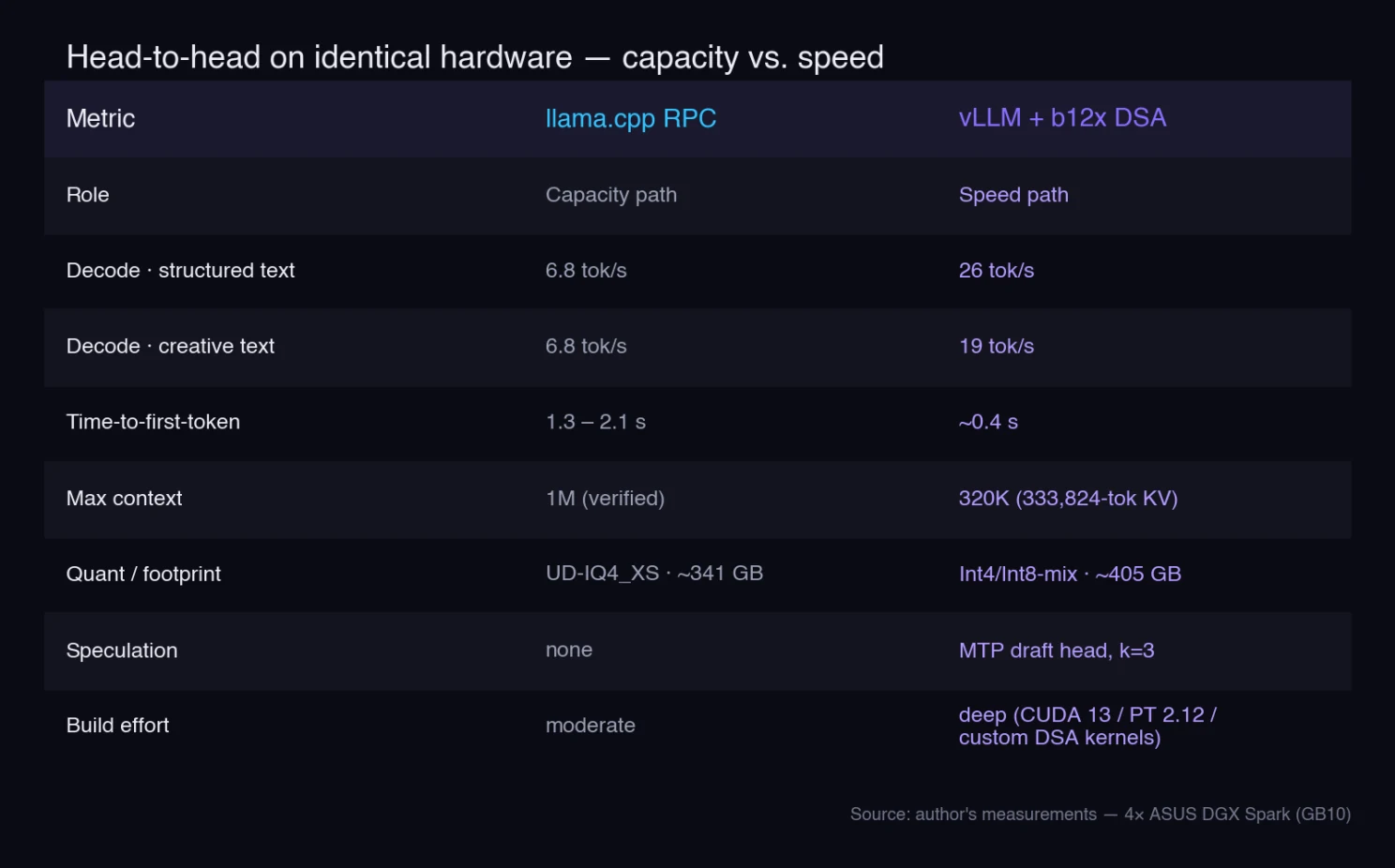
Two working stacks, measured head-to-head on identical hardware — capacity vs. speed.
To prove the point to myself, I ran GLM-5.2 entirely locally across four ASUS DGX Spark connected over a 200G RoCE fabric. This is the complete write-up: two working stacks, a firsthand head-to-head on identical hardware, and a reproducible build guide.
The hardware
Four ASUS DGX Spark form the cluster. Each carries an NVIDIA GB10 (Grace Blackwell, sm_121, aarch64) with 128 GB of coherent unified memory (LPDDR5X, ~273 GB/s, ~119 GB usable). This is the crux of everything: GPU and CPU share the same memory — weights, KV cache, and page cache all compete for the same bytes. The fast network is a MikroTik CRS812, 400G QSFP-DD broken out to 2× 200G QSFP56, MTU 9000; RoCEv2/RDMA over this fabric is the single biggest performance lever on this platform.
Stack 1 — llama.cpp RPC (the capacity path)
Serving runs on llama.cpp (CUDA 13, built for GB10 / sm_121a) with the RPC backend: one head (llama-server) plus three workers (ggml-rpc-server). The 78 layers are distributed as a pipeline across the four GPUs.
# Head node — serves GLM-5.2 across 3 RPC workers + local GPU
CUDA_VISIBLE_DEVICES=0 llama-server \
  --model GLM-5.2-UD-IQ4_XS-00001-of-00009.gguf \
  --alias zai-org/GLM-5.2 \
  --rpc 10.100.120.1:50052,10.100.120.2:50052,10.100.120.4:50052 \
  --ctx-size 524288 \       # 512K daily; 1M possible
  --n-gpu-layers 999 --host 0.0.0.0 --port 8080 --fit off \
  --no-mmap \               # CRITICAL to avoid unified-memory OOM
  --ubatch-size 2048 --cache-ram 0 \
  --cache-type-k q8_0 --cache-type-v q8_0 -fa auto \
  --chat-template-kwargs '{"enable_thinking":false}'

# Worker (per node), bound to its fabric IP
export LD_LIBRARY_PATH=/usr/local/cuda/lib64:$LD_LIBRARY_PATH
ggml-rpc-server --host 10.100.120.2 --port 50052
The bug that nearly sank it — head OOM. The first launch crashed ~9 minutes into loading with NVRM: Out of memory / Xid 31 (MMU Fault). Root cause: with an even split the head got its ~85 GB weight share plus the mmap page cache of the 341 GB file on top; on unified memory both compete for the same 120 GB. The fix: --no-mmap — llama.cpp then reads tensor-by-tensor straight into destination buffers. The head settled at ~86 GB and loaded cleanly.
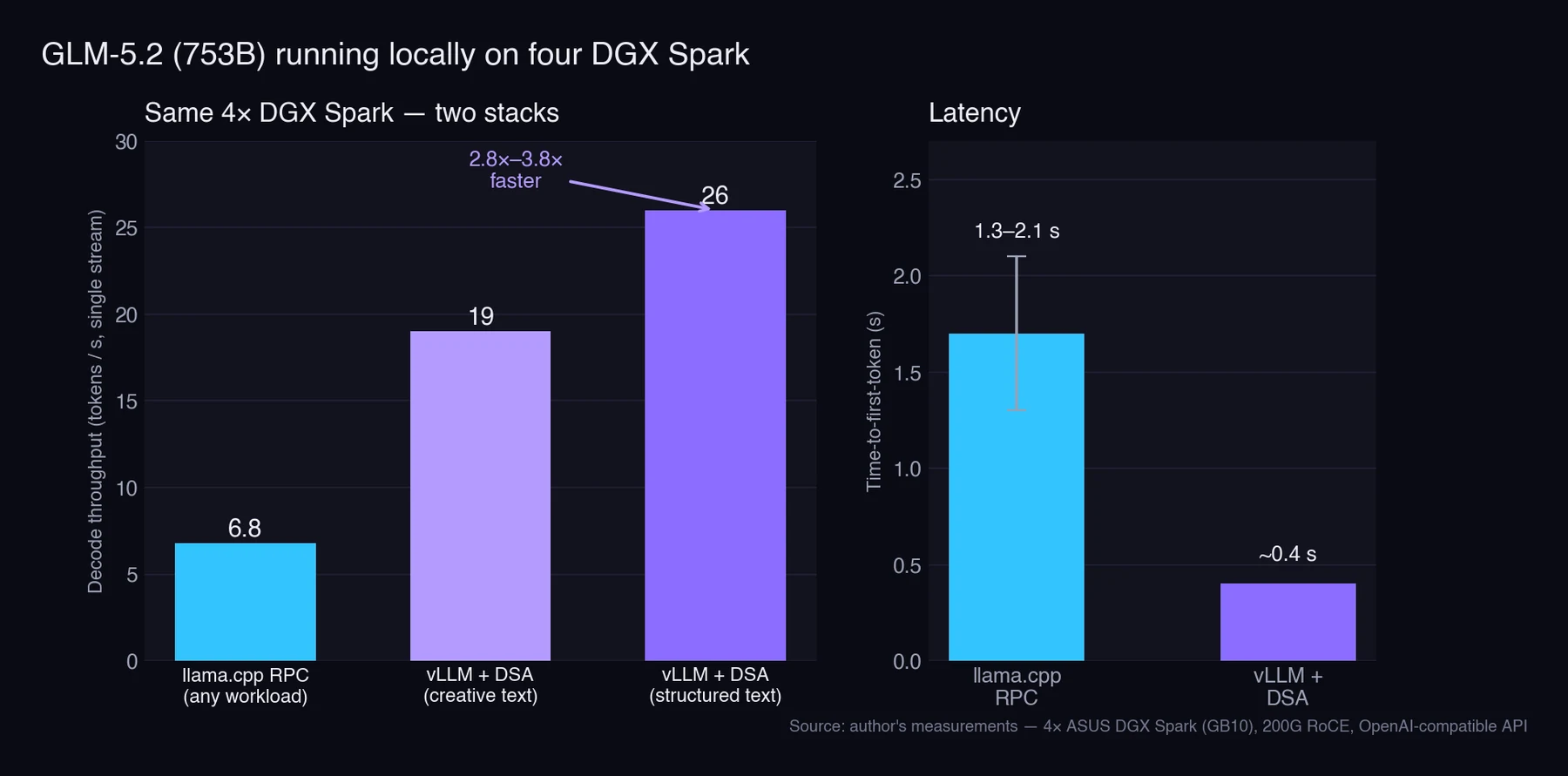
Single-stream decode is bandwidth-bound and llama.cpp RPC is a sequential pipeline (at batch 1 only one node computes while the others wait), so only parallel batching scales aggregate throughput. Sparse attention makes context nearly free: doubling 128K→256K cost the head a whole 1 GB. The verdict: llama.cpp RPC gets the model running with a giant context, but 20+ tok/s needs a runtime with real DSA kernels and working speculation. So I built it.
Stack 2 — vLLM + b12x DSA kernels (the speed path)
GLM-5.2 under a vLLM fork with real DeepSeek Sparse-Attention (sparse-MLA) decode kernels. This is the stack that finally worked:
- vLLM (GLM-5.2 DCP fork, local-inference-lab/vllm) on PyTorch 2.12.1 / CUDA 13, FlashInfer 0.6.14.
- b12x 0.23.0 sparse-MLA decode kernels (B12X_MLA_SPARSE), built on nvidia-cutlass-dsl 4.5.2 — CUDA-graph-capture-safe, which is what makes cudagraph_mode: FULL stable.
- TP4 + DCP2 — tensor-parallel across all four nodes, decode-context-parallel 2, fp8_ds_mla KV cache.
- MTP multi-token prediction (native draft head, k=3) — the speculation llama.cpp couldn't wire into the graph.
- Weights: QuantTrio Int4/Int8-mix (~405 GB), same 200G RoCE fabric, patched NCCL 2.30.4.
The lever is MTP: predictable text gets 3+ tokens accepted per verify step; high-entropy prose fewer, so creative output lands lower. A post-restart re-measurement returned 24.9 / 19.5 tok/s. And the full 320K context fits on unified memory: the engine reports a KV cache of 333,824 tokens — enough for the full max-model-len of 327,680. The ceiling is GB10's shared memory, not attention.
Three blockers worth documenting
- The TMA kernel wouldn't compile. b12x's sparse-MLA kernel died in CUTLASS tma_partition on sm_121 — a toolchain skew (b12x 0.23.0 needs torch ≥ 2.12, the harness pinned 2.11). Rebuilding on torch 2.12.1 + cutlass-dsl 4.5.2 fixed it.
- Distributed init hung. vLLM's ZMQ queue resolved the management-LAN IP instead of the fabric IP — cured by pinning VLLM_HOST_IP per node to its Rail-A address.
- The loader starved. gpu-memory-utilization competes with the weight loader's staging buffers. At 0.93 it wedged at 20%; 0.90 + max-num-batched-tokens 2048 loads cleanly and still fits the full 320K KV.
The head-to-head
Same four Sparks, same prompts, same day, each engine in its real production configuration (vLLM with MTP; llama.cpp without speculation). Decode is the inter-token rate with time-to-first-token excluded.
Reproduce it — condensed build guide
Assumes four GB10 nodes, passwordless SSH over the fabric, and ~405 GB of weights per node.
1. Wire & verify the RoCE fabric. The HCA carrying a rail is not identical across nodes (rocep1s0f1 vs roceP2p1s0f1). Map it per node, then confirm RDMA is engaged: ibv_devices ; show_gids | grep v2 (RoCEv2 GID index is typically 3).
2. Build the vLLM image. The one pin that matters: PyTorch 2.12.1 with cutlass-dsl 4.5.2; then install b12x as a thin overlay (pip install --no-deps b12x==0.23.0).
3. Fetch the weights and mirror to every node (QuantTrio Int4/Int8-mix), pushing across the 200G fabric so each node has a local copy at the same path.
4. Stage NCCL 2.30.4 on all nodes and LD_PRELOAD it — this avoids the known multi-node RoCE deadlocks on sm_121.
5. Launch TP4 + DCP2 + MTP:
docker run -d --name vllm_slot --cap-add IPC_LOCK --ulimit memlock=-1:-1 \
  --network host --ipc host --shm-size 10gb --gpus all \
  --device /dev/infiniband:/dev/infiniband \
  -v ~/.cache/huggingface:/cache/huggingface \
  -e LD_PRELOAD=/cache/huggingface/hub/nccl-2.30.4/libnccl.so.2 \
  -e NCCL_NET=IB -e NCCL_IB_GID_INDEX=3 -e NCCL_IB_HCA=$HCA \
  -e NCCL_SOCKET_IFNAME=$IF -e GLOO_SOCKET_IFNAME=$IF \
  -e VLLM_HOST_IP=$NODE_FABRIC_IP -e VLLM_USE_B12X_SPARSE_INDEXER=1 \
  -e TORCH_CUDA_ARCH_LIST=12.1a vllm-gb10-dcp:overlay212 \
  vllm serve /cache/huggingface/hub/glm52-quanttrio-unpruned \
    --served-model-name glm-5.2-quanttrio --host 0.0.0.0 --port 8210 \
    --trust-remote-code --reasoning-parser glm45 --tool-call-parser glm47 \
    --enable-auto-tool-choice --enable-prefix-caching \
    --speculative-config '{"method":"mtp","num_speculative_tokens":3,"draft_attention_backend":"B12X_MLA_SPARSE"}' \
    --tensor-parallel-size 4 --decode-context-parallel-size 2 \
    --attention-backend B12X_MLA_SPARSE --kv-cache-dtype fp8_ds_mla \
    --max-model-len 327680 --max-num-seqs 1 --max-num-batched-tokens 2048 \
    --gpu-memory-utilization 0.90 --async-scheduling \
    --compilation-config '{"cudagraph_mode":"FULL","max_cudagraph_capture_size":10}' \
    --nnodes 4 --node-rank $RANK --master-addr $HEAD --master-port 29501 ${HEADLESS:+--headless}
The API is ready in ~9 minutes; check curl http://localhost:8210/v1/models. Gotchas: keep gpu-memory-utilization at 0.90 (higher starves the loader), always docker rm -f orphaned containers before relaunch, and use pkill -x (not -f, which matches your own SSH session).
Quality check: five test questions (knowledge, logic, coding, language, physics) all answered correctly. GLM-5.2's quality at these quantizations is fine for everyday coding — the limiting factor is speed, not correctness.
Watching a 753-billion-parameter model answer in under half a second — on four boxes I could carry in a backpack — was the moment the cloud stopped feeling inevitable.— Stefan Hamann
04 · The project: Nyx — a local-first coding agent
Feels like Cursor. Runs entirely on your hardware. Costs nothing per token.
Open models caught up. Local hardware is ready. So what's still missing? The frontend. Every excellent AI coding extension — Cline, Roo Code, Continue.dev, Twinny — treats local models as one provider entry in a dropdown. They're designed around cloud frontier models; pointing them at a local server means hand-crafted Modelfiles, brittle tool calling, and agents that derail the moment a model gets the JSON slightly wrong.

Nyx inverts that: local inference is the product, not the fallback. A coding agent in its own editor sidebar that looks and behaves like a native agent panel — file-edit diff cards, checkpoints, approvals, @-mentions, semantic search, MCP tools, a job queue, project memory — but every request goes to your machines. No account, no cloud, no telemetry, no per-token bill.
- Built for your own hardware fleet. A first-class machine manager for multiple LAN endpoints — a DGX cluster, a Mac Studio, a llama.cpp box — with per-host model discovery, capability probing, and automatic failover to another machine serving the same model.
- Engineered for imperfect local models. Tool calls are recovered from whatever the model emits (OpenAI tool_calls, raw/fenced JSON, function-style text, DeepSeek DSML); arguments get JSON repair; edit_file matches whitespace-tolerantly; the prompt prefix stays byte-stable so the server's KV cache keeps working.
- Cursor-grade UX, fully offline. Checkpoints with Edit & rerun, approval cards that show the diff before applying, semantic codebase search over a local embedding index, an MCP client — plus a privacy report that lists every host the session contacted.
- Grind mode — fix until green. /grind npm test enters a fix-until-green loop, re-running the command after every agent turn until it passes. Let your own hardware grind overnight — no per-token bill.
Point Nyx's machine manager at the vLLM endpoint from the experiment above and you have a Cursor-grade agent driving a 753B model that never leaves your network. → github.com/sthamann/nyx-local-ai
05 · The forecast — with the math
When does open source match today's flagship? And when does that capability fit in a laptop?
Two questions, two calculations — extrapolations, not prophecies.
Part A — Capability catch-up
The anchor points are hard data. Today (July 2026): the best open model scores 51 on the AA Intelligence Index; the best closed flagship scores 56. And the time-lag is precise: Claude Opus 4.5 shipped Nov 24, 2025; GLM-5.2 reached parity-class on June 16, 2026 — a gap of 204 days ≈ 6.8 months, squarely inside the widely-cited 6–9-month open↔closed lag. The closed frontier climbs the index at ~+9–10 points/year; the open frontier tracks it ~7 months behind. Project both forward and the open line crosses 56 — today's flagship level — around Q1 2027.
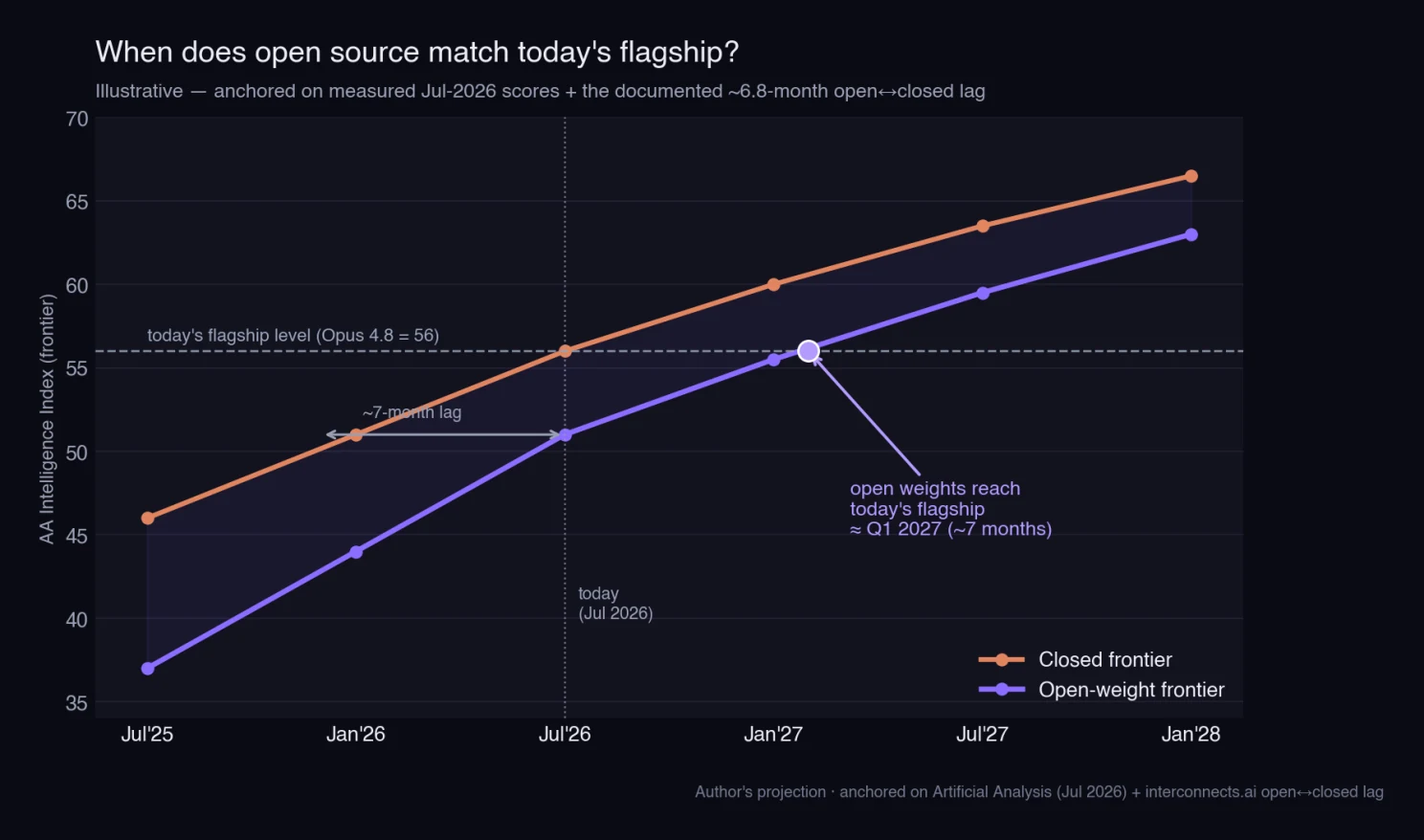
The more interesting second-order effect: the lag itself is compressing. DeepSeek-R1 trailed by roughly a year in early 2025; GLM-5.2 trails by under seven months now. If that continues, true parity plausibly lands in the 2028–2029 window — with the caveat that compute access and export policy could stall it.
Part B — Hardware shrink (the one you feel)
"As powerful as today's flagship" is only half the promise. The other half is on hardware you can afford. Today, GLM-5.2-class capability needs ~350 GB — four DGX Spark or a 512 GB Mac Studio (~$10–16k). Two forces drive the footprint down: algorithmic efficiency (params for a fixed capability roughly halving every ~8 months, accelerated by MoE sparsity and IndexShare) and quantization + hardware density. Combine them into a footprint half-life of ~9 months:
F(t) = 350 GB × 2^(−t / 0.75) (t in years from mid-2026)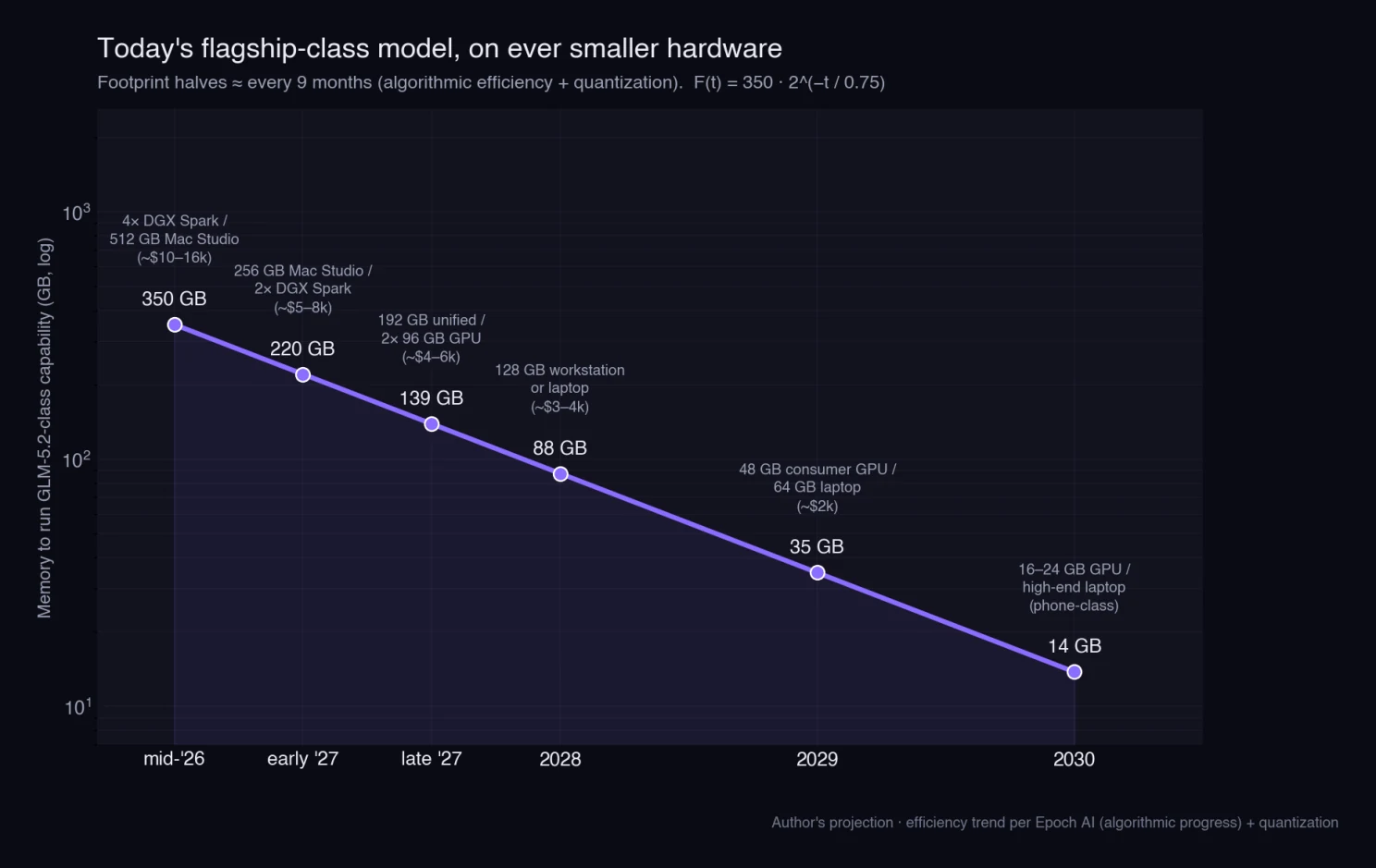
The milestone most developers will feel: late 2027, when today's flagship-class capability fits in a single 128 GB workstation or high-end laptop (~$3–4k) — an appliance, not a cluster. By 2029 it's a $2k gaming laptop; by 2030 it's your phone. And the cost curve rhymes: Epoch AI finds the price to reach a fixed benchmark has fallen a median ~50× per year (as fast as 200× since 2024).
06 · What it means — for software & agentic commerce
When frontier-class inference is free at the margin and private by default, the incentives change.
For software development
- Iteration becomes free. When a token costs electricity, not dollars, brute force flips: fix-until-green loops, overnight batch queues, agent swarms exploring N approaches — all stop being budget decisions.
- Privacy stops being a trade-off. MIT-licensed weights on your own metal mean proprietary code, regulated data, and air-gapped environments finally get a real agent. For finance, health, and defense this is the unlock.
- The model commoditizes; the harness differentiates. If everyone can run a 51-on-the-index model, the edge moves to who wraps it best — tool-call recovery, context management, evals, domain fine-tunes, UX.
- Hybrid becomes the norm. Local models handle the 80% of daily coding; the cloud frontier stays for the hardest 20%. The winning setup routes between them.
For agentic commerce
The same forces reshape how software buys and sells. 2026 is the year the rails standardized: Anthropic's MCP for data connectivity, OpenAI + Stripe's ACP for delegated checkout, Google's UCP for the full discovery-to-post-purchase lifecycle, and AP2/A2A for agent-to-agent settlement — coordinated under a Linux Foundation "Agentic AI Foundation." But protocols are only half the story: they matter only if merchants actually adopt them. That's the gap the Agentic Commerce Alliance exists to close and bring retailers, platforms, and payment providers together to turn these standards into real, transactable storefronts and supporting the merchants to learn on how to adapt strategies, tooling and differentiation.
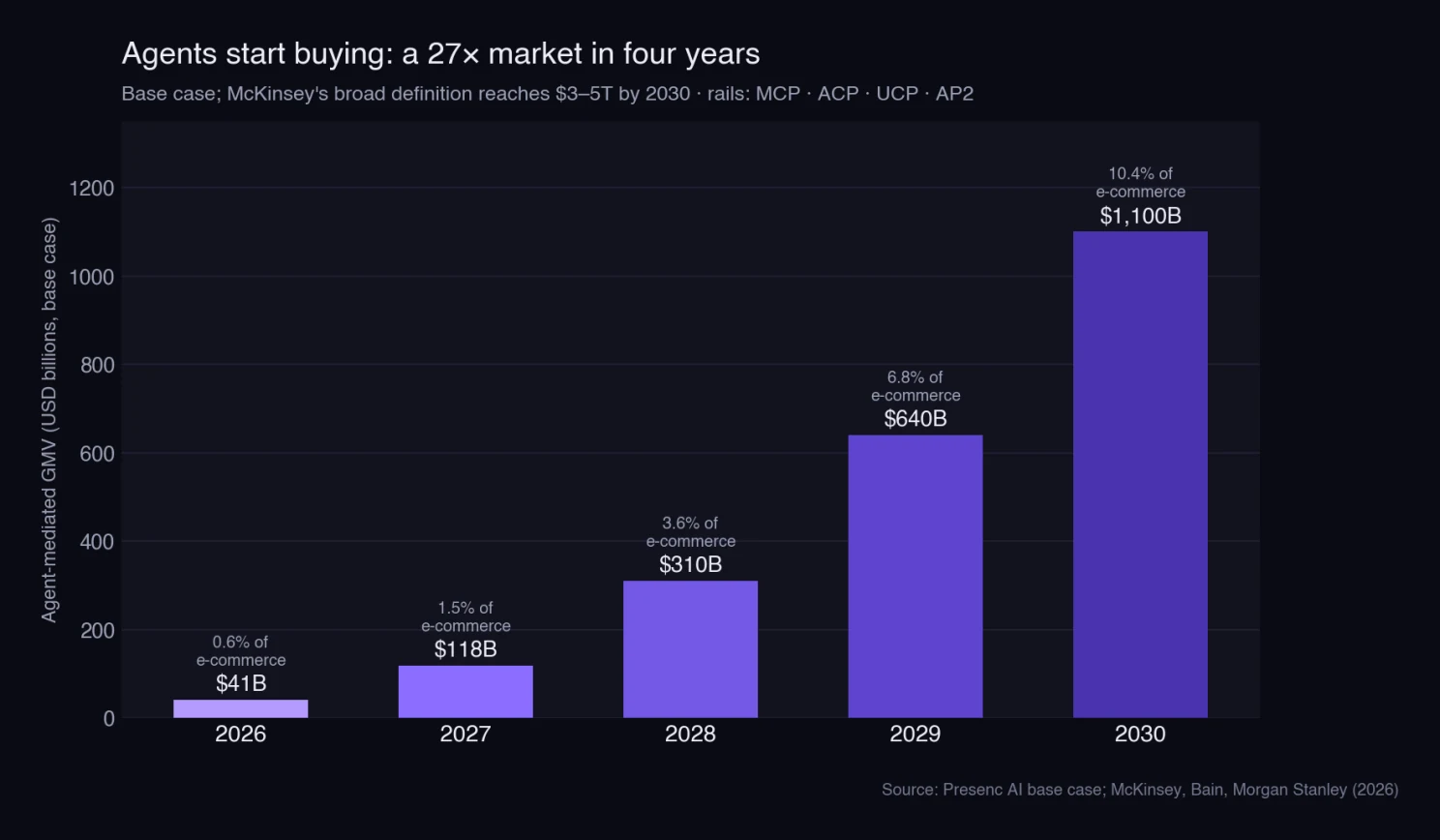
Cheap, private, open-weight inference is the missing economic ingredient that makes this real at scale:
- Always-on agents become affordable. "Procurement as a service running continuously in the background" only pencils out when inference is near-free.
- Merchants can own their commerce agent. Retailers running high-volume automated transactions have every reason not to pay a per-token tax on each one — and to keep pricing, inventory, and customer data in-house.
- Machine-readable or invisible. If your catalog and policies aren't machine-readable via MCP/ACP/UCP, agents — and by extension shoppers — won't find you. Commerce platforms (Shopware and peers) exposing these endpoints are wiring themselves into the agent economy.
- Agent-to-agent by default. The endgame is personal agents negotiating with a merchant's specialized agents over shared protocols. A local agent like Nyx — already an MCP client — is exactly that substrate.
Whats next
2026 is the year the asterisk fell off. Open-weight models reached the doorstep of the frontier, at a ninth of the cost, under licenses that let you run them anywhere — including four small boxes on a desk. The capability will match today's flagships within a year and collapse onto consumer hardware within three. The strategic consequence is simple: the center of gravity of AI is moving to hardware you own.
The frontier will always be for rent. The real question is how much of it you can own — and that share grows every quarter.
#OpenSourceAI #LocalAI #GLM52 #DGXSpark #vLLM #llamacpp #AgenticCommerce #Nyx #MCP #AIEngineering
Sources. Benchmarks: Z.ai / Hugging Face GLM-5.2 model card; Artificial Analysis Intelligence Index v4.1. Cost: cross-vendor API pricing, mid-2026. Efficiency & cost-decline: Epoch AI; arXiv "Tiered Super-Moore's Law"; interconnects.ai. Agentic commerce: McKinsey, Presenc AI, Bain, Morgan Stanley. DGX Spark experiment: firsthand measurements on four ASUS DGX Spark (GB10). Forecasts in §5 are the author's extrapolations.