🛫 Prologue – One Prototype, Two Hundret Coffees Later
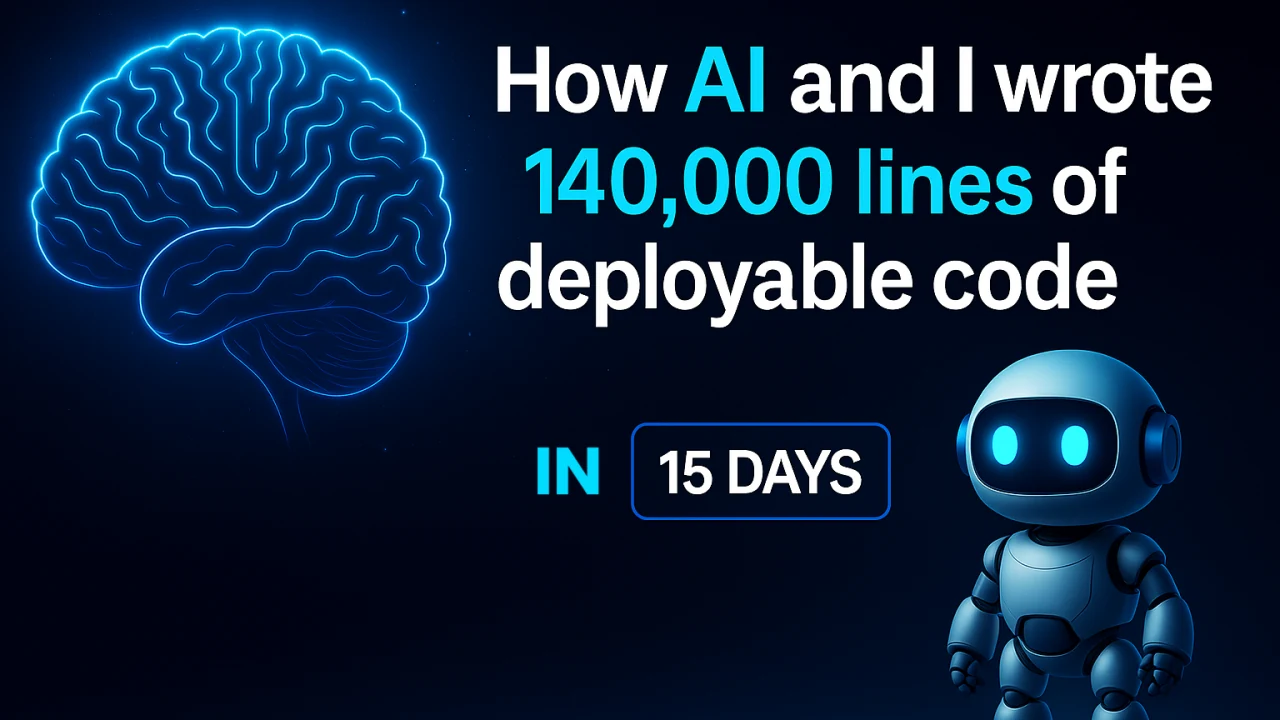
Back in March I published an experiment: 140 000 lines of properly-tested code written in 15 days with an LLM “pair-programmer”.(2) How AI-Powered “Vibe Coding” Helped Me Write 140,000+ Lines of deployable Code—And What It Means for Engineering
I closed the post and thought, “Time for a breather.” The universe disagreed.
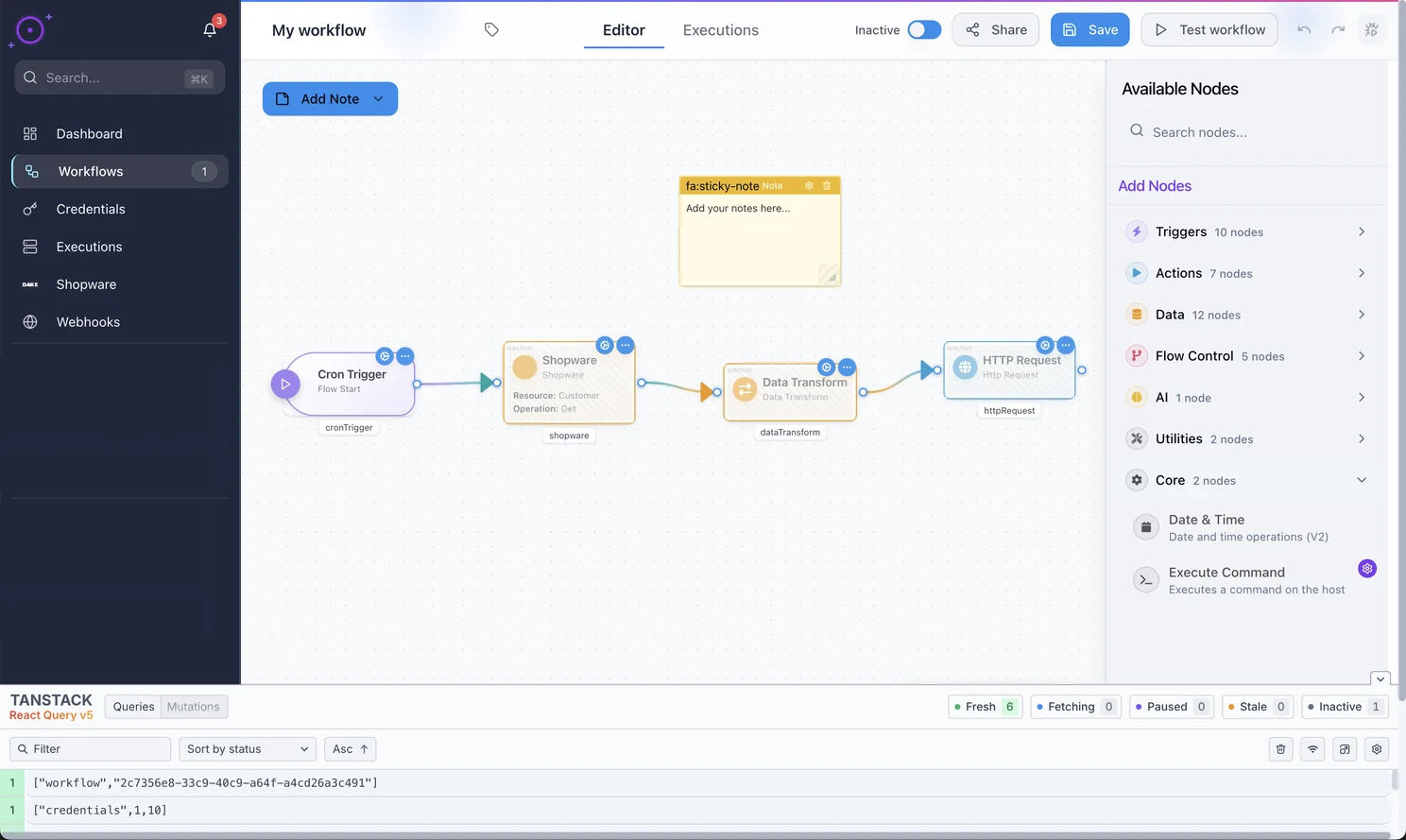
Since then the “little experiment” has stealth-leveled into a 200 k-LOC beast running happily in a live sandbox—no epic rewrites, no out-of-memory dramas, no spooky segfaults. The bot kept shipping, I kept curating, and the backlog kept melting.
New since the last episode
The extra 60 K lines slipped in so smoothly it felt like slotting a new cartridge into my old C-64—one clean click, no drama & a lot of progress on the different edges of the prototype:
- Execution Engine 2.0 - Benchmark shows 4x throughput vs. V1
- Webhook Framework - Inbound,Outbound,Retries, Dead-Letter queue
- Shopware Integration Layer - CRUD
- Telemetry & Time-Travel Debugger - Full event stream & replay
- Dynamic expression runner - Sandbox JS inside nodes
- 35 production-grade nodes (From S3 upload to Json sorcery)
🧭 Field Notes at 200 K LOC – What I Learned Since the Last Post 💡
Context windows finally swallow everything 🐳
I fed Gemini 2.5 Pro the entire repo, all ADRs, and half a Jira sprint in one prompt. It shipped a PR plus tests—no “see attachment (2/17)” breadcrumbs. Take-away: the fatter the context, the slimmer the code review.
Docs have become a living feedback loop 🔄
Each new module spawns its own README + ADR + mini-diagram, because the LLM will ask for them next session. Side-effect: humans read the docs again—forced by a bot that quotes them word-for-word in code review.
Testing first—but inverted 🧪
I start with plain-English acceptance criteria (“If Workflow X runs, Event Y must arrive in < 120 ms”). The model converts that into unit + integration tests. I only polish the edge-cases. Result: clearer quality bars, fewer midnight regressions.
Human oversight shifts to strategy 🧭
I used to spend 80 % of my week lint-brushing pull requests. Now that energy goes into why we’re building a feature—market fit, differentiation, margin. The AI handles the how. Biggest realisation: AI-first frees headspace.
Vibe: fewer glue chores, more “aha” moments 🚀
Repetitive work shrinks; idea volume spikes.
Bottom line: 200 K lines may sound like a jungle; in practice it feels like a well-kept code garden. The AI trims the hedges—so we can design the landscape. 🌳🤖
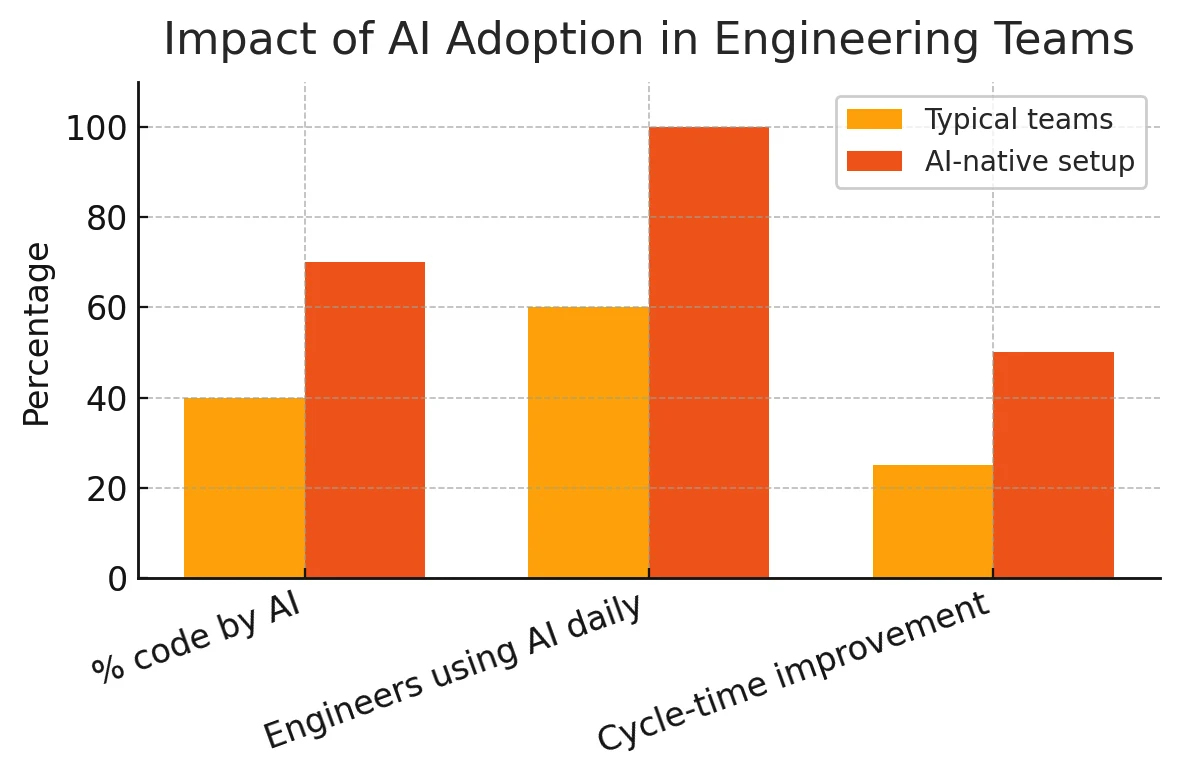
📊 Where the Automation Needle Sits (mid-2025)
Think of this table as an altimeter for AI adoption.
The “Typical team” column comes from public benchmarks:
- ~40 % of new code in Copilot-enabled files is already suggested by the AI
- 61.8 % of professional devs report using an AI tool every day, another 13.8 % are onboarding soon
- GitHub’s enterprise study shows Copilot can make tasks up to 55 % faster, so a mid-range 20-30 % cycle-time gain is realistic for conventional orgs
The point isn’t bragging rights; it’s to show how much headroom is still on the table for teams that move from “let’s try Copilot” to AI-first engineering discipline.
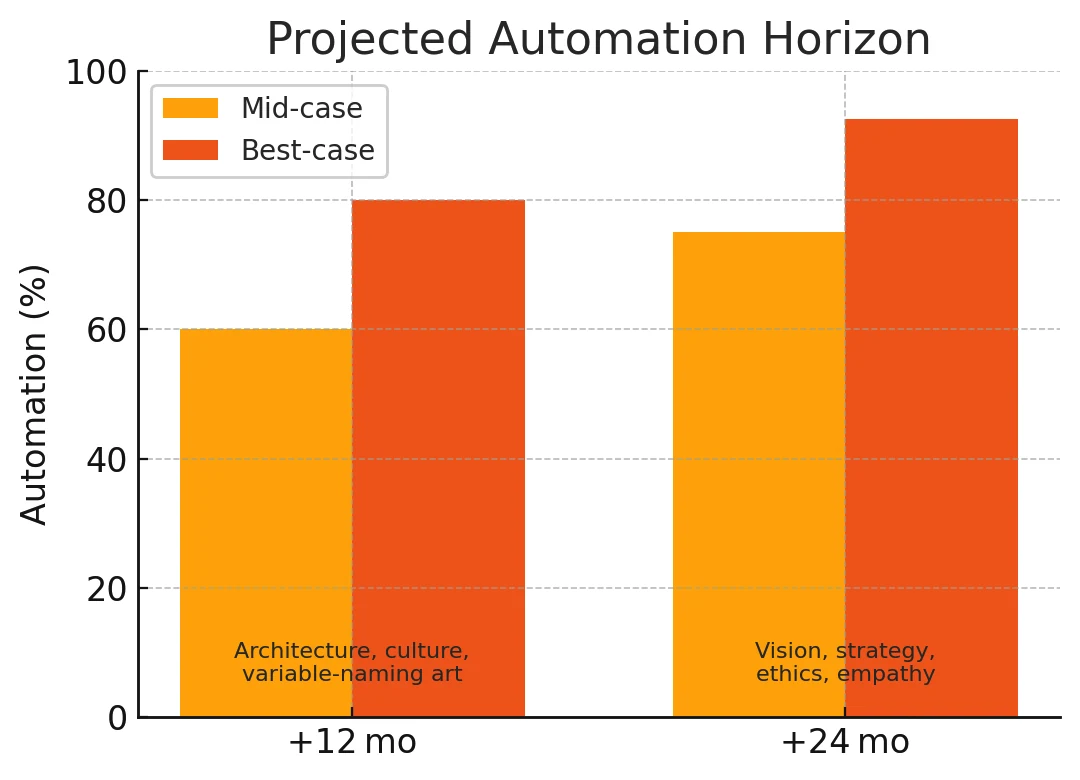
🔮 Peering 24 Months Ahead
Now we twist the telescope. Using current adoption curves plus tooling roadmaps, the second table projects how far automation can push by mid-2027: mid-case if progress just keeps its pace, best-case if the rapid-fire breakthroughs continue. The last column reminds us what stays human—creativity, strategy, empathy—so leaders can plan where to invest skills while the actual code part gets increasingly outsourced to silicon.
🛠️ Inside my Cursor AI Toolchain
“Use the right brain for the right problem.”
- Design hour – Gemini ingests the latest ADRs + diagrams, proposes architecture.
- Implementation cycles – Claude Sonnet iterates inside Cursor, writing the nuts & bolts.
- Guard-rails – A policy agent checks for secrets, licence headers, and test coverage before the PR can leave draft mode.
- Humans – Approve, rewrite comments for humour consistency, merge.
Subtle, repeatable, and way faster then everything I experienced before
💰 TCO & Time-to-Market — What AI Unlocks for eCommerce
- Cap-ex-heavy integrations that once ate six-figure budgets
- Feature lead times measured in months
- Dreaded big-bang migrations every major release
- SaaS sameness where every checkout looks alike
- “Can we afford it?” gatekeeping on experiments
Bottom line: when infrastructure writes (soon) itself, engineers shift from plumbing to play.
Expect:
- Integration kits on tap—warehouse robots today, quantum payments tomorrow (or at least next week 😉)
- Brand-signature storefronts—voice carts, spatial galleries, whatever sparks joy.
- Weekly A/B/Z tests—because rollback is as cheap as pushing forward.
The winners won’t be merchants who can customise, but ones who never stop customising.
📖 Tuesday, 13 April 2027 — A Boardroom-First Narrative for eCommerce Leaders
- 07 : 00 — Dashboards with your espresso
Overnight AI agents deliver a one-pager: conversion +0.8 pp, returns –0.3 pp, gross margin + €42 k. You skim, forward to the CFO, and walk into the day already calibrated.
Insight: KPIs beat you to the office.
- 08 : 15 — Morning stand-up, idea to spec
The CMO floats a “surf-season bundle” campaign. You ask, “Feasible by Friday?” An agent eavesdrops, drafts scope, effort (< €5 k), and risk map before the meeting ends.
Insight: Ideation now costs as little as a slide deck.
- 10 : 00 — Partnership at warp speed
A trending BNPL provider wants in. Tech lead runs the “payment-adapter template”; by 14 : 00 a certified plugin is live in staging, PCI clauses auto-checked.
Insight: Alliances sign at lunch, not quarter-end.
- 12 : 30 — Lunch-ping optimisation
Phone buzzes: split-test B is beating control by 12 %. You tap “auto-rollout.” The system back-propagates the winning flow to all locales before dessert.
Insight: Capturing upside is a swipe, not a sprint.
- 15 : 00 — Self-healing ops
Warehouse-robot API latency spikes. An agent throttles offers, reroutes orders to a 3PL, and files a trace-rich ticket—no war-room call, no customer tweets.
Insight: Crises defuse themselves; reputation stays intact.
- 17 : 45 — Strategy, finally
With zero plumbing work on your calendar, you and the CTO debate next-quarter “wow” features—AR fitting rooms and carbon-smart shipping. The agent reserves 20 % capacity and drafts ROI models overnight.
Insight: Time reclaimed becomes strategic oxygen.
Bottom line: AI agents now compress the loop from idea ➜ impact to mere hours, letting leadership steer direction instead of shovelling coal.
Tomorrow’s competitive edge? How many of these micro-decisions you can make—and un-make—before your rivals finish their first status call.
🙋🏻 Call to Adventure
I’ll keep flooring the throttle until the API flashes “429—cool your jets.”
Until that day, here are a few warp-in tips if you want to taste the same momentum:
- Start with one giant context-dump prompt. Feed the model everything—docs, schemas, even meeting notes. More context = fewer hallucinations.
- Write docs for Future-You first. README-driven development turns your LLM into a consistency cop and spares you déjà-vu debugging.
- Guard-rails early, not later. Secrets scanning, test-coverage gates, licence checks—bake them into the first commit so the bot never learns bad habits.
- Let the AI draft the tests. You keep the edge-cases; it handles the boilerplate. Confidence climbs, release friction drops.
- Ship tiny, ship daily. Short loops keep the model—and your stakeholders—in sync with reality.
Want the full future perspective? Grab my Agentic Commerce whitepaper and see how autonomous tooling reshapes the entire retail stack.
Now, back to nudging limits—if the platform lets me. Stay sharp, keep shipping. 🚀
— Stefan 🧑🚀🛒
#shopware #ecommerce #agenticcommerce #ai #ml #automation #b2b