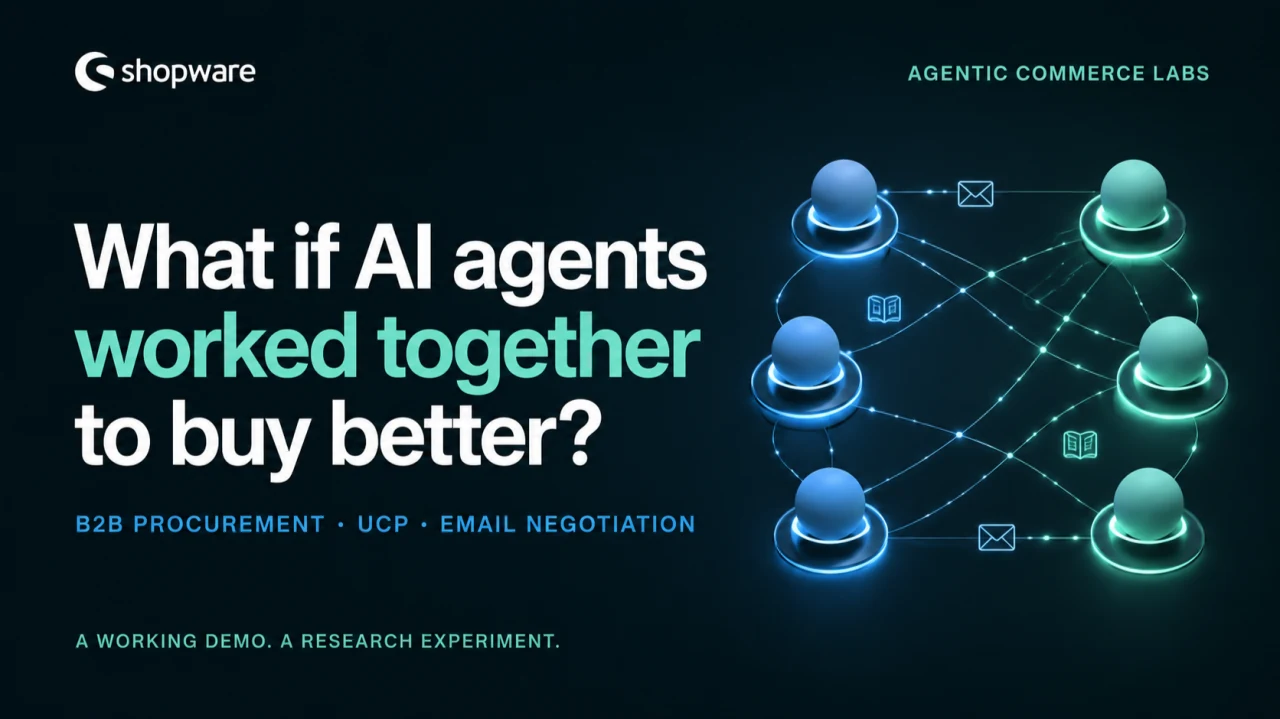
An experiment from the Agentic Commerce Labs: Procurement Swarm brings together Shopware, UCP and autonomous email negotiations in a fully working demo environment.
We asked ourselves a question: How could a swarm of AI agents help with B2B procurement?
Consider a straightforward assignment: equip 30 new workstations. Monitors, docking stations, keyboards, mice and accessories. There is a budget, a delivery deadline and a list of products. The task is to find a good overall deal.
Even this relatively small purchase involves several connected decisions. One supplier has the cheapest monitor. Another offers better terms on accessories. A volume discount only becomes available above a certain order value. Extra shipping can erase a price advantage. And an attractive offer is of little use if it arrives too late.
We wanted to explore the work between those decisions: gathering information, comparing conditions, asking follow-up questions and bringing the results together. That became the starting point for Procurement Swarm.
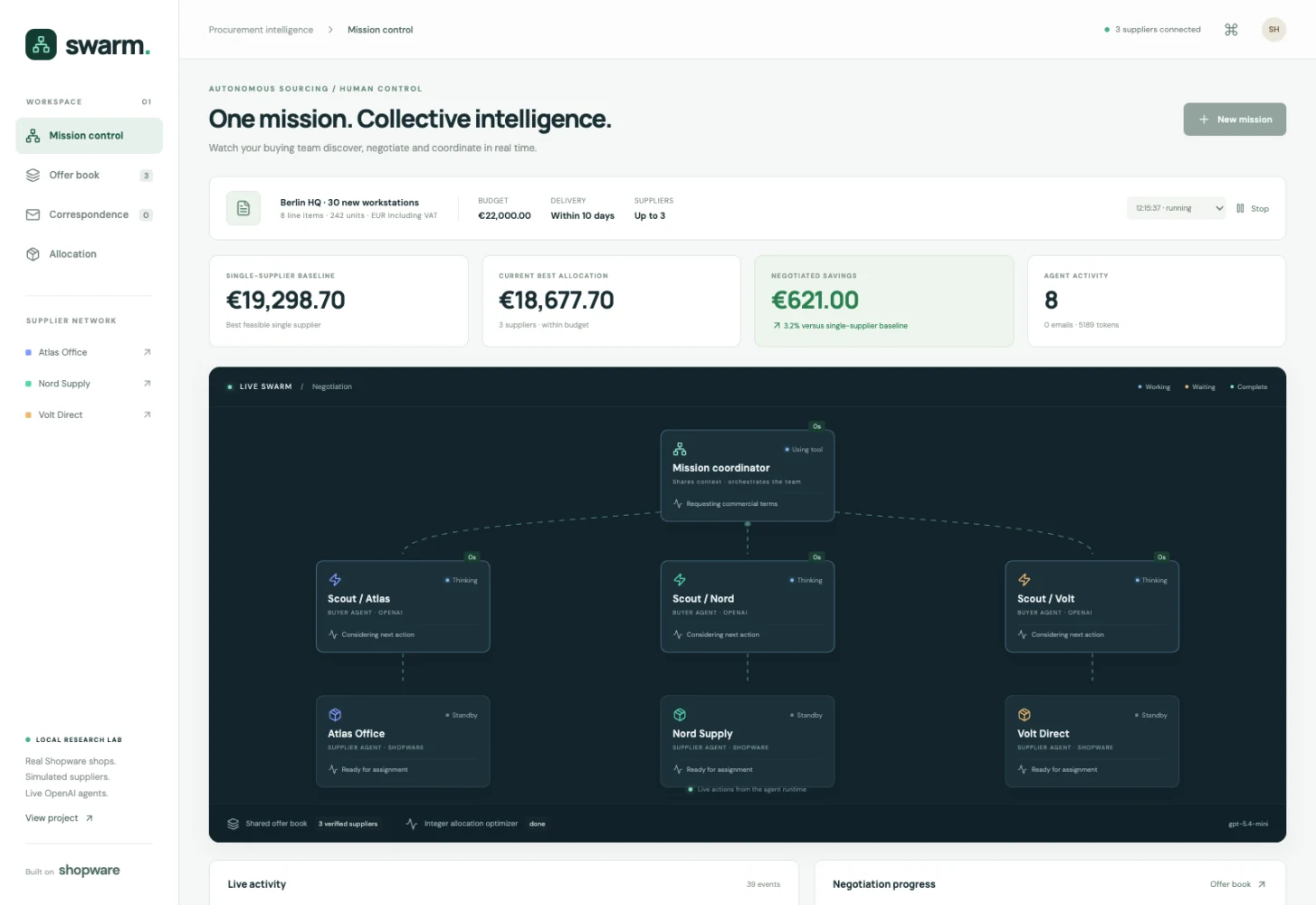
One purchasing brief puts several agents to work. This capture shows an early stage of the negotiation; the figures change as the run progresses.
A shared objective, several negotiations
For the experiment, we built three independent Shopware shops running in Docker. Atlas Office, Nord Supply and Volt Direct are simulated suppliers with different prices, delivery times and discount rules. Their catalogs and the resulting orders live in actual local Shopware instances.
Six OpenAI agents work across this environment: three on the buyer side and three on the supplier side. The buyer agents retrieve product information, request commercial terms and negotiate. The supplier agents respond within their configured limits.
The swarm idea comes from their shared context. Buyer agents publish the offers they receive. Information discovered by one can inform the others in the next negotiation round. They work toward a result for the entire purchasing brief.
A mathematical optimizer then calculates the best feasible allocation within the received offers and the rules of the model. It accounts for quantities, stock, delivery deadlines, shipping and discount thresholds. Language models handle the correspondence; the calculation of the purchasing plan remains inspectable.
Two routes to a supplier: UCP and email
One part of the experiment explores how agents can access commerce systems through structured interfaces. We use the Universal Commerce Protocol, or UCP, to discover the capabilities exposed by the demo suppliers and retrieve catalog information through our UCP integration. The underlying product data comes from Shopware. The official specification defines discovery and standardized catalog operations. (UCP Catalog REST)
We also wanted to explore another route: an agent writes an email, asks for better terms, waits for a response and continues the negotiation.
The agents compose these messages during the run. A local SMTP server actually delivers them, and an AI agent on the supplier side replies. All correspondence stays inside the demo environment. No real external suppliers are contacted.
The distinction matters: in this experiment, UCP handles discovery and catalog access. Commercial negotiation by email is a separate workflow. Carts and orders are subsequently created through Shopware’s interfaces.
This combination raises an interesting question for us: How could agents work across both standardized interfaces and the communication channels that people already use?
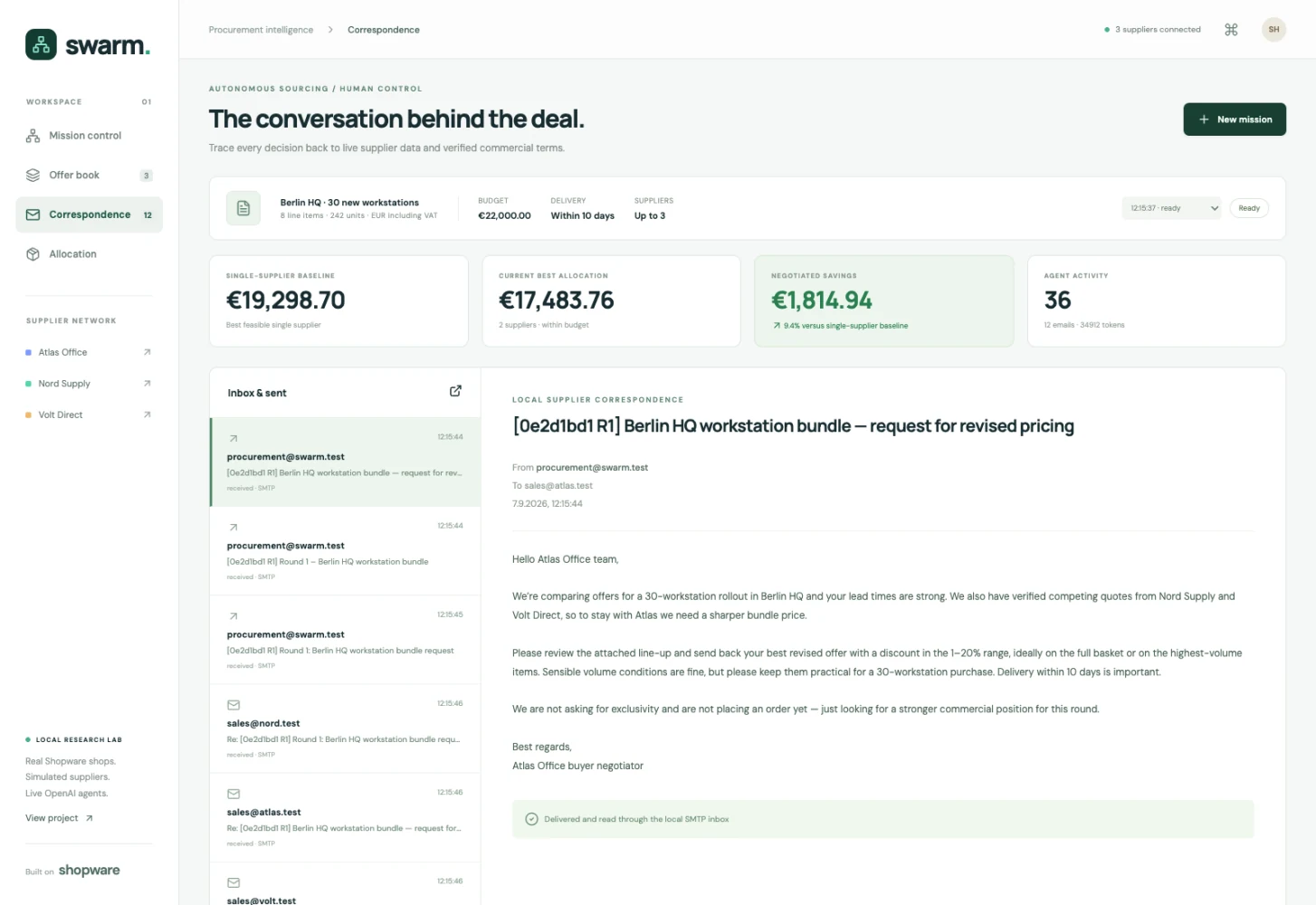
The negotiation can be followed in the inbox. Messages and replies travel through local SMTP. The figures in this capture reflect the offer before Shopware’s final rounding.
Autonomy needs a clear interface
When you watch this process, you want to know what is happening. Which agent is working? What action is it taking? What is it waiting for? Has the supplier replied?
That is why the visual interface is central to the demo. It shows active agents, tool calls, waiting states and interactions with suppliers. Alongside it, you can inspect the correspondence, the shared offer book and the proposed allocation.
The interface exposes actions, status updates and results. It turns an abstract idea about agents into a process that people can examine, question and improve.
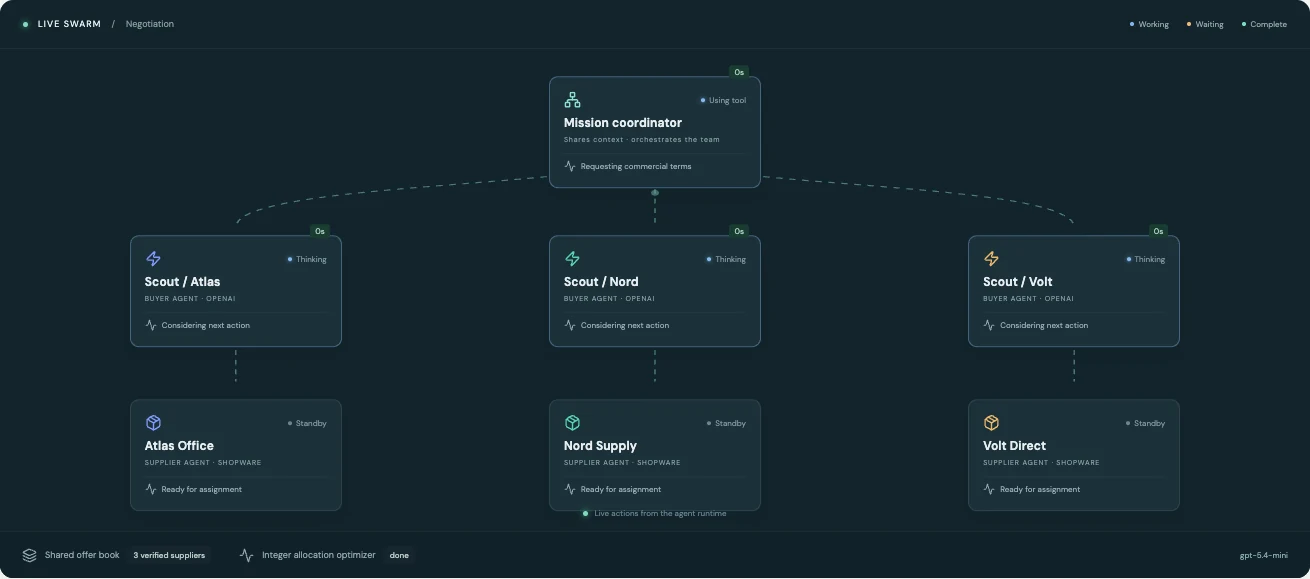
The graph makes the division of work visible. Activity states and waiting reasons come from the running orchestration.
What the test actually demonstrated
In one verified run, the demo purchased 242 units across eight line items. The agents exchanged twelve emails over two negotiation rounds. Before negotiation, the cheapest feasible purchase from a single supplier was €19,298.70.
The selected allocation across two suppliers came to €17,483.86 after Shopware’s calculation, including VAT and shipping. That is €1,814.84, or 9.4%, less in this test case. The comparison includes the effects of both splitting the purchase and negotiating the terms.
After human approval, the plan became two local Shopware test orders. The demo therefore carries the process from a purchasing brief through to an order result that can be checked in the commerce system.
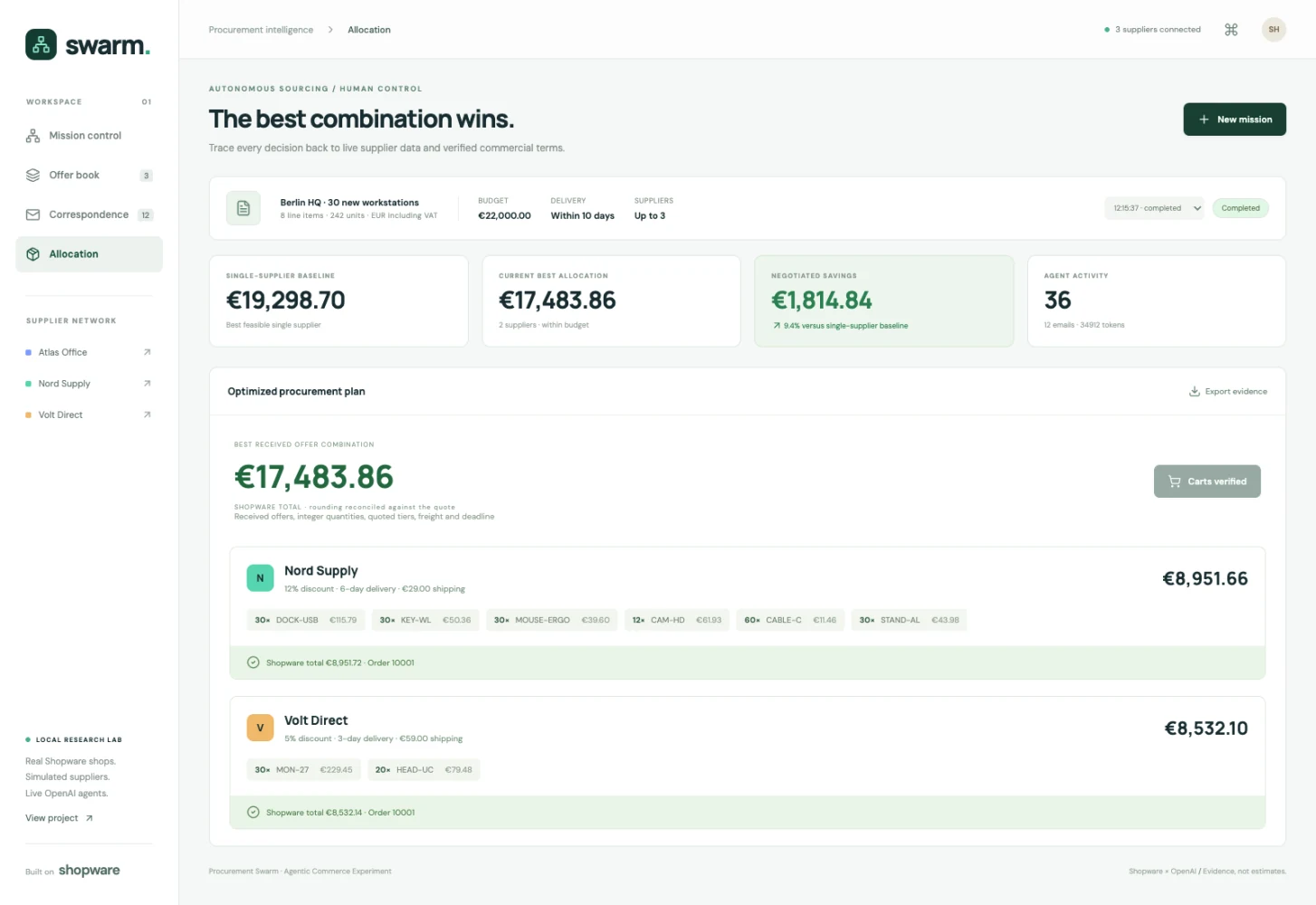
The verified outcome: two local test orders. Shopware’s calculated total is authoritative; the small rounding differences from the offer calculation are shown in the interface.
Watch the demo
The 85-second film starts with our research question and shows the working environment, the two supplier channels and the path to approved test orders.
Procurement Swarm — an Agentic Commerce Labs research experiment. Actual demo captures with AI-generated English narration.
The questions this opens up
The 9.4% result comes from our configured test conditions. Real suppliers, their willingness to negotiate and an open procurement market were outside the scope of this experiment.
Procurement Swarm is an Agentic Commerce Labs experiment, not a finished Shopware product. The demo environment works end to end within its stated scope. It gives us something concrete to test and a way to assess together where further development would be valuable.
I am particularly interested in how this approach holds up under more complex requirements: substitute products, framework agreements, quality criteria, changing availability and negotiations that take longer. There is also a question for procurement teams: which decisions would they want to delegate, and where would they want to step in?
The potential of AI in B2B becomes easier to discuss when we build these workflows and examine their results openly. That is what the Agentic Commerce Labs are for.
What procurement scenario would you give this team of agents next?