Not everything I do is AI, commerce and Copilots.
Sometimes, I fall down physics rabbit holes. This one’s particularly deep.
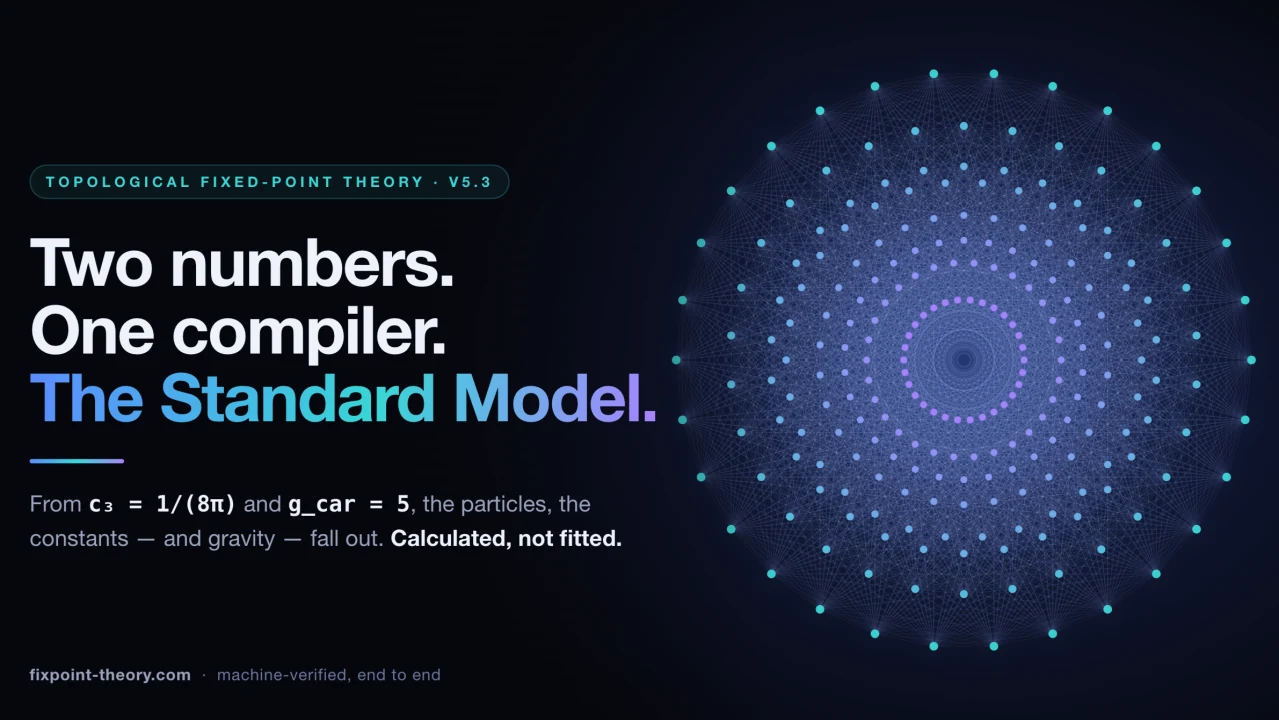
What started with a toy genetic algorithm ended up with a theory that tries to explain dozens of physical constants from just two numbers. No free parameters. No curve fitting. Just geometry doing math.
Is it right? No idea.
But it’s weirdly consistent. And 100 % falsifiable.
This post walks through the entire thing – from evolutionary code to Möbius topology, renormalization flows, and a vacuum hierarchy that might just connect α ≈ 1/137 to everything else.
Curious? Critical? Confused?
Jump in. 🔗 fixpoint-theory.com
Disclaimer first.
This post is not a peer-reviewed paper. It’s not marketing fluff either.It’s a raw, ongoing attempt to crack something that’s been haunting physics for a century ...
... Why do the constants of nature have the values they do?
What follows is a story. A strange one.
It starts with a genetic algorithm, takes a detour through 11-dimensional topology, and ends (maybe) with two numbers that might explain… everything?
The problem: α ≈ 1/137.036
Every physicist knows it. Every theory avoids it.
The fine-structure constant α defines the strength of electromagnetism. It’s one of the most precisely measured numbers in science. And yet:
We have no idea why it has that value.
String theory doesn’t explain it. The Standard Model just inserts it.
If you’re honest, it feels a bit like nature rolled the dice and got lucky.
But what if it didn’t?
A machine saw something we didn’t
In late May, I wrote a genetic algorithm to evolve field equations.
No goal other than: “Try to reproduce c, G, and α from scratch.”
After ~24 million evaluations, something weird happened.
All independent runs—no matter the seed—converged to the same two values:
- A gauge coupling of 1/(8π) ≈ 0.03979
- A scale parameter φ₀ ≈ 0.0581
I didn’t tell the machine to look for those.
They just… emerged.
That was the moment I got obsessed.
What the hell is 1/8π doing there?
Down the rabbit hole: Möbius topology and Chern–Simons levels
The number 1/(8π) isn’t arbitrary. It turns out it’s the natural fixed point of a topologically quantized Chern–Simons action in 11-dimensional supergravity.
A Möbius twist in the compactification halves the effective gauge level.
An E₈ symmetry structure stabilizes the hierarchy.
You end up with exactly one number:
c₃ = 1/(8π)
This isn’t a fit.
It’s the only value the topology allows.
From geometry to physics: How φ₀ falls out
The next challenge was to see if φ₀ ≈ 0.0581 could be derived from theory—rather than being a numerological leftover from the GA.
Turns out: yes.
By applying a renormalization group analysis to a 6D effective theory, you get a cubic fixed-point equation that links c₃, the RG flow, and the value of α.
Solving this equation self-consistently gives:
φ₀ ≈ 0.053171
That’s not the GA result. It’s close—but slightly shifted, which makes sense:
The GA operated on raw, uncorrected field equations. The theoretical value includes quantum corrections.
The match was… spooky.
What does φ₀ actually do?
Everything.
It’s the single VEV (vacuum expectation value) that defines a logarithmic hierarchy of all mass scales via:
φₙ₊₁ = φₙ · exp(–γ(n))
With γ(n) derived from nilpotent orbits of the E₈ group.
The cascade yields the proton mass, GUT scale, neutrino masses, even dark energy.
All via discrete steps—no continuous fine-tuning, no fudge factors.
So what does this mean?
I don’t know yet.
But here’s what I do know:
- The genetic algorithm stumbled on c₃ = 1/(8π) without knowing its topological meaning.
- The renormalization flow gives a unique value for φ₀ ≈ 0.053171—with no free parameters.
- From just those two numbers, the theory hits dozens of constants: α, mₚ, α_G, V_us/V_ud, axion mass, etc. (many within <1% deviation) .
- The theory makes concrete, testable predictions for:
If any of these predictions fail, the theory breaks. That’s the point.
This is not theology. It’s falsifiable physics.
Want to dig in?
I built a public site to explore all the math and ideas interactively:
There’s a live calculator, full documentation, and even an “Experimental Playground” where you can tweak φ₀ and see what breaks.
Your turn:
If you’re a physicist, string theorist, or just love beautiful structure—
please try to rip this apart.
I’m serious.
If I’ve made an error, show me. If there’s a fatal flaw, I want to know.
This isn’t about ego. It’s about whether the constants of nature are written in the topology of space itself.
Thanks for reading. I’ll keep updating as this evolves.
– Stefan