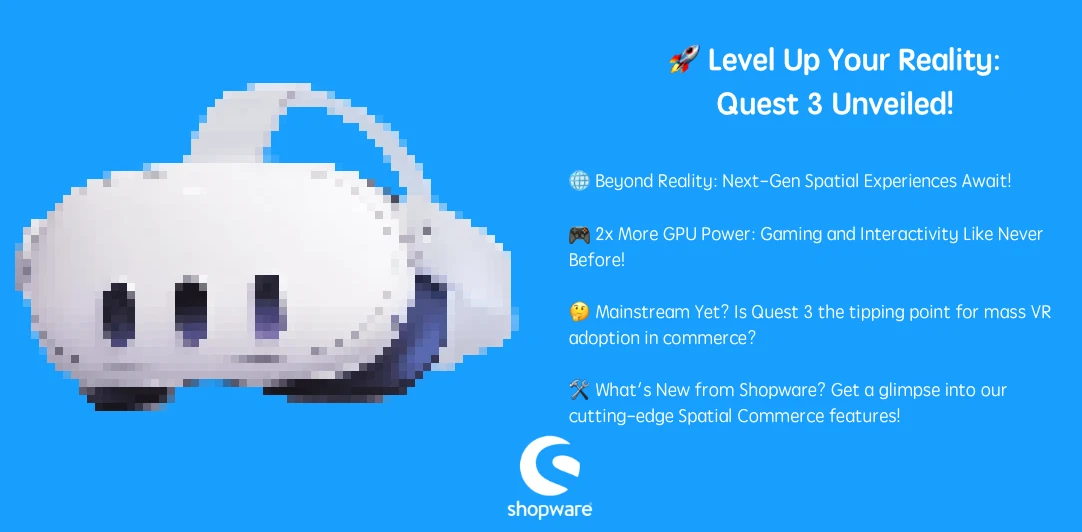
👓🛒 Ah, it's an exciting time to be alive! The world of Mixed Reality (XR) is evolving at warp speed, and we've got front row seats to the show. Just yesterday, Meta announced all the details of Quest 3 and the final release date (Oct 10), and it's nothing short of revolutionary. I was actually mulling over the future of XR after an enlightening session on be.inside. There, I saw a fascinating case study involving Pico and Tüv-Süd that made me think, "Imagine this, but supercharged with next-gen hardware!" So, without further ado, let's dig into what the Meta Quest 3 brings to the spatial commerce table, shall we?
View the embedded media in the original ↗Next-Gen Powerhouse: Quest 3’s Major Leaps
Think of the jump from Quest 2 to Quest 3 as going from a Playstation 3 to a PlayStation 5. The Quest 3 sports two LC-Displays with a resolution of 2,064 x 2,208 pixels per eye, 30% more pixels than its predecessor! It's also got Qualcomm's spanking new XR-Chip, the Snapdragon XR2 Gen 2, doubling the graphical prowess. It’s like strapping an IMAX theater to your face!
View the embedded media in the original ↗A Funny Meta Quest Pro Tale
Ah, speaking of evolving tech, remember when I was raving about Meta Quest Pro last year? I was singing its praises, and then bam! The price got slashed, and Meta pulled the plug on the Pro series. It felt like buying a first-class ticket on the Titanic! 🛳️💥 Compared to Apple Vision Pro, Quest 3 offers affordability with its rich features, making it more of a "people's champ" in the XR arena.
Quest-ioning the Mainstream: What's Still Missing?
But, let's put the rose-tinted glasses down for a second. What barriers still stop XR from going mainstream? Well, it's not all rainbows and unicorns yet. We need to see more life-like interactions, lower prices, and wider content ecosystems to really go bananas on this technology.
Shopware's Spatial Commerce Strategy: A New Dimension
Being a fan of innovation, I'm proud to say we're laying the foundation at Shopware to make 3D a standard feature. We at Shopware are continually pushing the boundaries of what's possible in digital commerce, and our next frontier is Spatial Commerce.
The first milestone in this journey is the native support for 3D models within Shopware's platform. Imagine allowing your customers to engage with your products in a three-dimensional space right within their browser. This feature is more than just an aesthetic upgrade; it adds a tangible layer to online shopping, offering consumers a closer look at the texture, dimensions, and usability of products before making a purchase decision.
However, we understand that not every business has the resources for an entire 3D storefront. That's why we're introducing "bridge elements" that enable a seamless integration of 3D effects into your existing 2D storefront. This hybrid approach ensures that you can deliver a more interactive and engaging user experience without a full-scale platform overhaul.
To make the creation of these 3D elements even easier, we're launching a scene editor. This tool lays the groundwork for more advanced spatial shopping experiences, offering a user-friendly interface for designing and deploying 3D scenes.
Recognizing the challenges many mid-market companies face in generating 3D models, we're partnering with industry leaders like Rooom and Solid Works. Together, we aim to simplify the 3D model generation process, making it more accessible and cost-effective.
Our efforts don't stop here. We're already collaborating with pioneering merchants to showcase the next-level experiences that are possible when leveraging the full capabilities of WebGPU and WebXR technologies.
In a world increasingly driven by digital innovation, Shopware's Spatial Commerce functionalities aim to place our clients at the forefront of this revolution. These are just the first steps in a journey toward a future where online shopping is as rich and interactive as the real world.
Towards an AI-Driven, Experience-Focused Future
In our vision, the commerce of tomorrow isn't a monotonous search for the "lowest price, fastest availability." Oh, no. It's a cinematic, emotionally-driven odyssey where half the work is done by AI agents, and the other half is you relishing in delightful, fun experiences. Shopware's spatial commerce fits perfectly into this jigsaw puzzle of what comes after smartphones. It's as if commerce and entertainment got married and had a baby, and that baby is named Spatial Commerce. 🍼🚀
When will it be mainstream?
Imagine stepping into the gaming universe, where each pixel is a new world to conquer—like Mario hopping from one mystery block to another but in 4D! 🍄 For all the tech aficionados and 'Ready Player One' dreamers out there, VR is the frontier we've all been impatiently eyeing. The hardware has evolved by leaps and bounds, but let's dive into the nitty-gritty, shall we?
When it comes to mainstream adoption, price is often the first roadblock that appears on our collective tech radar. But in this scenario, the pricing isn't the main villain—far from it. You're already getting a front-row seat to other dimensions for a relatively reasonable price. It's like getting a SpaceX ticket to Mars but only paying for the in-flight peanuts! 🚀
Let's put this into perspective: Apple Vision Pro, the alpha wolf of VR, is expected to debut at over $3500! In comparison, other VR setups offer an astonishingly immersive experience for a fraction of that price. Still, there's room for growth.
So what are the other key areas that need leveling up? I'd argue we need to focus on raw power, comfort, and battery life. Imagine strapping a gaming rig to your face but make it feather-light and with the stamina of an Energizer Bunny—that's the dream. We need GPUs to go from playing tag to participating in an Olympic sprint, around 3-4 times more potent than today's best. Plus, nobody wants to break the immersion by pausing for a recharge or adjusting an uncomfortable headset.
So, let's get the chatter going. What would be your top picks for the future of VR hardware? A built-in AI assistant that helps you navigate virtual worlds? Or maybe a self-cooling system that keeps your face from turning into a sauna? Drop your visionary thoughts below and let's make the future of VR as crowded and diverse as a Comic-Con convention! 🎮💥