Why the real shift in commerce happens below the interface
A few years from now, many commerce teams will struggle to explain what happened.
Traffic didn’t collapse overnight. Customers didn’t disappear.
There was no single platform moment that forced a rewrite of the playbook.
Things just… shifted.
While companies kept optimizing storefronts, funnels, and campaigns, a different layer of commerce started to take shape in the background. AI agents began to assist with decisions, then to execute purchases, and eventually to manage entire buying processes on behalf of humans.
At first, this looked incremental. Helpful. Optional.
But beneath the surface, something fundamental changed: the power of decision making moved away from humans and interfaces, and toward machines and protocols.
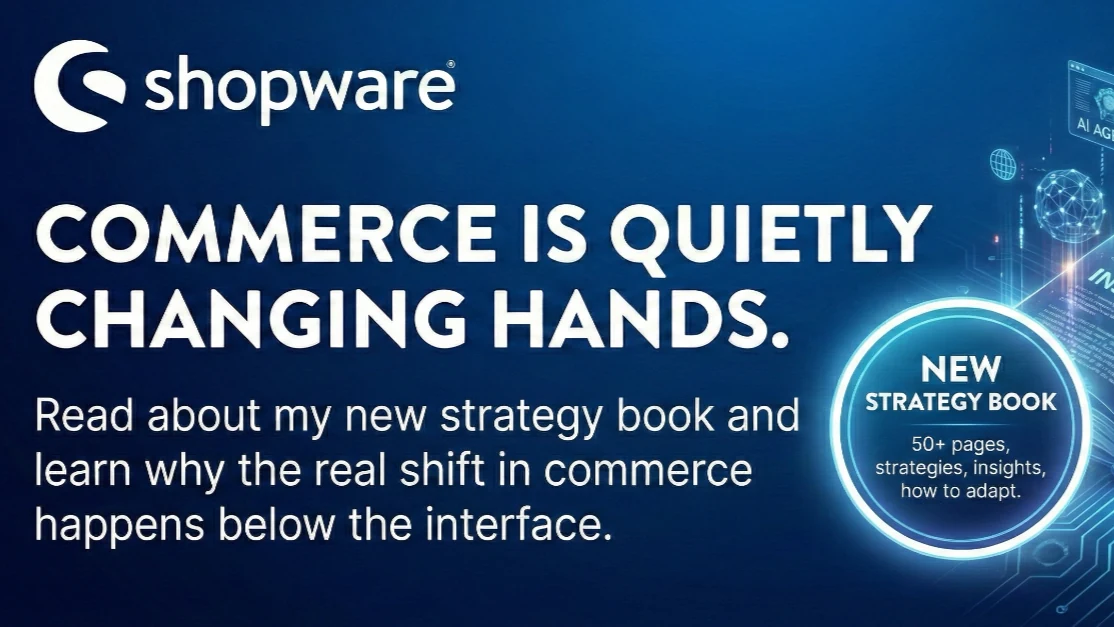
That is the starting point of my new Agentic Commerce Strategy Book.
Not the idea that agents exist.
But the realization that when agents buy, the architecture of commerce itself changes.
From Being Seen to Being Understood
Classic commerce rewarded visibility.
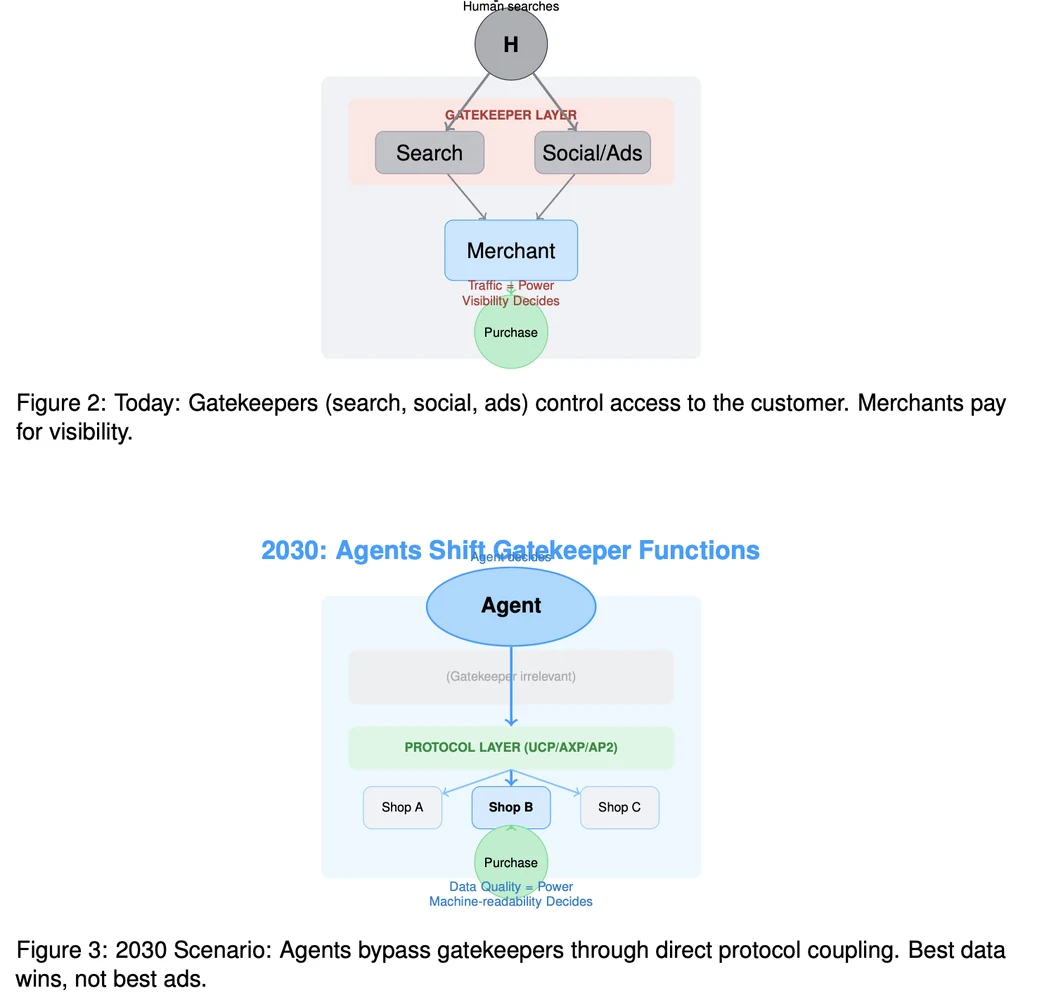
If you could attract attention through search, ads, marketplaces, or brand presence, you earned the right to compete. Shops were designed to persuade humans. Funnels were optimized for emotion, friction reduction, and conversion psychology.
Agents don’t operate that way.
They don’t browse websites. They don’t see banners. They don’t respond to storytelling or branding cues.
Instead, they query structured data, evaluate capabilities, compare trust signals, and select merchants based on reliability, latency, and machine-readable quality.
This is where the first major shift happens: visibility stops being the primary source of power. Machine readability replaces it.
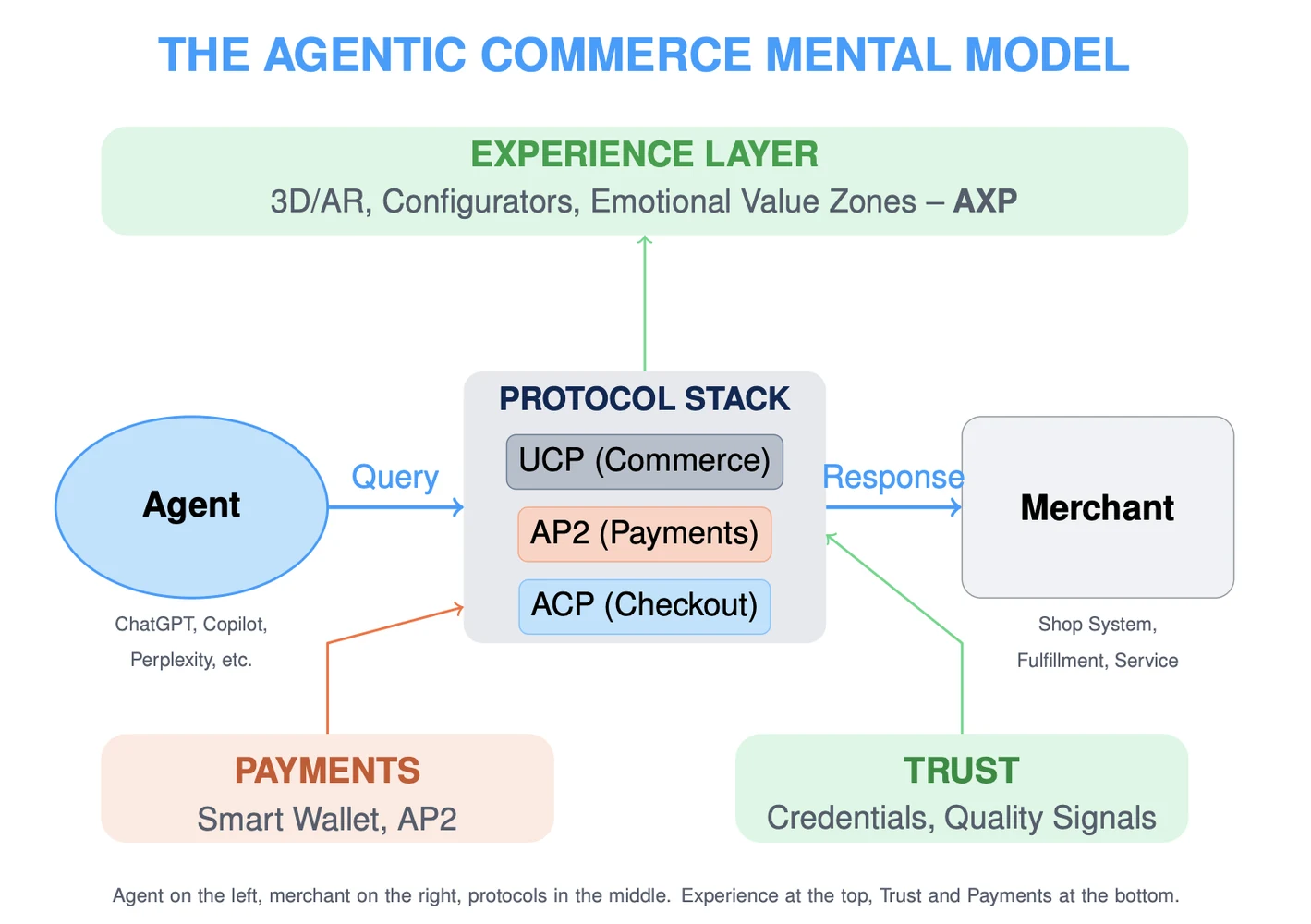
Once you see this model, many current debates in commerce suddenly feel oddly misaligned. Teams argue about frontend UX while agents are already deciding upstream. Budgets flow into acquisition channels while selection increasingly happens at the data and trust layer.
The change is quiet, but it’s relentless.
The Funnel Didn’t Break. It Was Reassigned.
One of the most persistent myths is that agentic commerce eliminates the funnel.
It doesn’t.
It reassigns control over each phase.
Awareness is no longer created by exposure, but by protocol reach.
Consideration becomes an exercise in structured comparison rather than persuasion.
Checkout success depends less on design and more on response times, mandates, and policy compatibility.
In the book, this shift is mapped phase by phase, comparing the classic human driven funnel with its agent driven counterpart.
This is also where many teams hit an uncomfortable insight.
For agents, conversion rate is not a primary signal.
Trust is.
An agent optimizing for a user’s long-term outcomes will consistently prefer a slightly more expensive merchant with verified credentials, stable fulfillment, and clean incident history over a cheaper but opaque alternative.
That single fact turns trust from a support topic into a strategic asset.
Experience After Automation
At this point, many assume the conclusion is obvious: if agents take over, experience becomes irrelevant.
The opposite happens.
As automation expands, experience becomes rarer and therefore more valuable.
But experience changes its meaning.
It is no longer about visual polish or emotional triggers. It becomes about decision support, confidence creation, and human escalation at the right moment. In the book, this is described through the concept of Emotional Value Zones: areas where agents cannot fully replace humans because the value is sensory, identity forming, communal, or rooted in expertise.
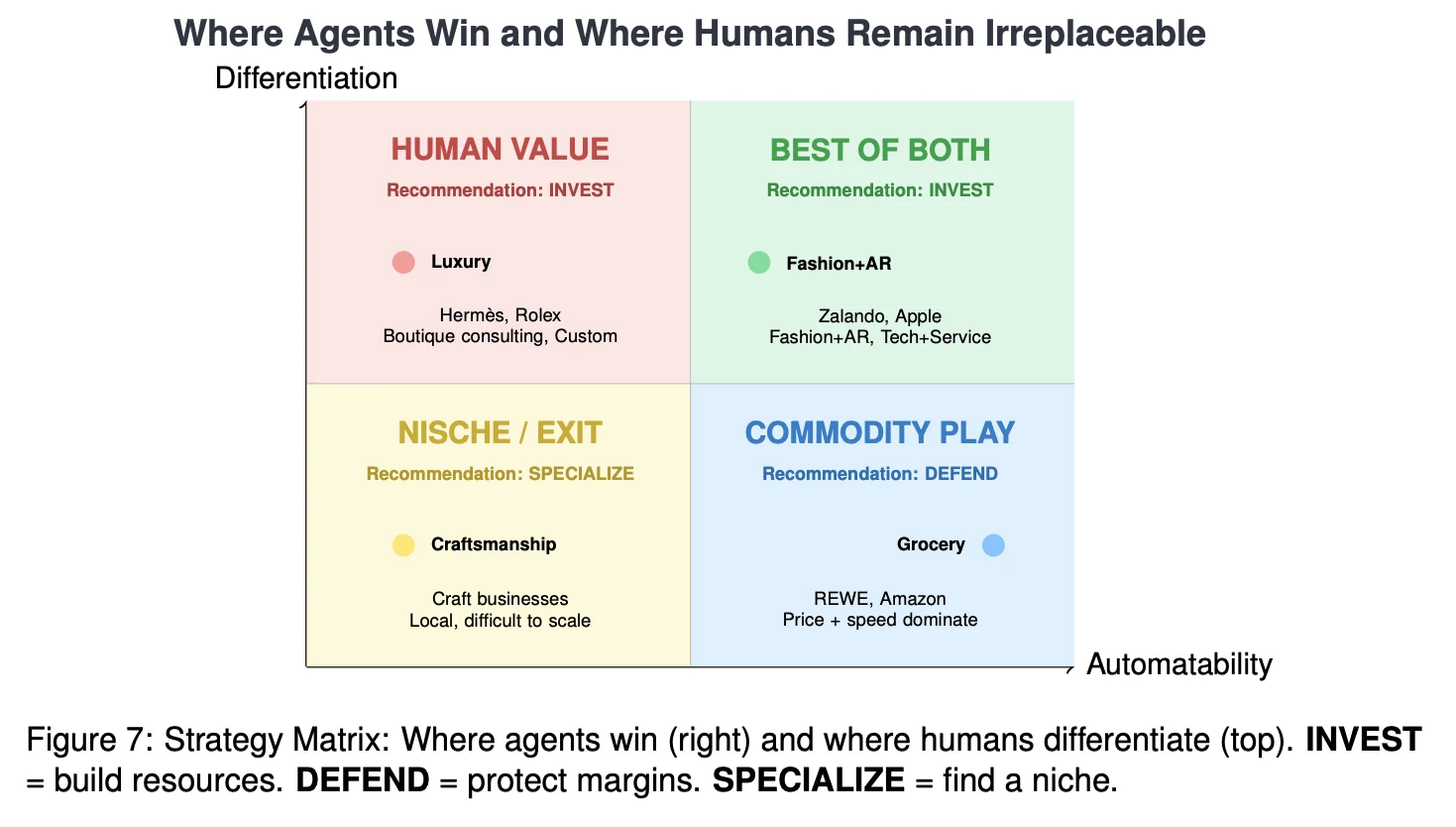
What emerges is a hybrid model. Agents handle efficiency. Humans handle meaning. The merchants who win are those who deliberately design for both, instead of over investing in one while neglecting the other.
Why I Wrote This Book
I didn’t write the Agentic Commerce Strategy Book to speculate about distant futures.
I wrote it because the transition phase is already underway and it is structurally confusing for many organizations. Metrics drift. Roles blur. Old optimization loops still run, even as their impact fades.
The book is meant as a practical guide to that transition. It connects protocols, trust, experience, and operating models into a coherent picture and translates them into concrete strategic and organizational decisions.
Commerce is not disappearing.
It is quietly being rewired.
And the merchants, platforms, and investors who understand the wiring early won’t just adapt. They will define the standards everyone else ends up following.
Download and Language Versions
The English version of the Agentic Commerce Strategy Book is available now.
👉 Download:
A German version is available as well for German-speaking teams and stakeholders.
Closing Thoughts
Agentic commerce is no longer a theoretical discussion.
The protocols are live. The first agent checkouts are productive. The shift has already begun.
The question is no longer if agents will shape commerce, but who defines the rules they operate by.
This is also why the Agentic Commerce Alliance exists:
an open industry initiative focused on open standards, interoperability, and merchant sovereignty in an increasingly automated economy.
👉 Learn more about the alliance here:
https://www.agentic-commerce.org
For those interested in the technical foundations, reference implementations, and protocol-level details, the Agentic Commerce Developer Hub provides deeper material, including the technical whitepaper published last week:
👉 https://agentic-commerce.dev
The Agentic Commerce Strategy Book connects these technical building blocks with their strategic and economic implications and is available in both English and German:
👉 https://agentic-commerce.sh/
Commerce isn’t becoming less human. It’s becoming more architectural. And architecture, once set, tends to last.
#AgenticCommerce #AICommerce #CommerceStrategy #AIAgents #FutureOfCommerce #shopware
Sebastian Hamann Jason Nyhus Paul Krauss Michael P. Pfeiffer Joachim Weber Alexey Pronin Mark Stanley Alexandros Bottenbruch Michelle Gill Martin Gaubitz Rick Watson Agentic Commerce Alliance