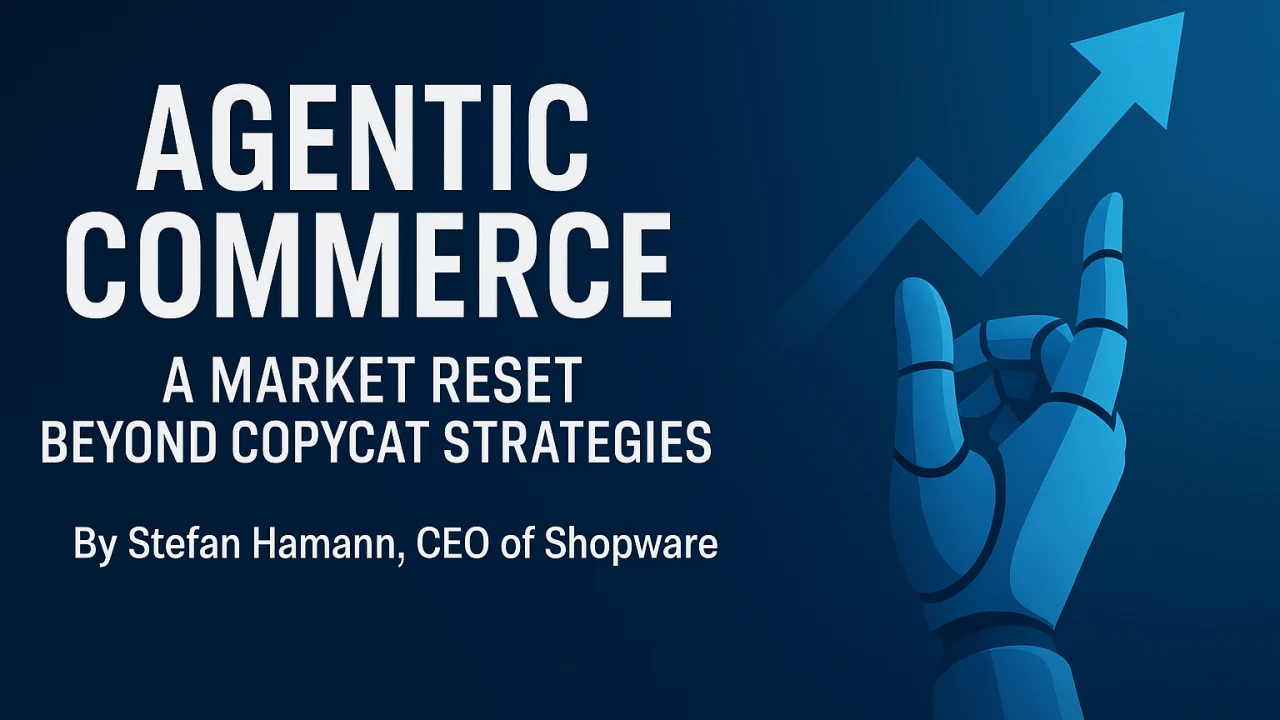
By Stefan Hamann, CEO of Shopware
The AI Agent Paradigm Shift in Commerce
In over two decades of eCommerce evolution, we’ve seen shifts from desktop to mobile, and from simple online catalogs to immersive experiences. Yet today we stand at the brink of a more radical transformation: Agentic Commerce, where autonomous AI agents handle discovery, negotiation, and purchases on behalf of customers. This isn’t some distant sci-fi scenario but it’s unfolding now, heralded by industry moves from giants like Amazon, Visa, and PayPal. PayPal´s CEO Alex Chriss call it the next era of commerce:
“Over 25 years ago, PayPal made history by simplifying digital money movement. Today, we are charting the next era: the era of agentic commerce.”
— Alex Chriss, President and CEO, PayPal
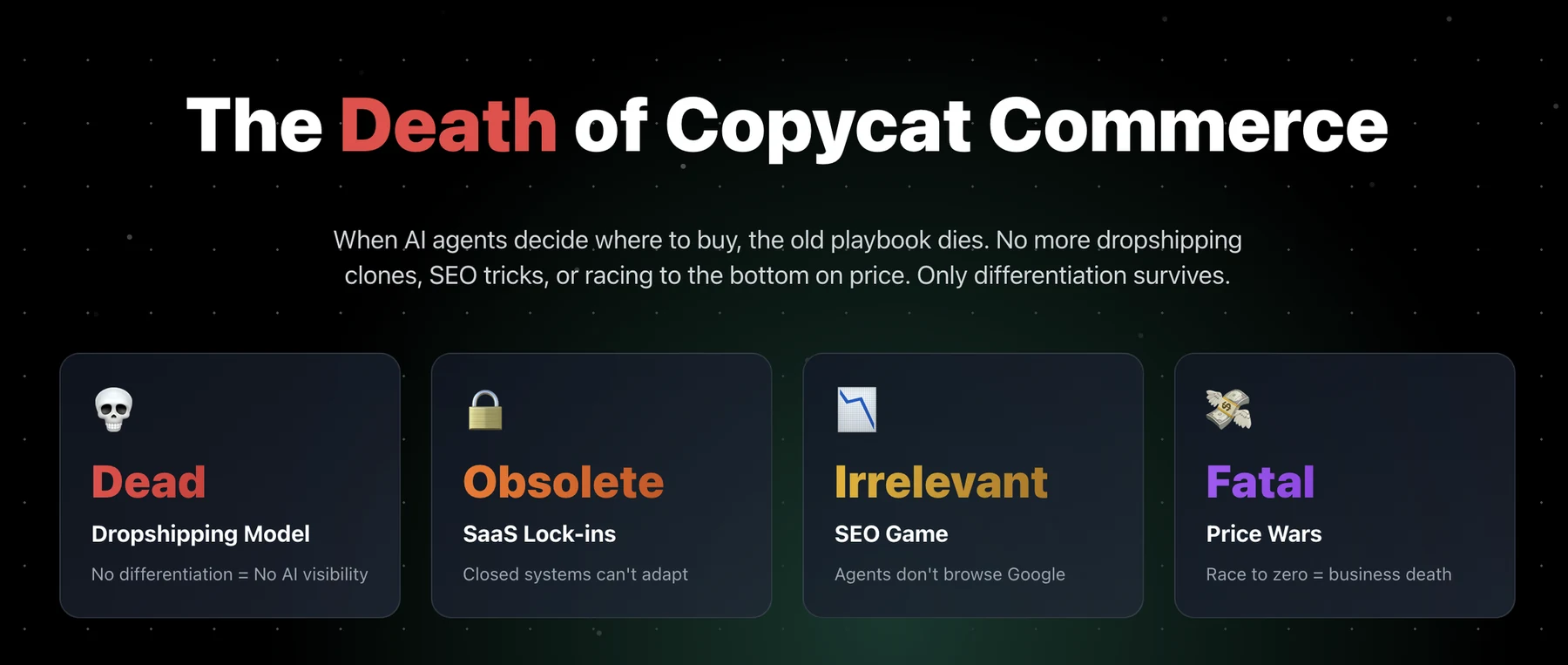
The implication is profound: we’re entering a systemic market reset in which many of the tactics that defined copycat commerce – lookalike web stores, price-matching wars, and SEO gimmicks – will no longer guarantee success when AI agents are calling the shots.
When AI shopping agents become the primary decision-makers, commoditized strategies rapidly lose their edge. If you and a dozen competitors all offer similar products with similar descriptions and pricing, an agent will simply default to the cheapest or fastest option available . In other words, a marketplace full of copy-paste offerings and shallow differentiation gets flattened into a price and logistics race to the bottom. As AI agents increasingly handle transactions in split seconds, traditional concepts of brand identity and customer loyalty risk becoming obsolete if we don’t adapt . Without intervention, merchants could be reduced to mere interchangeable listings – a farm of commodities discovered and filtered by algorithms . This is the reality of the coming “agent economy.” The old playbook of reactive, lookalike eCommerce – spinning up a generic storefront, undercutting on price, gaming search rankings – won’t survive the AI-driven reset.
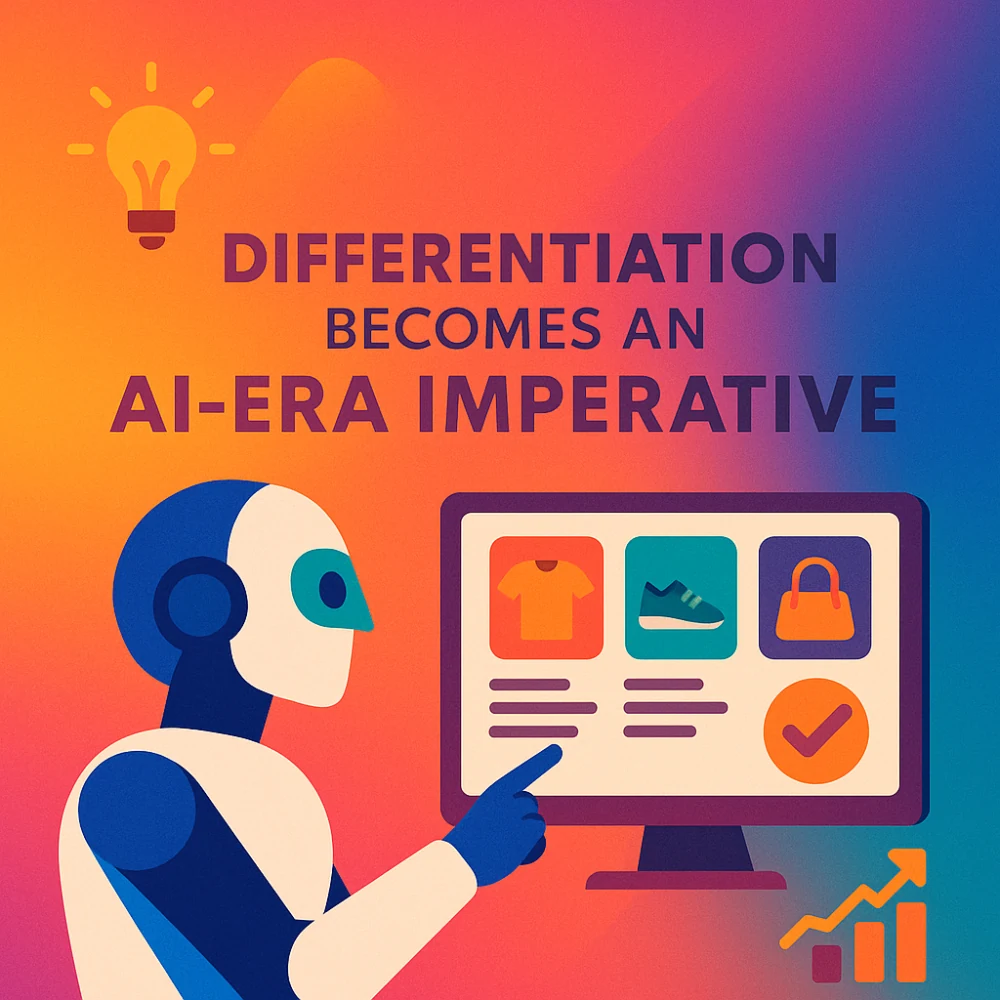
Differentiation Becomes an AI-Era Imperative
In a world where algorithms do the shopping, genuine differentiation isn’t just marketing fluff – it’s survival. To win an AI agent’s recommendation, merchants must compete on signals that machines recognize as value. That means focusing on data quality, trust, and performance over cosmetic brand polish. As one industry analysis put it, “winning in the age of agentic commerce won’t be about flashy visuals; it will be about data quality, structured content, and operational precision.” An autonomous agent doesn’t window-shop or respond to catchy ad copy; it parses databases and APIs for the option that best fits its user’s criteria.
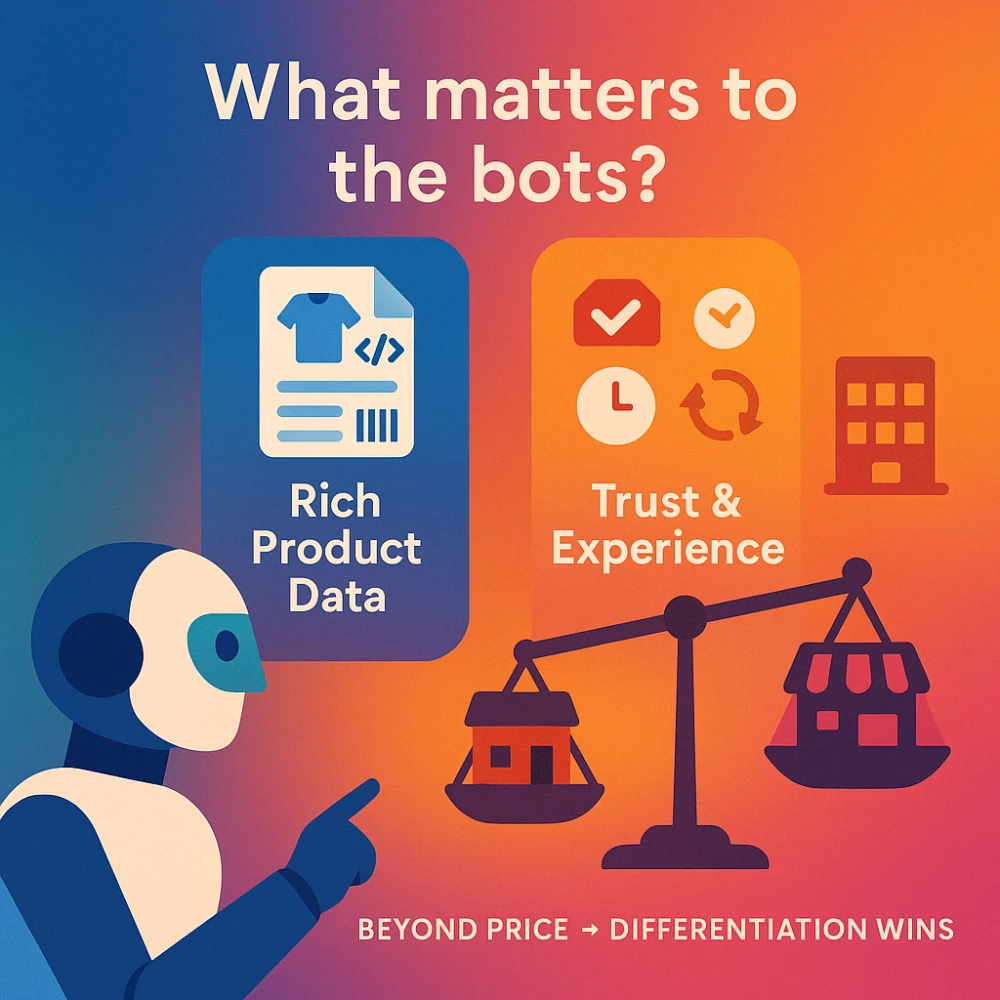
What matters to the bots?
First, rich, structured product data. Every product title, description, spec and schema tag must clearly communicate what makes an item unique . If your catalog isn’t machine-readable and up-to-date, you’re effectively invisible to AI-driven buyers.
Second, trust and experience signals are paramount – factors like inventory availability, fulfillment speed and reliability, transparent return policies, and dynamic pricing all feed an agent’s decision model . These are the new “SEO” for AI: if your store offers faster shipping or a more generous no-hassle return policy than a rival, an agent can rank you higher as a preferred option . Likewise, brand trustworthiness and service quality, historically hard to quantify – are being captured in data points that agents use to evaluate sellers. In effect, every merchant must prove their worth to an algorithm by exposing what makes their offering reliable and distinctive.
The upside of this shift is a more level playing field. Customer experience and integrity become measurable advantages. A small merchant with stellar fulfillment and unique products can outrank a big-box retailer in an agent’s eyes if they deliver better data and service metrics. AI agents will “gain access to more than just price”, they will consider things like product expertise, customer service quality, and community alignment with a brand’s values. In this way, agentic commerce heralds the end of “copycat commerce” and a renaissance of real differentiation. Merchants must ask: what makes us truly unique and trustworthy, and is that encoded in a way an AI agent will understand?
Defending Merchant Autonomy – The Agentic Commerce Alliance
Seeing this transformation on the horizon, we at Shopware knew that merchants – especially independent and mid-market businesses – would need a voice in shaping an AI-driven commerce ecosystem. That’s why earlier this year we launched the Agentic Commerce Alliance, a coalition of commerce platforms, AI innovators, and industry partners (including klaviyo and others) dedicated to developing open protocols that defend merchant autonomy in the age of smart agents . The Alliance is our proactive response to ensure the AI revolution in commerce amplifies, rather than erodes, market diversity.
“The Agentic Commerce Alliance is a strategic commitment to preserving a diverse, competitive, and innovative digital marketplace where AI technology amplifies – rather than diminishes – the uniqueness and humanity of commerce.”
These words I shared at the Alliance’s launch underscore our mission. We recognize that if the future of shopping is dominated by a handful of AI-driven “commerce hubs” or proprietary assistant platforms, merchants could be forced into one-size-fits-all pipelines, surrendering control over customer experience and terms of business. The Alliance´s mandate is twofold:
(1) ensure merchants of all sizes can participate in agent-to-agent commerce without ceding control to gatekeeping platforms, by establishing open, interoperable standards; and (2) leverage AI in ways that highlight true merchant differentiation, instead of letting everything devolve to price and ad spend . In practice, this means creating frameworks for AI agents to evaluate richer experience factors – not just scrape product feeds for the lowest price .
Crucially, this alliance isn’t just talk. It brings together a growing roster of industry players – 15 and counting – from payment providers to AI startups and commerce platforms, all collaborating to pilot real solutions. Shopware, as an open-source commerce leader (powering over 55,000 merchants worldwide), provides the backbone and philosophy: a commitment to openness and empowerment of the seller . PayPal, as a partner, brings deep expertise in payments and consumer trust, ensuring that the solutions we craft work seamlessly with how transactions and buyer protections evolve.
By working together on neutral ground, we aim to prevent a future where merchants must integrate separately with dozens of AI shopping assistants under opaque rules. Instead, open protocols can allow any merchant’s systems to speak the language of intelligent agents.
Building Open Standards: Ambient Storefronts, Instant Returns, and More
What do these open protocols and standards look like? The Alliances members are hard at work on several pioneering concepts:
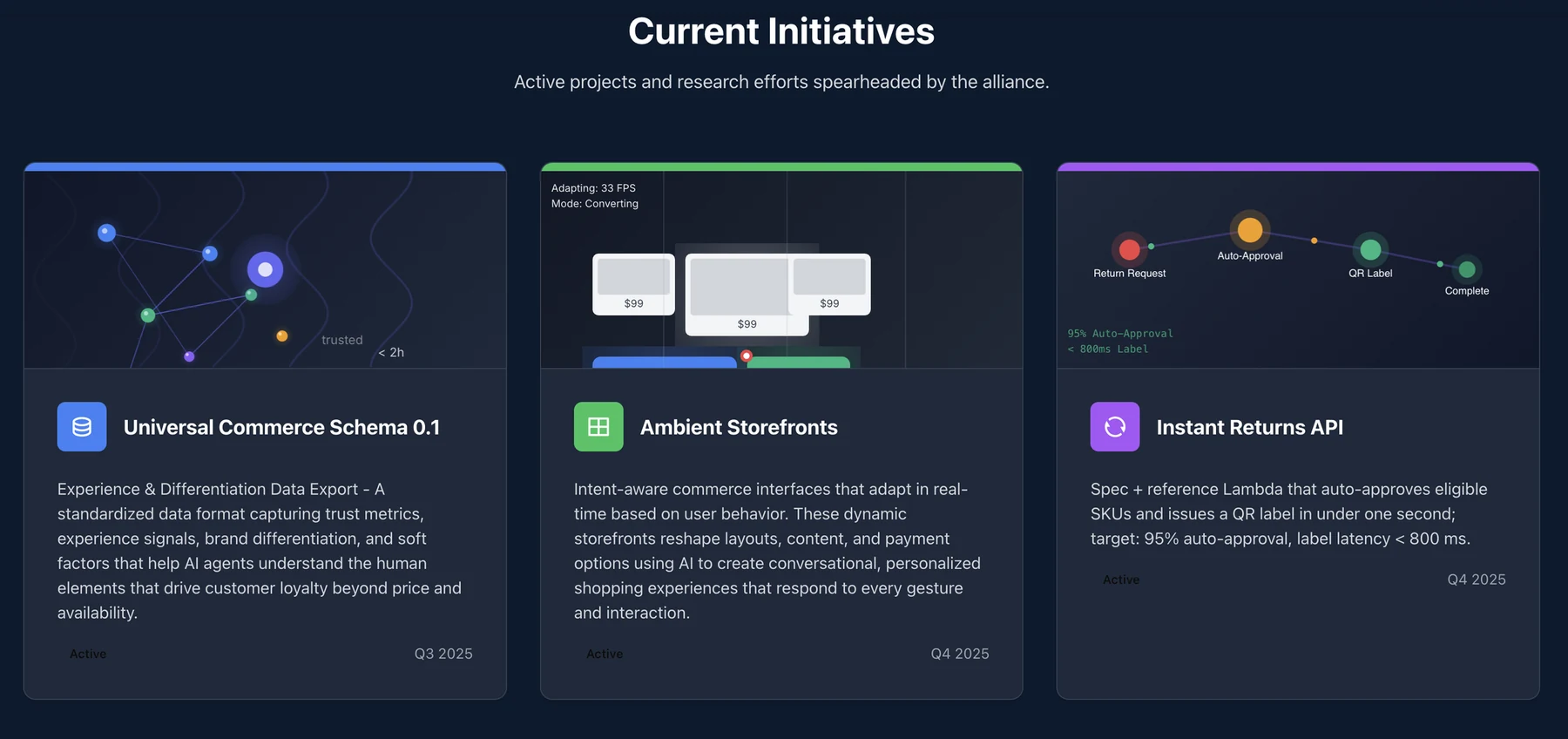
- Ambient Storefronts: The idea that the traditional online “storefront” website will fade in importance, replaced by intent-aware commerce interfaces that can surface anywhere. In an ambient commerce world, a customer’s AI assistant might assemble a shopping experience on-the-fly across multiple merchants – effectively creating a dynamic storefront tailored to the user’s intent at that moment. These interfaces adapt in real time based on context and behavior, reshaping layouts, content, and offers without the customer manually navigating to a single site. It’s the antidote to today’s static, copycat web stores, and it acknowledges that the storefront as a destination is giving way to experience-as-a-service embedded wherever the buyer’s need arises.
- Instant Returns API: Returns are a pain point both for customers and merchants, often involving delays and uncertainty. In the agentic model, speed and assurance matter even more – an AI agent will favor merchants who can handle post-purchase needs efficiently. The Alliance is prototyping an Instant Returns API, an open specification that would let agents automatically initiate and approve a return on an item in seconds. Imagine an AI agent evaluating a product for its user and preferring a seller that guarantees “instant return approval” if the item isn’t right. By auto-approving eligible returns (with appropriate fraud checks) and issuing a return shipping label nearly immediately, merchants can signal a frictionless, trust-filled experience. Our target with this initiative is ambitious: for 95% of straightforward returns, an agent could secure approval and a QR return label in under a second. The benefit is twofold – customers gain confidence (encouraging purchases via agents), and merchants capable of instant returns get a competitive boost in agent rankings.
- Universal Commerce Schema: One challenge in an AI-driven commerce landscape is how to convey all these new differentiation signals in a standardized way. Today’s eCommerce schemas (like schema.org for product data) only scratch the surface. The Universal Commerce Schema we’re developing is a data format to export key trust and experience metrics in addition to core product info. This means any merchant can publish, in machine-readable form, things like their average fulfillment time, return policy strictness, customer satisfaction scores, warranty offerings, sustainability metrics – essentially any attribute that an AI shopper might factor in when deciding “who should get this order.” By defining a common schema for this, we enable AI agents to compare apples-to-apples across different stores on experience factors, not just price and specs. Long term, this universal schema could feed into agent “reputation” systems: much like search engines indexed the open web, AI commerce agents will index open commerce data streams. Ensuring those streams include rich, comparable experience data will push the whole industry toward better practices and transparency.
These are just a few of the interoperable standards and APIs under incubation. The Alliance is also coordinating pilot networks – sandbox environments where merchants and developers can test agent-to-agent interactions using these protocols. By experimenting in pilots, we learn what works in real life and refine the standards accordingly.
Bold Theses: The Storefront Dies, B2B Gets Autonomous
It’s an exciting – and at times unsettling – moment. As a tech CEO, I often challenge my team with bold theses about where this is headed. Here are two provocative predictions I stand behind:
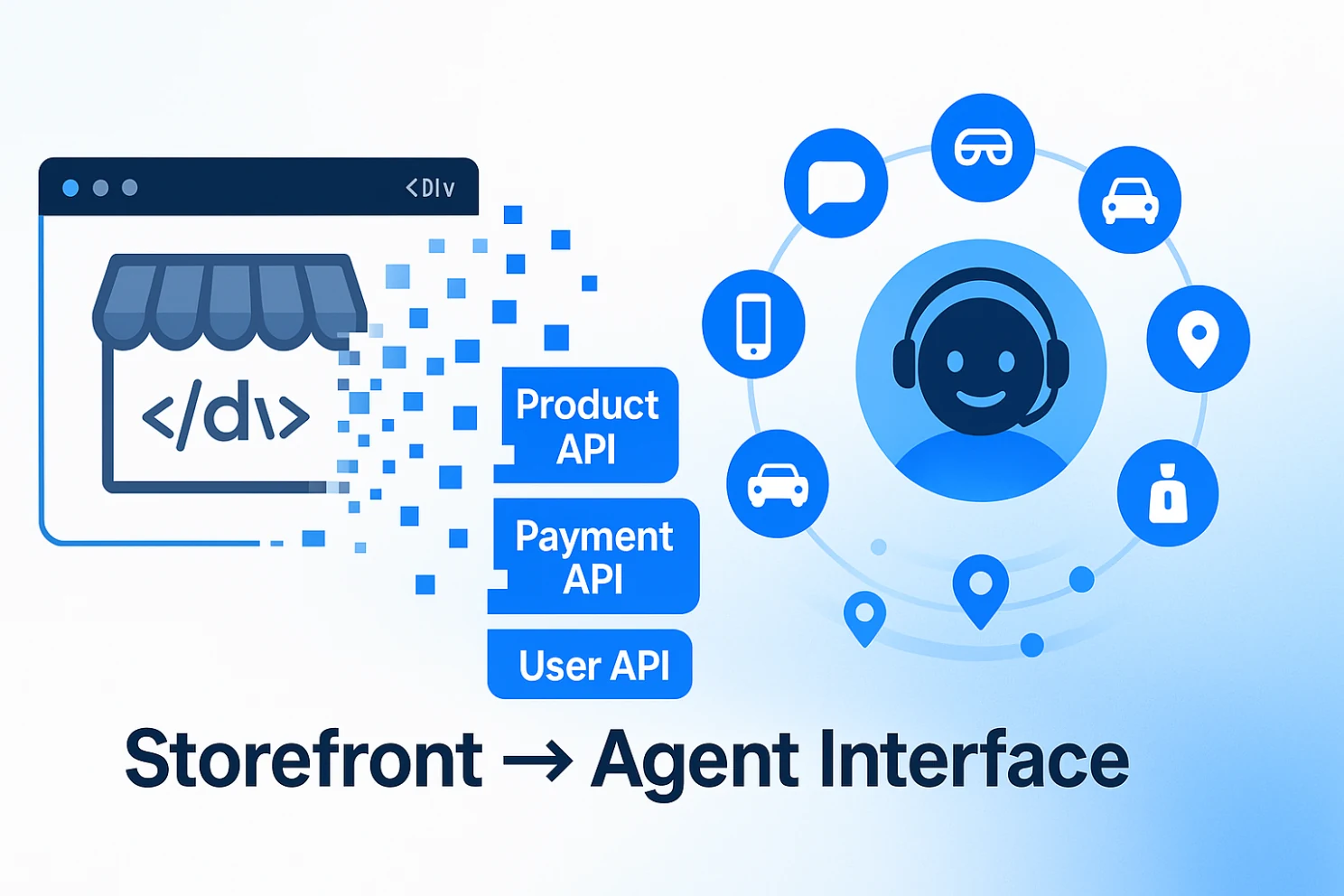
1. The Storefront as We Know It Will Disappear. In the coming years, I foresee the death of the traditional online storefront. Not in the sense that brands will stop showcasing products, but in the sense that customers won’t be going to your website to shop. Instead, shopping opportunities will be ambient – woven into the fabric of digital life via AI assistants, search results, smart home devices, AR interfaces, and more. Your next sale might happen via a conversation between a user’s AI and their car’s dashboard, or within a chat thread, or through a voice command to a home assistant – all without the customer ever visiting “.com.” We already see early signals: Amazon’s experimental “Buy for Me” feature lets an AI agent purchase products from third-party sites on a user’s behalf , and OpenAI’s ChatGPT can now plug into commerce to fulfill user requests without the user manually browsing. Ambient, intent-driven commerce means your store needs to be wherever the customer’s intent is expressed, not waiting for them to come into your walled garden. This thesis pushes us at Shopware to rethink front-end experience entirely – towards headless, adaptive, AI-negotiable commerce infrastructure.
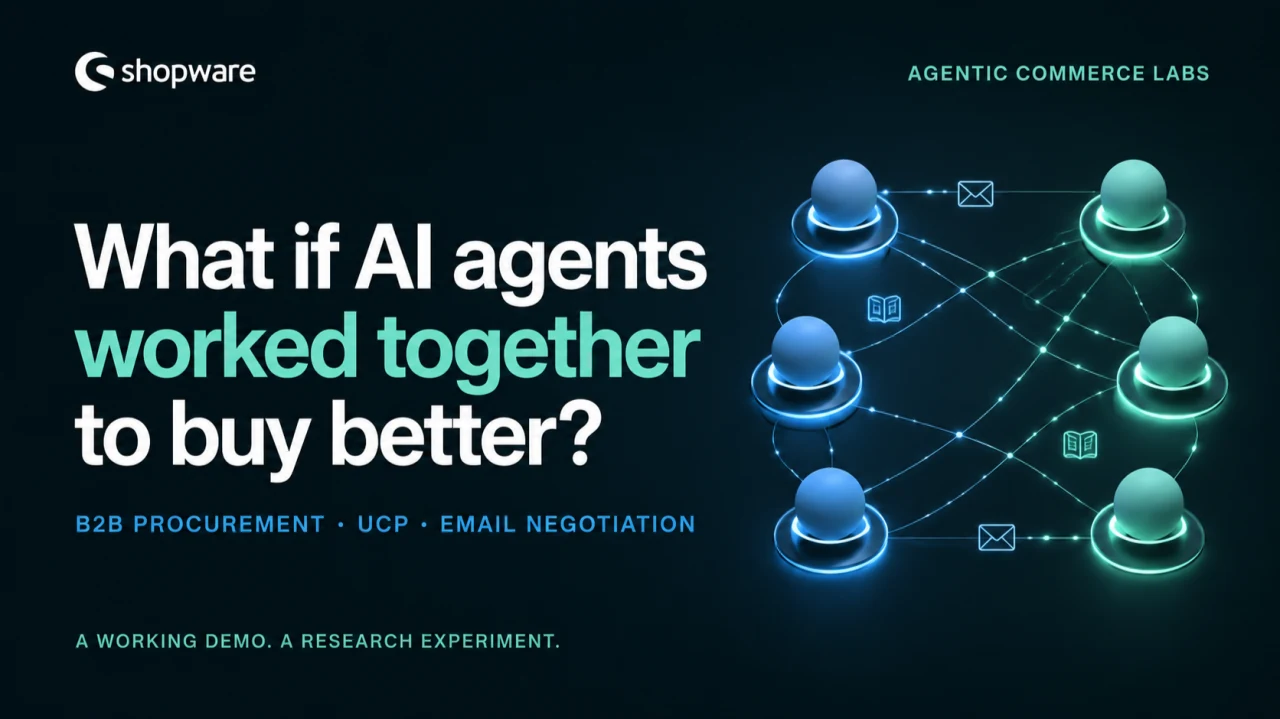
2. In B2B, AI Agents Will Become the Primary Buyers. Business procurement is on the cusp of its own agentic revolution. We expect that in complex B2B purchasing – think sourcing raw materials, components, or enterprise services – AI procurement agents will take over many duties of today’s buyers and purchasing managers. These AI agents can instantly gather requirements, search a network of approved suppliers, negotiate prices or terms within preset parameters, and execute orders, all while following company policies. The efficiency gains are enormous. In fact, one of the early use cases we’re exploring in the Alliance is exactly this: AI-driven procurement networks. The writing is on the wall: in B2B settings, an AI agent might soon be the one reading your spec sheets and RFQs, not a human – effectively becoming the primary stakeholder in the buying process. Others in the industry agree; we’re seeing prototypes of “B2B procurement agents that source materials and manage complex purchasing workflows.” The implications? B2B sellers must prepare to interface with algorithmic buyers by providing impeccable data and integration points. The old relationships and sales channels will evolve, with human-to-human interaction focusing on exceptions and strategy, while routine orders go fully autonomous.

Ethics, Governance, and the Open Ecosystem
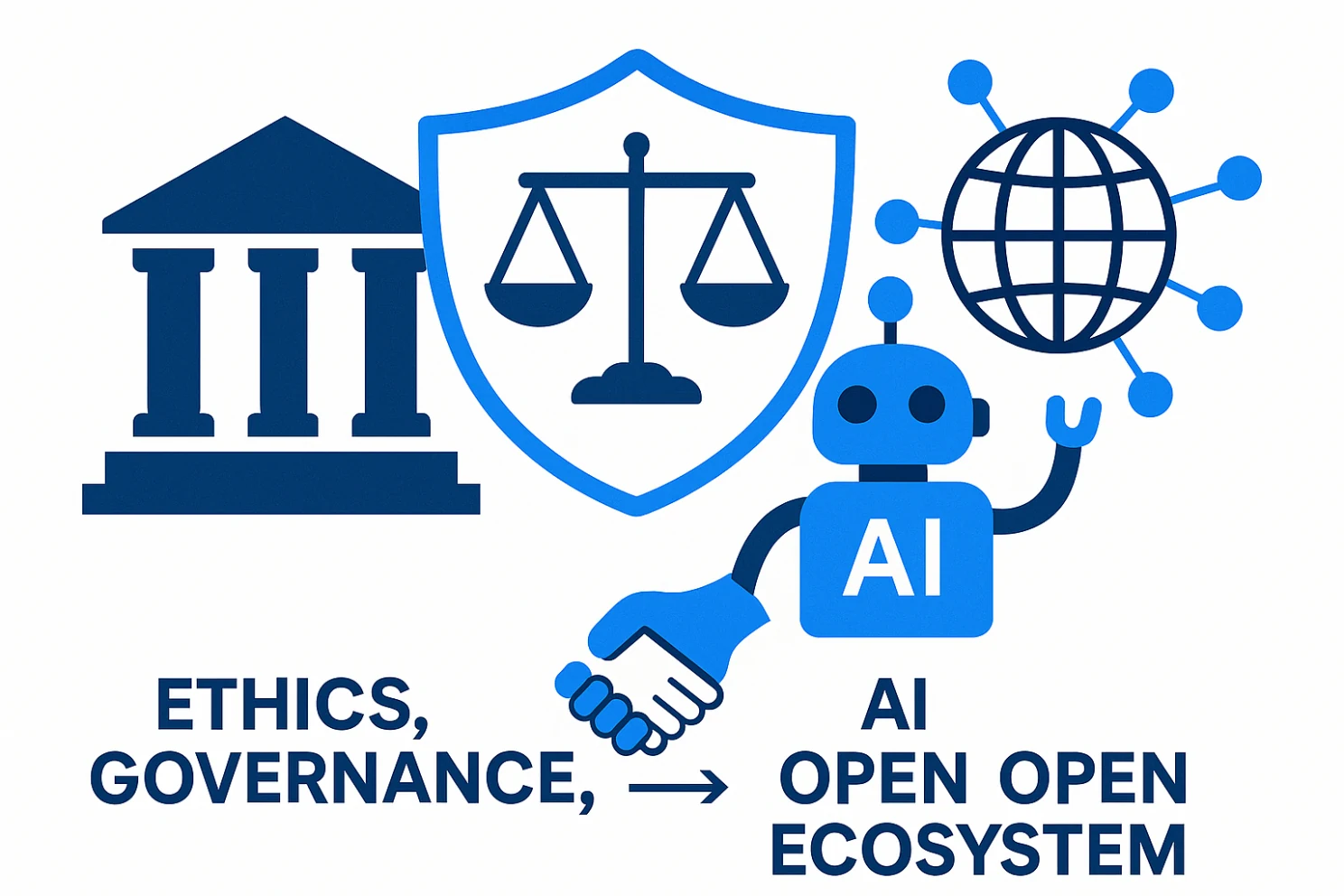
With great power (of autonomous AI) comes great responsibility for all of us shaping this space. One of my core beliefs – and a foundational principle of Shopware’s approach – is that the next decade of commerce must be defined by ethical AI use, sound governance, and open ecosystems. What does that mean practically? It means building systems that empower merchants and consumers, not exploit them. It means insisting on transparency in how AI agents make decisions – no black boxes picking winners and losers in the market without accountability. It means governance frameworks to ensure, for example, that an AI agent doesn’t inadvertently discriminate against small merchants or favor suppliers in anti-competitive ways. And it means open standards over closed platforms, so no single entity (be it a tech giant or a rogue AI) can unilaterally dictate the rules of commerce.
Through my whitepapers and essays on agentic-commerce.sh and our work with the Alliance (agentic-commerce.org), I’ve emphasized that an open, collaborative approach is the only sustainable path forward. We advocate for protocols and schemas that anyone can implement, and for a decentralized commerce ecosystem resilient to monopolization. AI will no doubt concentrate power in some areas – for instance, whoever provides the dominant agent platform will wield influence – but by pushing for openness and merchant-first design, we aim to keep the playing field as fair as possible. In practice, this involves urging merchants and platforms: keep your systems open and API-driven for easy integration, maintain high data quality, and always prioritize the merchant and customer perspective when adopting automation . If we do that, we ensure AI becomes an empowerment tool rather than a gatekeeper.
Ethical considerations also extend to privacy and consent. Agentic commerce will rely on sharing a lot of data between agents and platforms (product data, user preferences, transaction histories). We must set governance guardrails so that this data is used appropriately and securely. For example, merchants should have the right to know and influence how their data is used in AI recommendations, and consumers should have control over how their AI agent represents their interests. These are not trivial issues, and they’re an active topic in the Alliance discussions. The commerce industry has been through waves of change before, but this time the decisions might be made by non-human actors – we need new ethical frameworks to handle that reality.
From Vision to Action: Get Agentic-Ready
Agentic Commerce isn’t theory – it’s already shifting the rules. The winners will be those who act now:
- Make your data agent-friendly. Think dataset, not brochure. Structured titles, attributes, policies. If agents can’t parse it, they won’t pick you.
- Open up with APIs. Inventory, pricing, returns – expose what matters. If an agent asks “can you deliver tomorrow?”, your system must answer instantly.
- Build trust through performance. Fast shipping, clean returns, zero errors. Agents reward what they can measure.
- Be everywhere. Don’t wait for buyers to come to you – publish where agents live. Marketplaces, graphs, Agentic Commerce Alliance pilots.
- Experiment early. Join the Agentic Commerce Alliance, test emerging flows, play with agent integrations. Waiting is the riskiest strategy.
Conclusion: From Reactive Commerce to Proactive Autonomy
The end of “copycat commerce” is not a cause for panic, but a call to action. We are moving from a reactive model, chasing customer clicks and follows, to a proactive, autonomous commerce model where success depends on being chosen by an algorithm acting on a customer’s behalf. It’s a future where commerce becomes ambient (always around us, ready to fulfill needs instantly) and where autonomy reigns (for consumers, through their AI agents, and for merchants, through freedom from centralized gatekeepers).
As a commerce technology leader, I am optimistic and realistic in equal measure. Optimistic because agentic commerce can unlock incredible efficiency and personalization, potentially boosting revenue and customer satisfaction in ways we’re only beginning to imagine. (For instance, letting AI handle routine orders or upsell opportunities can capture sales that might otherwise be lost .) And realistic because such a transformation will bring challenges technical, regulatory, and cultural , that we must navigate carefully. The copycats won’t survive this shift, but those who adapt will thrive in a landscape that rewards authenticity, quality, and transparency above all.
At Shopware, this vision guides us every day. It’s why we invest in open-source and open standards, why we launched the Agentic Commerce Alliance, and why we encourage merchants to adopt a forward-looking, merchant-first mindset. The commerce world is rebooting itself in real time. Now is the moment to innovate, differentiate, and collaborate , so that in the new era of agentic commerce, your business can not only participate, but lead with confidence and integrity.
Stefan
http://www.agentic-commerce.org
http://www.agentic-commerce.sh