Six months can be an eternity – at least in the world of AI-powered commerce. What was vision in May 2025 is becoming reality today.
When we published our first Agentic Commerce cheat sheet in spring, much was still speculation. Today, just half a year later, hundreds of millions of people using chatGPT and other platforms for product recommendations and shopping. PayPal, Visa, and Google have created open standards. And the entire industry is gearing up for a fundamental transformation: Shopping is increasingly becoming a background task – handled by AI agents acting on behalf of customers.
The Tipping Points Have Arrived
Development is moving faster than expected. Three major turning points have shaped the last six months:
OpenAI Opens the Floodgates: With Instant Checkout in ChatGPT and the open Agentic Commerce Protocol (ACP), OpenAI turned 700 million weekly users into potential buyers overnight. This is a new giant sales channel establishing itself in weeks.
PayPal Goes All-In: The October announcement of Agentic Commerce Services was a signal. PayPal fully adopts ACP, brings its complete infrastructure – buyer protection, dispute resolution, the entire trust machinery – and makes tens of millions of merchant products purchasable via ChatGPT in 2026. The "Agent Ready" solution promises: integration in minutes instead of months.
Google Lays the Foundation: With the Agent Payments Protocol (AP2), Google creates a payment-method-agnostic standard for agent payments. 25+ partners from payments and commerce are on board. The key: a tamper-proof audit trail documents every step – from purchase intent to transaction. Transparency and liability become traceable, even when machines act for humans.
Why This Is More Than Just a New Channel
Agentic Commerce doesn't just change where people shop, but who shops. AI becomes the gatekeeper of the customer journey. It decides in fractions of a second: Which product fits? Which merchant delivers faster? Where does the price-performance ratio make sense?
For merchants, this means:
- Incomplete product data? The agent scrolls on.
- Outdated inventory? Filtered out.
- No structured attributes? Invisible.
At the same time, radical new possibilities emerge: 24/7 shopping without cart abandonment. Automatic reordering when supplies run low. Price-threshold purchases that an agent executes in milliseconds when a limited product becomes available. Multi-shop purchases in a single conversation, coordinated by an agent ordering from five merchants in parallel.
Amazon already reports: 250 million users use the AI assistant Rufus. These users buy 60% more frequently. The impact: over $10 billion in additional annual revenue. This shows: AI-powered advisory works – when it's done right.
Shopware: Building the Open Infrastructure for Agentic Commerce
At Shopware, we recognized early on: this transformation must not be shaped by a few tech giants alone. Merchants must retain control over their data and processes. The freedom of commerce must not become negotiable.
That's why we founded the Agentic Commerce Alliance together with leading digital companies in spring 2025. An initiative that unites AI-first software companies, researchers, and merchants – with a clear goal: open standards, interoperable agents, and merchant-centric data sovereignty.
The Alliance is not a debating club. We're working on concrete solutions:
- Open protocols like the Agentic Product Protocol (Enhanced Agent optimized product export) & the Agentic Experience Protocol (Merchant based micro-experiences directly embedded in the chat-interfaces of chatGPT and others)
- Reference implementations that respect GDPR, CCPA, and the EU AI Act
- Shared research under permissive licenses – for maximum impact
- Talent exchange between member teams to accelerate innovation
The Shopware Agentic Commerce Labs: From Theory to Practice
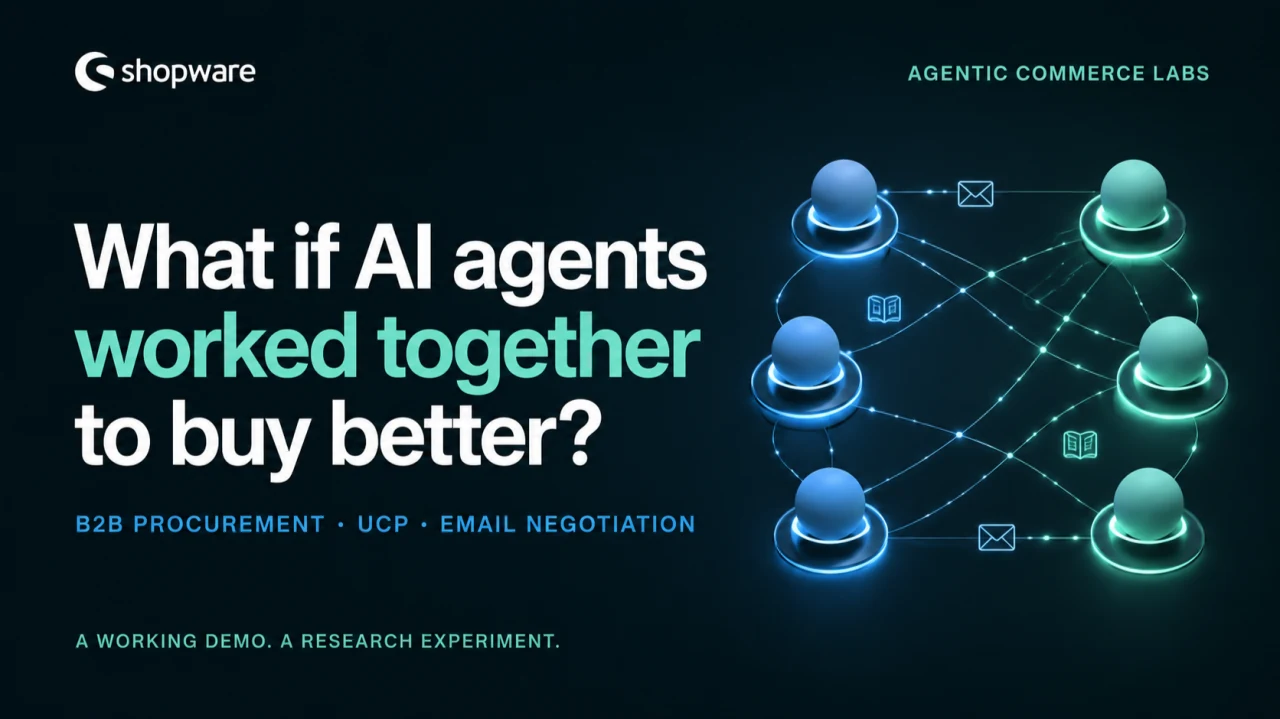
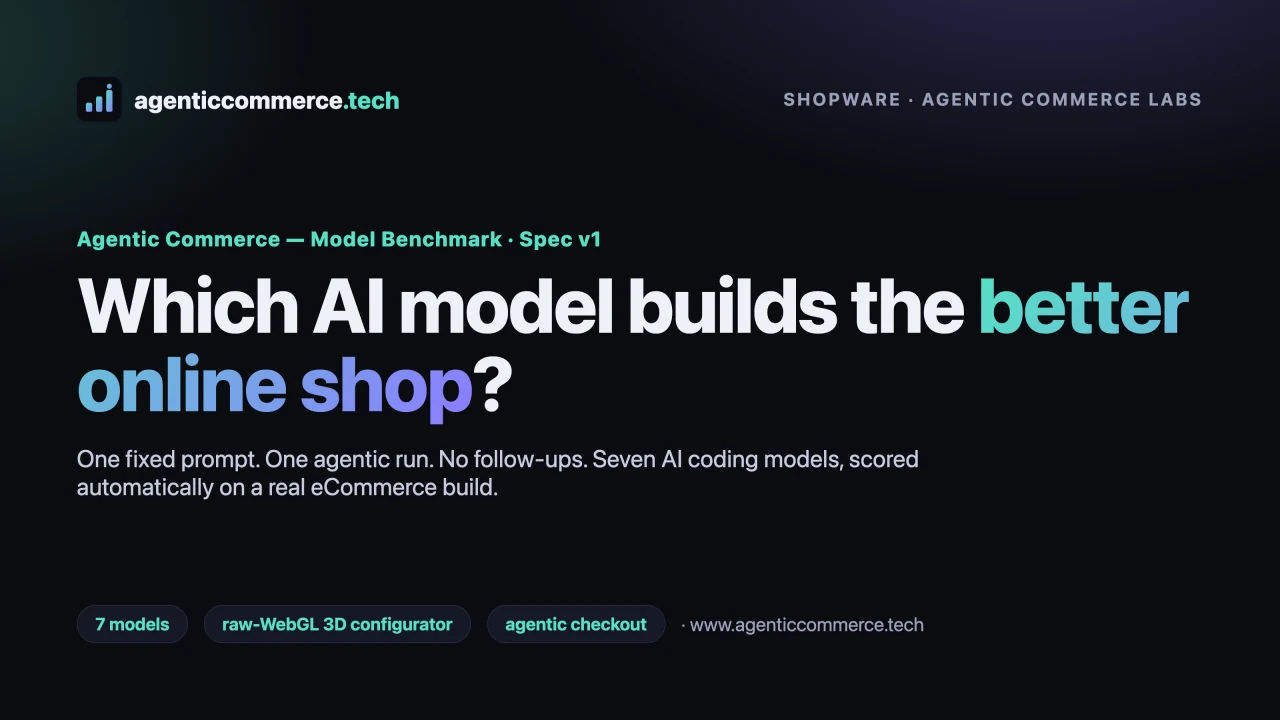
In parallel, We've launched the Shopware Agentic Commerce Labs. A dedicated team for research, prototyping, and education. We're not just theorizing about the future – we're building it.
Our current focus areas go deep into the fundamental questions of agentic systems:
Full LLM-Based Shop Operations: Can entire shops be created, moderated, and operated purely through AI? We're exploring how merchants could configure complex e-commerce systems through natural conversation – from product catalog setup to workflow automation to customer service orchestration. The goal: democratize commerce technology so profoundly that technical barriers disappear.
Physics-Inspired AI Architectures: We're investigating how architectures inspired by physical principles – topological structures, dynamical systems, symmetry principles – can create more robust, efficient, and interpretable AI agents. These aren't just theoretical exercises: physics-motivated designs could enable merchant-specific smart agents that understand causality, maintain consistency, and learn with dramatically less data.
Hyper-Personalized Agent Experiences: Every merchant has unique needs. We're working on frameworks that allow businesses to train their own agentic systems – agents that embody brand values, understand product nuances, and deliver experiences that feel authentically human while operating at machine scale. The automation degree increases for the merchant, but more importantly: the customer experience improves sustainably.
Spatial Commerce Meets AI: We're combining our leadership in spatial commerce with agentic capabilities. Imagine AI agents that don't just process text and images, but understand three-dimensional product spaces, can configure complex items in real-time, and create immersive shopping experiences that adapt to each customer's context.
Real-Time Personalization at Scale: Moving beyond batch processing and rule-based systems to true real-time adaptation. Our experiments with streaming AI models and edge computing enable personalization that responds to customer intent as it emerges – not hours later.
The Labs operate with a philosophy I call "back to the engine room." Less iteration, more fundamental rethinking. We translate theory into working systems – and share findings openly with the ecosystem.
Shopware's Technical Foundation: API-First for the Agentic Era
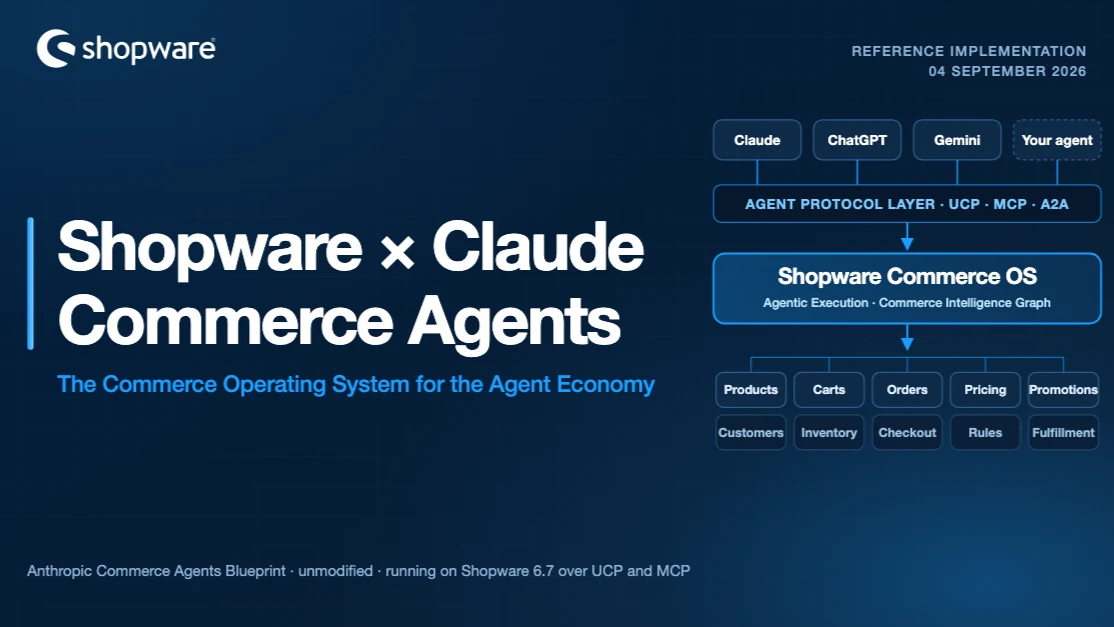
Our API-first architecture isn't a buzzword – it's our strategic advantage. Shopware is inherently built for the kind of programmatic, agent-driven interactions that Agentic Commerce requires. Whether it's OpenAI's ACP, Google's AP2, or future protocols we haven't seen yet: Shopware can integrate them.
We're currently developing our own MCP (Model Context Protocol) server as core technology for data exchange between AI models and shops. This enables any AI agent – whether ChatGPT, Claude, or custom merchant agents – to securely access product catalogs, inventory, pricing, and order systems through a standardized interface.
Combined with Shopware Copilot – our agentic assistant already live in the admin – we're creating a complete stack: from merchant-facing AI that helps run the business, to customer-facing agents that drive conversion, to the infrastructure layer that makes it all interoperable.
What Does This Mean for Merchants? Six Action Areas
The message is clear: Those who don't act today will be invisible tomorrow. AI agents won't ask if your shop is ready. They'll simply move on to the next one.
1. Make Product Data and Systems Agent-Ready Complete, structured, current data is the new currency. Invest in product data quality, real-time APIs, and automated quality checks. An agent can scan dozens of shops in seconds – the slowest feed loses.
2. Be Present on the Right AI Platforms ChatGPT Instant Checkout, Google Shopping, PayPal's Agent Ready – identify where your customers will shop in the future. Thanks to open standards, integration is easier than ever today. Shopware's API-first approach makes us ready for this new world.
3. Develop Your Own AI Experiences Don't just wait for external agents. Create proprietary AI services – a shopping chatbot, voice interfaces, messenger integration. This way you retain direct customer access and data, instead of being completely dependent on external platforms.
4. Take AI-SEO Seriously Your visibility in AI responses will become as important as Google rankings. Structured FAQs, machine-readable attributes, Schema.org markup – all of this pays into your "Share of Agentic Shelf."
5. Build Trust Use the security features payment providers offer: tokenized payment data, buyer protection, transparent processes. Communicate clearly that customers retain control. Trust is the fuel for adoption.
6. Build Organization & Know-How Train your teams. Assign responsibility for AI integrations. Define new KPIs: Data Fill Rate, Update Speed, Agent Uptake Rate, AI Visibility Score. The era of AI agents requires new metrics – and new thinking.
The Future Belongs to the Bold
Agentic Commerce is no longer a distant vision. It's happening now. The protocols exist. The payment infrastructure is in place. The major platforms are live or about to be.
What sounded futuristic in May 2025 is reality in November: AI agents are shopping. For millions of people. Every day.
For many founders and CEOs, this is the moment to go back to the engine room. To ask the old questions: What excited us at the beginning? What is our core DNA? And how do we evolve this DNA for an era where AI and Agentic Commerce are rewriting the rules?
At Shopware, we've asked these questions – and found answers: open standards instead of silos, shared research instead of proprietary lock-ins, merchant control instead of platform dictates.
Change is coming either way. The only question is: Do we shape it – or watch?
What are your thoughts on Agentic Commerce? Do you see it as opportunity or threat? Let's discuss in the comments.
#AgenticCommerce #ArtificialIntelligence #Ecommerce #Shopware #AgenticCommerceAlliance #DigitalTransformation #Future #Innovation